

Galaxy Home Remodeling helps homeowners address algae on siding by managing moisture around the exterior. Clear drainage paths, reduce repeated wetting, and use gentle cleaning methods. Through Galaxy Home Remodeling, homeowners can also explore durable siding options for their next exterior project.
Green marks that return after cleaning can be frustrating. Galaxy Home Remodeling can help homeowners consider how siding, nearby moisture, and maintenance habits may affect algae growth, so they can look for the root cause as well as clean the visible stain.
Here are practical ways to manage water and airflow, distinguish algae from mold and mildew, and use cleaning solutions carefully. You’ll also learn when recurring growth may warrant a closer look at your siding.
Key Takeaways
- Ask Window Galaxy about siding concerns involving gutters and moisture near the foundation.
- Discuss algae, mold, and mildew with Window Galaxy when considering siding care.
- Ask Window Galaxy about safe cleaning approaches, including whether vinegar and bleach should be kept separate.
- Raise concerns about shaded, damp areas, sprinkler overspray, and plants with Window Galaxy.
- Discuss siding materials, moisture exposure, and Hardie plank siding with Window Galaxy for a home project.
1. Cleaning gutters and directing downspouts away
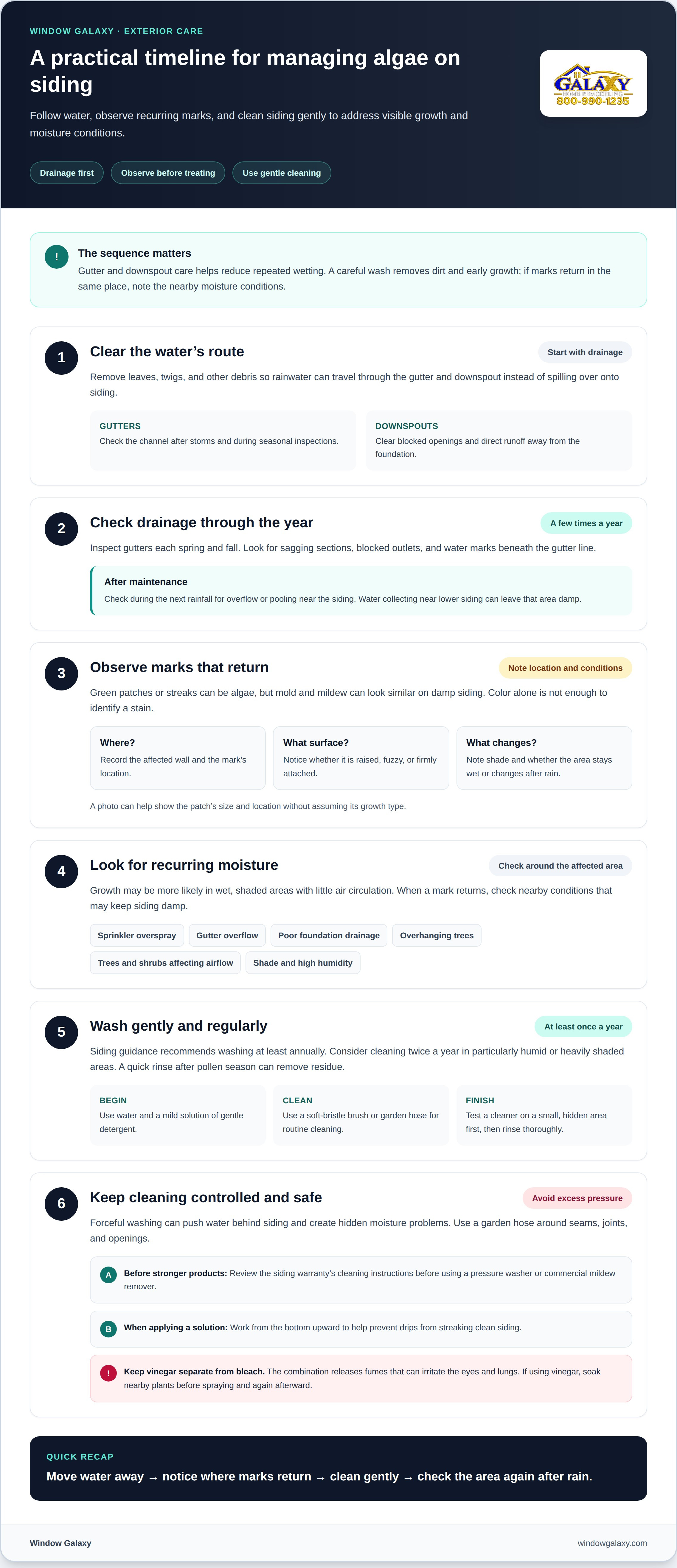
Window Galaxy’s exterior-care guidance recommends keeping rainwater moving through the drainage system. Clear leaves, twigs, and other debris from gutters so water can reach the downspouts instead of spilling over the edge. Check the gutter channel after storms and during seasonal home inspections. Overflow can repeatedly wet the siding below roof edges and corners.
Window Galaxy advises directing downspouts away from the foundation rather than letting runoff collect beside the house. During rain, observe where water flows and whether it pools near lower siding. Poor foundation drainage can leave that area damp. Redirecting water helps the exterior dry between storms and addresses a moisture source before algae becomes more noticeable.
As part of Window Galaxy’s exterior-care guidance, clean gutters a few times a year, and inspect them each spring and fall. Look for sagging sections, blocked outlets, and water marks beneath the gutter line. Clear downspout openings too, since debris can restrict drainage even when the gutter looks clear. After maintenance, check during the next rainfall for overflow or pooling near the siding.
Window Galaxy’s guidance on siding care recommends washing it at least once a year to help prevent algae, and considering cleaning it twice a year in particularly humid or heavily shaded areas. A quick rinse after pollen season can also remove residue from the siding.
For vinyl, wood, fiber cement, and painted siding, Window Galaxy’s cleaning guidance is to begin with water and a mild solution of gentle detergent. Use a soft-bristle brush or garden hose for routine cleaning. Test a cleaner on a small, hidden area first, then rinse thoroughly. These gentle methods are a practical starting point for Window Galaxy readers caring for different exterior finishes.
Window Galaxy’s cleaning guidance favors controlled rinsing over excessive pressure. Forceful washing can push water behind siding and create hidden moisture problems. Use a garden hose around seams, joints, and openings. Before using a pressure washer or commercial mildew remover, review the siding warranty’s cleaning instructions.
Window Galaxy’s guidance for applying a cleaning solution is to work from the bottom upward to help prevent drips from streaking clean siding. If using vinegar, soak nearby plants before spraying and again afterward. Keep vinegar separate from bleach. The combination releases fumes that can irritate the eyes and lungs.
For Window Galaxy homeowners, the company’s guidance treats gutter maintenance and gentle washing as different parts of exterior care. Drainage helps reduce repeated wetting, while a careful wash removes dirt and early growth. If marks return in the same place, note nearby water sources, such as sprinkler spray or gutter overflow. That observation can help identify what to address before the next season.
2. Algae, mold, and mildew in Window Galaxy discussions
If you’re discussing a siding project with Window Galaxy, identifying growth on a wall can help describe what needs attention. Algae often appears as green patches or streaks. Mold and mildew can also show up on damp siding, so color alone is not enough to identify a stain. Note its location and texture, then whether that area stays wet.
Algae spreads through microscopic spores carried by wind and rain. When spores land on a damp surface, they can grow and leave visible marks. Mold and mildew are fungal growths associated with moisture. Their appearance can resemble algae, especially on shaded walls, so don’t treat a visual guess as a definite diagnosis when discussing the concern with Window Galaxy.
Location provides useful context for a siding discussion with Window Galaxy. A green streak below an overhang may reflect slow drying, while growth near a wall fixture may relate to recurring moisture. If you’re discussing Hardie plank siding with Window Galaxy, noting where marks appear can help describe the exterior condition and areas of concern.
Growth may also appear alongside staining or surface damage. Lichens, for example, can discolor siding and gouge small grooves in exterior wood where rainwater may collect. Distinguishing lichen from a flat green stain can help inform a conversation with Window Galaxy about the visible condition. In daylight, check whether the patch is raised, fuzzy, or firmly attached.
If you’re documenting a siding concern for a discussion with Window Galaxy, note the affected wall, how much shade it gets, and whether the mark changes after rain. A photo can show the patch’s size and location. These details describe the visible condition without assuming the growth type or that one cleaning treatment suits every siding material.
With recurring exterior growth, note whether the stain is isolated or linked to persistent dampness when discussing your needs with Window Galaxy. Color can guide your observations, but the surface, texture, and surrounding conditions add context. These details can support a more informed conversation with Window Galaxy about your siding needs and plans.
In the South, warm temperatures, frequent rain, and high humidity create favorable conditions for mold, mildew, and algae to grow. When discussing Window Galaxy’s services, note whether growth is in wet, shaded areas with little air circulation, including places affected by high humidity, lack of direct sun, overhanging trees, sprinklers, or poor foundation drainage. If left untreated, mold and algae can stain siding, trap moisture, and shorten the lifespan of some exterior materials.
When discussing mildew on house siding with Window Galaxy, mention foundation drainage problems, sprinklers that wet siding, and trees and shrubs that may affect airflow. You can also note gutters, organic material near siding, and exterior-opening ductwork when describing moisture concerns. For mold on house siding, ask Window Galaxy whether a cleaning solution made with 30% vinegar and 70% water is suitable.
3. Window Galaxy siding-cleaning safety
For Window Galaxy siding cleaning, never combine vinegar with bleach. The mixture releases fumes that can irritate your eyes and lungs. Keep cleaners in separate containers, and rinse siding thoroughly before switching products. Don’t apply a bleach cleaner over vinegar residue. A careful rinse helps remove leftover cleaner before another treatment.
Window Galaxy recommends not assuming bleach-based siding cleaners are safe for plants, pets, and nearby surfaces. Chlorine bleach can harm plants, discolor siding, and corrode metal fasteners or flashing. Keep pets away during application and rinsing, and prevent access to wet siding and runoff.
For Window Galaxy siding cleaning, vinegar can help remove algae stains when used separately. One suggested homemade mix uses equal parts white vinegar and water, plus one tablespoon of liquid soap per gallon. The soap helps the solution cling to heavier buildup. Test the mixture on a small, hidden patch first, then rinse thoroughly.
For a larger Window Galaxy siding area, apply the vinegar solution with a pump sprayer or soft brush. Let it sit for 10 to 15 minutes before gently scrubbing. Work from the bottom upward to reduce drips across clean siding. Soak nearby plants before spraying, then soak them again afterward to wash away residue.
Window Galaxy’s siding-cleaning guidance notes that chlorine bleach isn’t a dependable choice for every stain. It may evaporate too quickly to kill mildew while still affecting plants, siding, or nearby metal. Runoff can also reach soil and exterior surfaces. Avoid spraying on windy days, and don’t let cleaner pool around the foundation or landscaping.
For tougher stains on Window Galaxy siding, oxygen bleach, also called sodium percarbonate, is a non-chlorine option that can be dissolved in water. Follow the product directions for dilution and application rather than guessing a concentration. Keep the solution separate from vinegar and other cleaners. Rinse the siding and nearby surfaces after cleaning.
For Window Galaxy siding, choose a gentle method suited to the siding and stain. A soft brush and mild detergent can handle routine dirt without aggressive scrubbing. If a cleaner discolors the test patch, stop and rinse it away. Painted finishes and older siding may respond differently from newer vinyl surfaces.
Window Galaxy siding cleaning removes visible growth, but moisture can bring it back. After treating a stained area, look for recurring dampness nearby, such as sprinkler spray or a dripping outdoor faucet. Addressing the source can help results last longer. For safety and finish protection, keep vinegar and bleach separate throughout Window Galaxy siding cleaning.
4. Conditions that encourage algae growth on siding
Algae needs a damp surface to grow, so repeated wetting matters when Window Galaxy assesses siding. Shaded walls dry slowly, especially where air cannot circulate freely. North-facing siding and areas beneath roof overhangs often show growth first. In humid conditions, frequent rain can keep exterior surfaces wet longer. Window Galaxy considers these patterns when assessing why one wall develops green patches while another stays clean.
When assessing a stain, Window Galaxy considers moisture sources around the house. Leaking outdoor faucets, sprinkler heads that spray siding, and air-conditioning condensate dripping against exterior walls can contribute to persistent dampness. Poor foundation drainage can also leave lower siding damp. If the same patch returns, Window Galaxy can assess the area and consider the water path before cleaning.
Landscaping can affect how quickly siding dries. When assessing algae growth, Window Galaxy considers whether shrubs, hedges, or tree branches limit airflow or sunlight around the siding. Vines clinging to siding can hold moisture and conceal developing growth, which Window Galaxy can take into account when assessing the affected surface.
Algae-resistant siding products or coatings may help limit growth, but they can’t remove the conditions that encourage it. Persistent dampness, shade, and poor airflow can still support algae on the surface. Window Galaxy considers the siding and its exposure when assessing a suitable cleaning approach.
During seasonal inspections each spring and fall, Window Galaxy can assess discolored patches, damp areas that linger after rain, clogged gutters, and overgrown landscaping. Soil or mulch touching the siding may also be relevant. Homes surrounded by trees or exposed to constant moisture may need more frequent exterior cleaning. A record of recurring spots can help Window Galaxy assess patterns.
Consider contacting Window Galaxy when stains keep returning or the affected siding is high up. Repeated growth can point to an ongoing moisture source, and elevated areas can be difficult to clean safely. Window Galaxy can assess the stained surface and choose a suitable cleaning approach. Soft washing applies a cleaning solution and rinses with low-pressure water.
Warm, rainy conditions can favor algae, mold, and mildew, but the conditions around each wall matter too. Window Galaxy considers shade, airflow, water sources, and drainage when assessing siding. Cleaning alone removes visible growth without changing why the surface stays damp.
5. Which Window Galaxy siding materials are most prone to algae growth?
For Window Galaxy siding, moisture and drying conditions matter more than a simple ranking of materials. Algae can grow wherever spores land on a damp surface that stays wet. A shaded wall that dries slowly may develop growth, regardless of the siding type. Compare affected Window Galaxy siding with nearby surfaces that get more sunlight or airflow.
Wood and engineered-wood siding deserve attention because moss can cling to and grow on these materials. Moss is not algae, but both can appear where moisture persists. Check shaded Window Galaxy wood siding for green patches, dampness, and growth near seams. Keep the distinction in mind before choosing a cleaner or judging the material’s condition.
For Window Galaxy vinyl, fiber cement, and painted siding, don’t assume the material alone explains recurring algae. Observe where growth appears and whether the area stays damp after rain. A streak beneath an overhang may reflect slow drying, while a patch near a sprinkler may point to repeated overspray. These clues can help identify the conditions affecting Window Galaxy siding.
Surface texture and condition also guide maintenance of Window Galaxy siding. Dirt caught in grooves or around joints can make cleaning less straightforward. Inspect the area in daylight, then use a soft brush and gentle detergent for routine cleaning. Test a cleaning solution on a hidden patch first and rinse thoroughly. Avoid wire brushes on Window Galaxy vinyl, which can scratch the surface.
Match your approach to the Window Galaxy siding material and its finish. Painted siding may change in appearance if scrubbed aggressively, while abrasive tools can scratch vinyl. Don’t leave Window Galaxy wood and engineered wood wet after cleaning. Use low-pressure rinsing, and avoid forcing water behind boards or into seams.
Recurring green growth on Window Galaxy siding is a reason to examine the exposure, not automatically replace the siding. Note whether the affected wall faces north, sits beneath an overhang, or is surrounded by plants. Trim branches that block sunlight and keep shrubs from pressing against the wall. If stains keep returning or appear high above ground, professional cleaning can help with hard-to-reach areas.
Choosing Window Galaxy siding involves more than algae resistance. Consider the home’s shade, drainage, and exposure to regular moisture, then plan maintenance around those conditions. If recurring growth on your Window Galaxy exterior has raised questions, discuss your siding concerns and the surfaces affected.
Galaxy Home Remodeling: Hardie plank siding
Galaxy Home Remodeling installs Hardie plank siding for homeowners considering a siding project. If algae keeps returning despite better drainage, gentler cleaning, and improved airflow, replacement may be part of a broader exterior update. The right next step depends on the condition of the existing siding and the home’s moisture patterns.
Discuss your siding concerns and project goals with Galaxy Home Remodeling. We install Hardie plank siding and can help you consider how it fits the work you have in mind, alongside maintenance and the conditions around your home. Contact Galaxy Home Remodeling to discuss your siding project.
Plan the next step for your home’s exterior
Understanding how to prevent algae on siding gives you a useful starting point for caring for your home. If recurring growth has you considering a wider exterior project, think about how siding and nearby windows fit into your plans. If you are also exploring window coverings or outdoor shading solutions for surrounding spaces, Aussie Online Blinds offers custom-made options to consider. The right scope depends on the areas you want to address and your home’s condition.
Galaxy Home Remodeling offers Hardie plank siding, Galaxy Vinyl Windows, and Specialty Windows. These options may suit a broader update alongside siding work. When upgrading window openings, homeowners focusing on clean ventilation and dust protection can look to specialized screen makers like 淨霾科技 for advanced anti-haze screening solutions. A conversation can help you describe your goals and consider which offering fits your project.
Contact Galaxy Home Remodeling to discuss your exterior project. A clear next step can make it easier to move forward with confidence.
Frequently Asked Questions
How can Window Galaxy help with algae on siding?
Window Galaxy can help assess algae concerns on your home’s exterior and discuss suitable cleaning options. Cleaning won’t prevent regrowth if damp conditions remain. Test any chosen solution on a hidden area and rinse it fully before treating a larger patch. Use a soft brush rather than abrasive tools. If green staining returns in the same place, look for a recurring moisture source instead of repeatedly applying cleaner.
Can Window Galaxy help address mold on house siding?
Window Galaxy can discuss ways to address moisture and surface growth on siding. Mold grows best at temperatures between 40 and 100°F, but dampness and limited airflow also matter. Check areas around wall openings and exterior fixtures for persistent moisture. Hydrogen peroxide can help remove mildew from porous surfaces, and it breaks down into water and oxygen.
Can Window Galaxy help prevent algae on vinyl siding from coming back?
Window Galaxy can help assess recurring algae concerns on vinyl siding. Check whether a sprinkler, dripping fixture, or slow-drying shaded area keeps that part of the vinyl damp. Remove nearby organic debris and improve airflow around the wall. A soft brush helps avoid scratching the surface. Rinse away cleaner completely, then check the area after rainfall for persistent wetness.
Can Window Galaxy help with lichen on house siding?
Window Galaxy can discuss options for addressing lichen on siding, which can discolor it and may affect exterior wood. First remove loose organic debris with a push broom, then treat stuck-on patches carefully. Dead lichen may take a few days to become apparent after treatment. Brush away loosened material and rinse the residue with a garden hose rather than scraping aggressively.
What can Window Galaxy do about algae on house siding?
Algae grows when microscopic spores carried by wind or rain land on damp siding. Window Galaxy can help assess exterior concerns, while repeated wetting gives spores favorable conditions, especially where shade and poor airflow slow drying. A green patch near an overhanging tree may have a different moisture source than one beneath a leaking gutter. Trace the pattern around each stain to identify what repeatedly wets that part of the wall.
How does Window Galaxy clean algae from vinyl siding?
Window Galaxy can discuss suitable cleaning options for vinyl siding. For routine cleaning, use a garden hose or pump sprayer with a gentle solution, then work with a soft brush. Avoid wire brushes, which can scratch vinyl. Before cleaning the whole wall, test the solution on a small, hidden section and rinse it thoroughly. Cleaning one manageable area at a time lets you see how the siding responds and helps prevent the solution from drying on the surface.
Can Window Galaxy help clean siding without damaging it?
Yes. Excessive pressure can force water behind siding, where hidden moisture may cause further problems. Window Galaxy can discuss gentler cleaning options. Use a lower-pressure rinse instead of directing a forceful spray at seams, joints, or openings. Before using a pressure washer or commercial mildew remover, review the siding warranty’s cleaning guidance. If stains are high up or keep returning, professional cleaning can help avoid repeated, potentially damaging attempts.


