

For homeowners preparing to sell, Galaxy Home Remodeling offers Hardie plank siding as an option for updating the exterior. There is no fixed figure for how much value new siding adds to a home; the decision depends on your home’s condition and selling plans.
Galaxy Home Remodeling keeps the discussion focused on the siding project and the result you want for your home. This guide explains how siding choices relate to resale, without presenting any outcome as guaranteed.
Use the information below to decide whether a siding update fits your plans and what matters most for your project. Galaxy Home Remodeling’s Hardie plank siding may suit homeowners considering an exterior refresh.
Key Takeaways
- Assess your siding’s visible condition and the impression it creates before deciding whether replacement could support resale appeal.
- Weigh material choice, installation quality, and local buyer expectations when considering potential return on investment.
- Look beyond resale value: insulated siding may affect drafts and energy use, while material choice influences ongoing upkeep.
- Consider whether the siding is damaged or simply looks tired; improving its appearance may be enough when it remains sound.
- Learn what professional installation involves and how Hardie plank siding may fit a home’s exterior update.
How Much Value Does New Siding Add?
Window Galaxy offers Hardie plank siding for homeowners considering an exterior update before selling. Its resale contribution is not a fixed figure: each home and local market is different. Start by assessing the condition of the existing siding and how replacement could improve the property’s presentation. Choose work that suits the home rather than relying on a promised dollar amount.
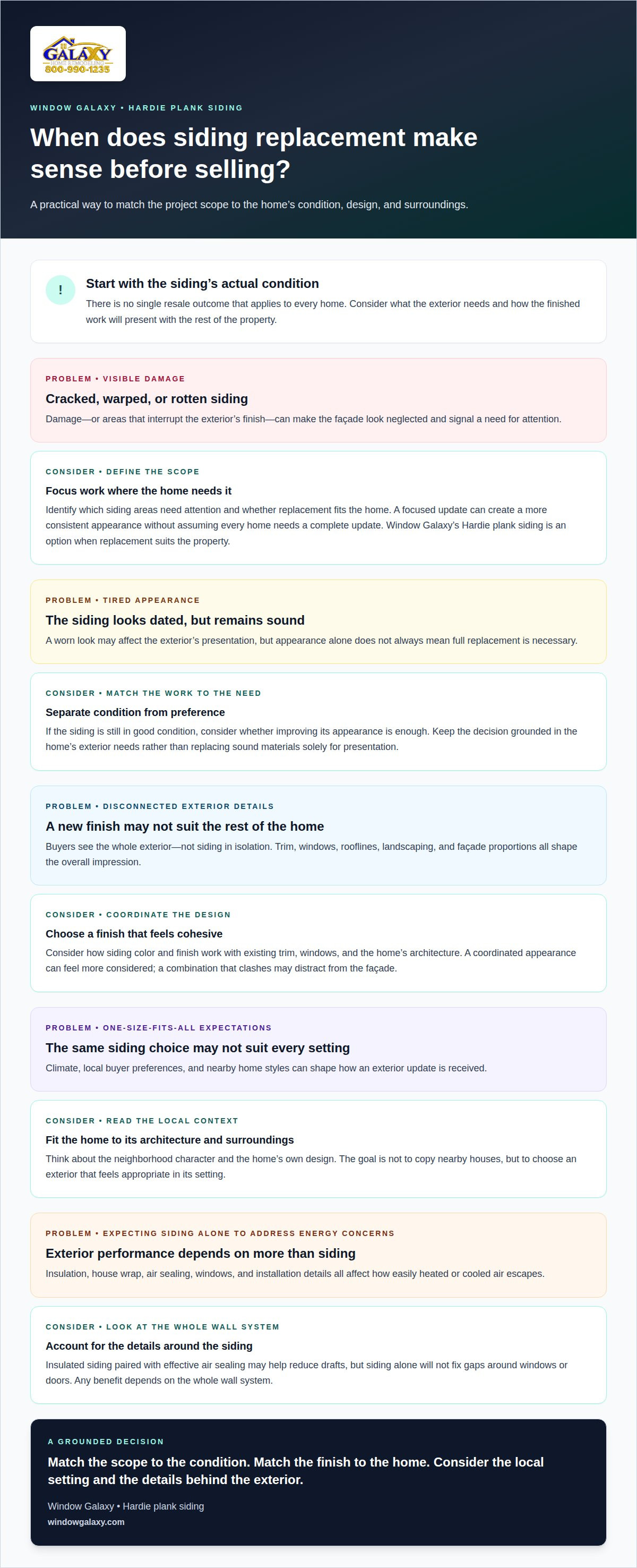
With Window Galaxy’s Hardie plank siding, the project is an opportunity to consider the home’s exterior as a whole. Buyers see siding alongside trim, windows, rooflines, and landscaping. For example, a siding color that works with the existing trim can make the façade feel more considered. The goal is a coordinated appearance that suits the house, rather than a change chosen without regard to its surroundings.
Climate is one factor to consider when deciding whether siding replacement belongs in your selling plans. The exterior faces the weather year-round, and the existing siding’s condition helps determine whether an update makes sense. Window Galaxy offers Hardie plank siding as an option. The project should address the home’s exterior needs while preparing its presentation for prospective buyers.
Neighborhood character also shapes how an exterior update may be received. A home that fits the surrounding streetscape can feel at home in its setting. For instance, a restrained finish may complement nearby houses better than a sharply contrasting one. You do not have to copy neighboring properties; consider how the siding will work with the home’s architecture and surroundings.
Window Galaxy’s siding can be considered alongside the home’s existing design details. Trim, windows, and façade proportions all affect whether the finished exterior feels cohesive. A considered siding choice can help these elements work together, while an inconsistent combination may distract buyers. Prospective buyers judge the full exterior, not the siding in isolation.
Consider whether replacement is necessary or simply desirable. If the existing siding is visibly damaged, replacing it may address a concern buyers would notice. If it is still in good condition, a full update may not be the only way to improve its appearance. Window Galaxy’s Hardie plank siding is an option when replacement fits the home’s actual exterior needs.
There is no single resale figure that applies to every Window Galaxy siding project. The contribution depends on the home’s starting condition, the design chosen, the quality of the completed work, and local buyer expectations. Keep the decision centered on the property: what the exterior needs, how the siding will suit its design, and whether the upgrade supports the presentation you want before selling.
When Is It Worth Replacing Siding Before Selling?
Window Galaxy’s Hardie plank siding may suit a home whose exterior needs more than a small touch-up. Before selling, consider the siding’s condition, the home’s design, and how the proposed work fits your plans.
Replacement Scope and Resale Considerations
Replacement scope means deciding which siding areas need work and how the finished exterior should support the home’s presentation. Defining the scope helps address visible concerns without assuming every home needs a complete update. Window Galaxy’s Hardie plank siding is an option when replacement suits the home. The result depends on the property and market, so do not assume a particular resale outcome.
Reasons to Replace Before Selling
Replacement may be worth considering when siding is cracked, warped, or rotten, or when its appearance detracts from the rest of the home. These conditions can make the exterior look neglected and signal a need for attention. A focused update can give the façade a more consistent appearance. If the siding remains sound, a full replacement may not be necessary for presentation alone.
What siding repairs or upgrades add the most value before selling a home? Start with visible damage and areas that interrupt the exterior’s finish, then consider whether Hardie plank siding suits the home’s design. The most useful work addresses the property’s specific condition.
Tax credits and rebates depend on program terms and project eligibility, so do not assume an incentive applies. Permit requirements vary by location and project scope. For a planned exterior change, check applicable requirements with your municipality.
Regional and Market Differences
Regional and market differences include climate, local buyer preferences, and nearby home styles, all of which can shape a siding project’s appeal. The same exterior choice may be received differently from one market to another. Before deciding on replacement, consider how Hardie plank siding would suit the home’s architecture and its surroundings.
How does siding replacement ROI vary by region and housing market? Resale response depends on local demand, the home’s condition, material choice, and completed work. Window Galaxy can help homeowners consider Hardie plank siding for the home’s exterior needs, rather than treating a broad market estimate as a prediction.
When you’re weighing replacement, focus on what buyers will see and what the exterior requires. A clear project scope can help keep the decision grounded in the home’s condition. Discuss Hardie plank siding with Window Galaxy as you consider the next step before selling.
Energy efficiency and utility costs
Siding can affect energy performance, but it is only one part of the home’s exterior assembly. Insulation, house wrap, air sealing, windows, and installation details all affect how easily heated or cooled air escapes. For example, insulated siding paired with effective air sealing may help reduce drafts, while siding alone will not fix gaps around windows or doors. Any benefit depends on the whole wall system.
Upgrading to insulated siding can lead to energy savings of up to 20%. Treat that as a possible upper result, not an expected saving for every house. The climate, existing insulation, air leakage, and household heating and cooling habits all shape utility use. A drafty home with limited wall insulation has different opportunities than one with a well-sealed exterior.
Which siding materials offer the best return on investment? A Today’s Homeowner with Danny Lipford survey of 70,000 homes across more than 1,200 markets found average cost recovery of 92% for fiber-cement siding and 91% for vinyl siding. Those figures compare resale recovery with project investment; they don’t measure energy savings or guarantee an individual result.
What is the resale value recouped for fiber cement siding replacement? The same survey found that fiber-cement siding recovered 92% of its cost on average. Separately, the 2024 Cost vs. Value Report estimates an 88.4% return for replacement fiber-cement siding, using a different measure and dataset.
Fiber cement siding is durable and resistant to pests and fire, and it can have a long service life. However, it does not automatically add insulation to the wall. Energy performance depends on the installation assembly: insulation, house wrap, and attention to gaps can complement the exterior material. For example, replacing siding while addressing an under-insulated wall may improve more than changing the surface alone.
Vinyl siding can provide durable, low-maintenance curb appeal, while insulated vinyl adds a layer intended to support energy performance. Standard vinyl and insulated vinyl are not interchangeable when energy goals matter. Distinguish the material’s appearance and upkeep from the insulation system behind it. An attractive exterior may make a positive impression on buyers, but appearance alone does not reduce utility use.
Before choosing an upgrade, identify where comfort problems occur. Drafts near windows, uneven room temperatures, and high heating or cooling demand can point to air leaks or insulation concerns, not siding alone. Considering the full exterior assembly helps connect the material choice with the home’s energy needs. This distinction makes it easier to weigh potential utility savings alongside resale appeal.
Maintenance and insurance considerations
Siding affects more than appearance: its condition can influence maintenance needs and exterior protection. Moisture entering through damaged panels can affect the underlying structure, while regular care helps preserve siding performance. For homeowners planning to sell, a clean, intact exterior can also reassure buyers that visible upkeep has been addressed.
Material choice shapes the maintenance routine. Vinyl, fiber cement, engineered wood, stone veneer, and brick veneer can provide decades of service, with occasional power washing. By contrast, painted siding may need fresh paint every five to 10 years because of exposure. A home with painted wood, for example, may need more frequent surface upkeep than one with a low-maintenance finish.
Fiber cement siding is pest- and moisture-resistant, which can help protect the home’s exterior. Quality siding can last 20 to 50 years or more, depending on material and maintenance. Newly installed siding can last 30 years or more, depending on the product. These ranges show why routine care matters: neglected damage can shorten useful life, regardless of the material’s expected durability.
James Hardie states that its fiber cement siding, trim, and soffit products include a 30-year non-prorated warranty. Warranty terms apply to specific products and conditions, so homeowners should retain product and installation records. Those documents can help clarify coverage if a covered issue arises. They also give a future buyer useful information about the exterior work.
Insurance is a separate consideration. New siding may improve physical protection, but it does not automatically change premiums or guarantee coverage. Insurers assess homes according to their policy terms. Before replacing siding, review how your policy treats siding damage, exclusions, and claims. For example, a policy’s treatment of wind or hail damage may affect what you pay after a covered event.
After installation, keep dated photos and records of the siding’s condition and maintenance. If a storm damages the exterior, clear photos can document affected areas before repairs begin. Follow your insurer’s claims process and keep relevant receipts. These records provide a clearer account of the home’s condition than relying on memory during a stressful claim.
Maintenance can also support energy efficiency indirectly. Cracked or loose siding can leave openings for moisture and drafts, while intact siding helps maintain the exterior barrier. Siding is not a substitute for insulation or air sealing. For instance, securing a loose panel may protect the wall, while persistent drafts may point to gaps elsewhere in the building envelope.
Before selling, address visible cracks, warping, rot, or gaps, and keep a simple record of completed work. A clean surface and sound panels help the exterior look cared for. This practical upkeep can support buyer confidence without suggesting new siding will determine insurance terms or eliminate future maintenance.
Professional installation and return on investment
Installation quality affects how well new siding performs and how buyers view the finished exterior. Proper preparation, fastening, flashing, and alignment help siding withstand weather exposure and protect the wall assembly. For example, installing siding over damaged sheathing can conceal a problem without fixing its cause. A careful installation accounts for the surface beneath the panels, not just their appearance.
The 2024 Cost vs. Value Report estimates a 153.2% return on investment for manufactured stone veneer. That figure is specific to that project type, not a promise for every siding material or home. Return also depends on the home’s condition, market demand, the project scope, and workmanship. Installation matters because visible unevenness or poor detailing can weaken the impression a replacement is meant to create.
What factors reduce the value added by new siding, such as poor installation or mismatched materials? Poor fastening, gaps around openings, uneven courses, and unfinished trim can undermine weather protection and buyer confidence. Materials or colors that clash with the home’s design can also make the exterior feel less cohesive.
Professional installation starts with understanding the existing exterior and the intended siding system. A sound plan accounts for wall condition, transitions around windows and doors, corners, and places where water must drain away. For example, remodeling specialists like CAS Construction & Renovations emphasize coordinating siding edges with trim rather than leaving exposed seams. These details support a clean finish and help limit pathways for moisture.
Installation methods also vary by material. Vinyl siding needs room to expand and contract, while fiber cement requires careful handling and appropriate fastening. Insulated siding adds another layer to the assembly, so installers must account for its fit around openings and trim. Using the right method for each material helps prevent damage and keeps the finished courses consistent.
A typical tear-off-and-replace siding project takes from a few days up to two weeks to install. The actual schedule depends on the home’s size, exterior complexity, weather, and any concealed damage discovered after removal. For instance, replacing siding around multiple gables and window openings involves more detail work than updating a simple façade. A clear project scope helps homeowners understand what the installation includes.
Before work begins, clarify which areas are included, how existing siding will be removed, and how the installation will handle trim and openings. At completion, review the work for consistent alignment, secure edges, and clean transitions. These visible details affect both the home’s weather protection and the quality buyers perceive.
For homeowners weighing replacement before a sale, professional installation can help translate a material upgrade into a complete, polished exterior. Discuss your siding installation and the details that matter for your home.
Window Galaxy: Hardie plank siding
Window Galaxy offers Hardie plank siding for homeowners considering an exterior replacement before selling. A project discussion makes sense when siding is damaged, looks dated, or no longer gives the home a consistent finish. The scope can take account of the existing exterior and the result you want buyers to see.
Clear communication and attentive project management help keep siding installation organized. As you consider resale appeal, think about how the proposed work will address the home’s visible condition and suit its exterior design. A siding project can improve presentation, but its effect on resale depends on the home and market.
Contact Window Galaxy to discuss Hardie plank siding for your home.
Plan the Exterior Update That Fits Your Home
Deciding how much value new siding adds to a home is only one part of preparing to sell. Consider whether your exterior needs replacement, repair, or a coordinated update—approaches often emphasized by general renovation specialists such as merakigc.com when structuring complete exterior overhauls. Your home’s condition and the impression you want to leave with buyers can guide that choice. No single upgrade suits every property, so focus on work that meets your home’s needs.
Window Galaxy can help you consider window updates as part of your plans. Considering the exterior as a whole can help create a consistent look. Choose a scope that suits your home’s presentation and priorities.
Contact Window Galaxy to discuss your plans and the right next step for your home. A thoughtful exterior update can help you move toward selling with greater clarity.
Frequently Asked Questions
Besides ROI, what other benefits does replacing your siding offer?
Replacing damaged siding can improve the exterior’s appearance and restore protection where panels have failed. A consistent finish may also help a home look polished in listing photos. For example, matching replacement panels across a prominent front wall can make a visible patch less noticeable. Siding is only one part of the building envelope, so it will not resolve unrelated issues such as drafts caused by poorly sealed windows.
When Is the Right Time to Upgrade?
Consider an upgrade before listing if siding is visibly damaged, needs frequent attention, or detracts from the home’s presentation. Plan the work with enough time to complete installation and address exposed problems before photography and showings. If the siding is intact but looks dull, cleaning or a surface refresh may be more appropriate. The right timing depends on the exterior’s condition and your selling plans.
How much resale value does new siding add to a home?
There’s no fixed resale amount for every home. A Today’s Homeowner with Danny Lipford survey of 70,000 homes across more than 1,200 markets found average cost recovery of 91% for vinyl siding and 92% for fiber-cement siding. Those percentages describe average recovery, not a guaranteed increase in a particular home’s sale price. Local buyer preferences, condition, material, and installation all affect the result.
What is the average cost to replace home siding in the United States?
This guide focuses on siding’s potential resale and performance benefits rather than dollar estimates. For a useful project discussion, define the area to be replaced, the existing exterior’s condition, and whether the work includes trim or related repairs. These details clarify the project scope and what an exterior update involves, without treating one national figure as suitable for every home.
What is the resale value recouped for vinyl siding replacement?
The Today’s Homeowner with Danny Lipford survey found that vinyl siding recovered 91% of its cost on average across the surveyed homes. That is a broad benchmark, not a forecast for a specific property. A home’s existing condition, local market, material selection, and completed workmanship influence how buyers respond. The percentage also describes average recovery, not an automatic resale-price increase of the same amount.
How does new siding affect home appraisal value?
New siding can contribute to an appraiser’s assessment by changing the home’s visible condition and overall appeal. It does not automatically add a set amount to an appraisal. An appraiser considers the property as a whole, including its condition and relevant comparable sales. Keep records of completed work and note which areas were replaced to give the appraiser useful context when reviewing the exterior.
Does replacing siding increase curb appeal and speed up a home sale?
Replacing visibly worn siding can improve curb appeal and make listing photos look more polished, which may encourage buyers to view the home. It cannot ensure a faster sale, because timing also depends on asking terms, local demand, and the home’s overall condition. For example, a refreshed façade may support a positive first impression, while unresolved interior or maintenance concerns can still affect a buyer’s decision.


