
The shingle that looks more substantial isn’t automatically the right choice for your roof. If you’re weighing architectural shingles vs 3-tab, it helps to compare their appearance and construction, then check the requirements and documented performance of the specific products available for your home.
The best fit depends on more than looks. Your roof’s condition, the appearance you want, and product requirements relevant to your home all deserve a place in the discussion. This guide explains the differences and offers practical questions to ask, without treating either shingle type as the universal winner.
You’ll learn what to look for in each style, which roof and weather considerations to raise, and how to compare product information. Window Galaxy USA lists roofing among its offerings, but its available shingle materials aren’t specified here. Confirming which options are currently available is a practical first step in discussing your project.
Key Takeaways
- Compare the typical appearance and construction of architectural and 3-tab shingles, then check the specific products available for your roof.
- With architectural shingles vs 3-tab, don’t assume one type always performs better. Review product documentation and installation requirements.
- Start with your roof’s condition, the look you want, and any documented product constraints.
- Ask for product specifications, maintenance guidance, and warranty details before discussing your roofing project.
- Window Galaxy lists roofing among its offerings. Confirm current shingle availability and project details directly.
Architectural Shingles vs. 3-Tab: What Is the Difference?
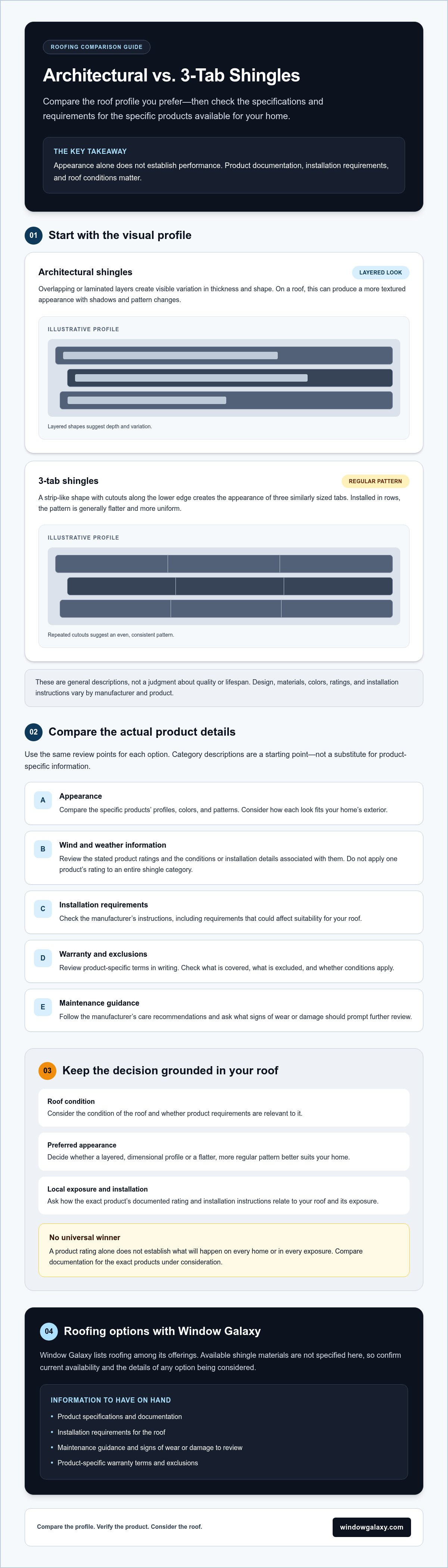
Architectural shingles have a layered, dimensional look, while 3-tab shingles have a flatter surface with a repeating pattern of evenly sized tabs. This difference in construction affects the finished roof’s appearance. It doesn’t, by itself, establish how a particular shingle will perform. For that, check the product’s documentation.
How architectural shingles are generally constructed
Architectural shingles are typically made with overlapping or laminated layers that create visible variation in thickness and shape. On a roof, that construction can produce a textured appearance, with shadows and pattern changes across the surface. Design, materials, ratings, and available options depend on the manufacturer and product. Treat “architectural” as a broad category, not a complete specification. The general Asphalt shingle overview can help explain common material terms, but product documents are where to verify details for a specific shingle.
If you’re discussing roofing with Window Galaxy, ask which architectural products are currently available and request their documentation. That keeps your comparison focused on actual options rather than assumptions about the category.
What defines a 3-tab shingle
A 3-tab shingle has a regular strip-like shape with cutouts along its lower edge. When installed in rows, those cutouts create the appearance of three similarly sized tabs. The result is generally a flatter, more uniform roof pattern than the dimensional profile associated with architectural shingles. This describes a typical appearance, not a judgment about quality or lifespan.
A simple way to picture the difference is to look at the overall pattern of each roof:
- Architectural: Layered-looking shapes create more visible depth and variation.
- 3-tab: Evenly spaced cutouts create a consistent row of repeated tabs.
These are general descriptions. Shingle composition, product ratings, colors, and other options vary by manufacturer and product. Installation requirements may also be product-specific, so don’t assume two shingles in the same category use identical instructions.
In the architectural shingles vs 3-tab comparison, start with the visual profile you prefer, then verify what each product is made of and what its documentation says. Window Galaxy lists roofing among its offerings, but its current shingle materials aren’t specified in the available information. Confirm availability and the details of any option under consideration before drawing conclusions.
Architectural vs. 3-Tab Shingles: Compare Performance Carefully
A useful comparison looks beyond shingle shape. For architectural shingles vs 3-tab, check the documentation for the exact products under consideration, then consider how installation instructions, roof condition, and local exposure affect suitability. Category descriptions can help you understand the basics, but they don’t replace product-specific details.
| Comparison category | What to review |
|---|---|
| Appearance | Compare the finished profiles, colors, and patterns shown for the specific products. Consider how each look fits your home’s exterior. |
| Wind and weather information | Check the product’s stated ratings and the conditions or installation details associated with them. Don’t apply one product’s rating to an entire shingle category. |
| Installation requirements | Review the manufacturer’s instructions, including any requirements that could affect whether the product suits the roof. |
| Warranty and exclusions | Ask for the product-specific terms in writing. Check what is covered, what is excluded, and whether any conditions apply. |
| Maintenance guidance | Follow the manufacturer’s care recommendations and ask what signs of wear or damage should prompt further review. |
Compare documented details, not category assumptions
Wind performance depends on the shingle’s documented rating and how the roof is installed. A product rating alone doesn’t establish what will happen on every home or in every exposure. Ask the roofing professional to identify the exact product being considered and explain how its installation requirements relate to your roof. If you’re comparing two options, request the same types of documentation for both so you can assess them on equal terms.
Read warranty language closely, too. Terms and exclusions can differ by product, so don’t assume a warranty associated with one architectural or 3-tab shingle applies to every product in that category. Maintenance guidance may vary as well. Keep the relevant documents and ask for clarification before making a selection.
Consider New Jersey conditions project by project
In New Jersey, ask a qualified roofing professional to consider your home’s exposure and the current condition of its roof. The right discussion depends on the particular property and documented product requirements, not a blanket statement that one shingle type suits the whole state. Ask how the proposed option relates to the conditions at your home, and request an explanation of any applicable local requirements rather than relying on assumptions.
Window Galaxy lists roofing among its offerings, but its current shingle materials and roofing-specific installation details aren’t specified in the available information. If you’re discussing a roof project with Window Galaxy roofing services, confirm which products are available and ask to review the documentation for each option under consideration.
Does One Shingle Type Always Perform Better? Understand the Tradeoffs
No. Neither architectural shingles nor 3-tab shingles automatically perform better in every comparison. The label describes a general style, not a guarantee of durability or suitability. When weighing architectural shingles vs 3-tab, separate your visual preference from what the specific product documentation can confirm about performance.
A dimensional profile may appeal if you want more texture and variation across the roof. That’s an aesthetic preference. It doesn’t, on its own, establish that a shingle will last longer or withstand particular weather conditions. To assess performance claims, compare the exact product’s documented ratings, installation instructions, warranty terms, and exclusions. Don’t apply specifications from one product to every shingle in its category.
When architectural shingles may fit your priorities
Architectural shingles may be worth considering if their layered appearance suits your home’s design. If durability is one reason you’re considering them, ask for product-specific evidence rather than relying on the category name. Review the manufacturer’s stated performance information and any conditions, including installation requirements tied to those claims. Without verified details for the actual product, avoid assuming a longer service life or stronger performance.
When 3-tab shingles may remain a consideration
The consistent, repeated pattern of 3-tab shingles may suit a homeowner who prefers a flatter, more uniform roof appearance. Whether a particular product is appropriate depends on its documented specifications and the roof being assessed. Ask which options are currently available, what limitations the manufacturer identifies, and whether the product’s requirements align with your roof. Don’t rule out a category without roof-specific evidence.
The roof itself matters, too. Its condition, shape, and design can affect which documented product requirements are relevant. Installation details matter because a shingle’s stated performance is connected to following its instructions. Ask a qualified roofing professional to explain how the proposed product fits the roof and which specifications support the recommendation.
- For appearance: Decide whether you prefer a dimensional or more uniform profile.
- For performance: Compare documented ratings for specific products, not broad category claims.
- For project fit: Review roof condition, design, and installation requirements together.
Window Galaxy lists roofing among its offerings, but its available business information doesn’t identify current shingle materials or product specifications. Confirm which options are available and ask to review their documentation before choosing. That keeps the decision grounded in your priorities and the details of your roof.
How to Choose Between Architectural and 3-Tab Shingles for Your Home
Start with your roof, not a shingle label. Before choosing between architectural and 3-tab shingles, consider the roof’s condition, the appearance you prefer, and any product requirements that could affect suitability. Use these questions to make a roofing discussion focused and useful.
- 1. Describe the roof’s condition. Ask whether its current condition or design affects which shingle products can be considered. Share any concerns you’ve noticed and ask what needs to be assessed before a recommendation is made.
- 2. Identify the look you want. Decide whether you prefer a dimensional profile or a flatter, more uniform pattern. Ask to see examples of specific available products rather than relying on category descriptions alone.
- 3. Identify documented product constraints. Ask whether the manufacturer lists requirements or limitations relevant to your roof. Have the professional explain how those details apply to the options being discussed.
- 4. Request the product details in writing. Confirm the proposed shingle type and manufacturer in writing. Ask for the product documentation, including stated performance information, installation instructions, and warranty terms for that specific option.
- 5. Clarify project communication. Ask how product decisions, installation details, and project updates will be communicated. Make sure you know whom to contact with questions and how changes or concerns will be discussed.
Keep claims tied to evidence. If a recommendation mentions weather performance, durability, or warranty coverage, ask which product document supports it and whether conditions or exclusions apply. This helps distinguish a product-specific fact from a general statement about architectural shingles or 3-tab shingles.
It’s also reasonable to ask what remains uncertain. If the available information doesn’t establish that a particular option suits your roof, ask what assessment or documentation would help clarify the decision. A useful discussion connects your preferences with the roof’s condition and the requirements of the actual product being considered.
Window Galaxy lists roofing among its offerings, but its current shingle availability and roofing-specific installation details aren’t specified in the available information. Confirm those details directly, and bring your questions about product documentation and communication to the conversation. To discuss your roofing project with Window Galaxy, use the details provided on its website.
Discuss Your Roofing Options With Window Galaxy
Window Galaxy lists roofing among its offerings, making the company a possible contact for discussing a roof project. Its available business information doesn’t specify which shingle materials are currently offered or describe roofing-specific installation details. Confirm those points before assuming architectural shingles, 3-tab shingles, or both are available for your home.
What to bring to a roofing conversation
A little preparation can make the discussion clearer. Bring any product information you already have, along with a short list of roof concerns and the appearance you prefer. If you’re comparing architectural shingles vs 3-tab, explain what you want to understand, such as how each option’s documented features relate to your roof.
- Describe your roof concerns. Share what you’ve noticed and ask whether the roof’s current condition or design affects the options under consideration.
- Explain your appearance preferences. Say whether you prefer a dimensional look or a more uniform pattern. Ask which examples, if any, are currently available for your project.
- Ask what products are offered. Confirm the shingle type and manufacturer for each option being discussed. Don’t assume a general category description identifies a product Window Galaxy carries.
- Request supporting documents. Ask for the manufacturer’s product information, stated specifications, installation requirements, and applicable warranty documents. Request a plain-language explanation of any unclear terms or limitations.
Keep recommendations connected to evidence. If a claim concerns weather performance, durability, or product coverage, ask which document supports it and whether it applies to the specific shingle under discussion. This helps distinguish confirmed product details from general descriptions. You can also ask how installation requirements will be explained and how project communication and coordination will be handled. Window Galaxy’s business information emphasizes customer communication and project management, but roofing-specific processes should be confirmed directly.
A clear next step for your roofing project
Before deciding, make sure you understand which product is proposed, what its documentation says, and how the next steps will be communicated. If a detail hasn’t been confirmed, ask rather than relying on an assumption. A straightforward conversation can help you organize your questions and understand what information is available for your roof.
For a practical next step, discuss your roofing project with Window Galaxy. Ask which shingle options are currently available and bring the comparison questions that matter to you.
Make Your Shingle Choice With Confidence
The architectural shingles vs 3-tab decision isn’t about choosing a universal winner. Architectural shingles offer a dimensional look, while 3-tab shingles create a more uniform pattern. For either option, compare the specific product’s documentation, installation requirements, and stated performance details rather than relying on category-wide assumptions.
Start with your roof’s condition and the appearance you prefer. Then ask which shingle options are available for your project and request clear explanations of their specifications and applicable documents. These details can help you have a more informed conversation and understand how a proposed option fits your roof.
Window Galaxy lists roofing among its offerings and emphasizes project management and customer communication in its business summary. Current shingle availability and roofing-specific details should be confirmed directly. Discuss your roofing project with Window Galaxy and bring your questions to the conversation. With the right information, you can move forward feeling prepared.
Frequently Asked Questions
What is the main difference between architectural shingles and 3-tab shingles?
The main difference is their typical construction and finished appearance. Architectural shingles generally have a layered, dimensional profile, while 3-tab shingles have a flatter look with a regular pattern of tabs. These are broad category descriptions, not complete product specifications. Materials, ratings, and other details vary by product, so review the manufacturer’s documentation for the exact shingles under consideration rather than assuming every product in either category performs the same way.
Are architectural shingles always better than 3-tab shingles?
No. Neither type is automatically right for every roof. The architectural shingles vs 3-tab decision depends on your preferred appearance, roof condition, the specific products under consideration, and their installation requirements. Compare documented specifications instead of relying on category-wide performance claims. A qualified roofing professional can explain how each available option fits your roof and which product information supports a recommendation.
Which shingles are better for a New Jersey home?
There isn’t one shingle category that’s universally best for every New Jersey home. The home’s exposure, roof design, and roof condition all matter, as do the specifications of the selected product. Ask a qualified roofing professional to assess your property and explain whether the manufacturer’s documentation addresses conditions relevant to your project. Confirm installation requirements for the specific product instead of relying on a general claim about regional suitability.
Do architectural shingles last longer than 3-tab shingles?
Service life depends on the specific shingle product, installation, maintenance, and conditions affecting the roof. Without current, product-specific evidence, it isn’t appropriate to promise that one category will last longer. Review the manufacturer’s information for the proposed shingles and ask how any stated service-life claims relate to the product. Also request an explanation of warranty terms, coverage conditions, and exclusions, since warranty language shouldn’t be treated as a guaranteed lifespan.
Can architectural and 3-tab shingles be compared by wind rating?
Yes, but compare the documented ratings for the exact products under consideration, not assumptions about architectural or 3-tab shingles as broad categories. Ask which manufacturer document states the rating and what conditions apply. Installation requirements matter because the product’s stated performance may depend on following its instructions. A roofing professional can identify the relevant product information and explain how its requirements relate to your roof.
How do I decide which shingle type suits my roof?
Start with your roof’s condition, the appearance you prefer, and the specifications of products available for your project. Ask what installation requirements apply and request documentation for performance claims. A project-specific discussion is more useful than choosing from a category label alone. Before a consultation, write down your questions and bring any product information you have, so you can compare options and clarify what’s known about each one.
Does Window Galaxy offer architectural shingles or 3-tab shingles?
Window Galaxy USA lists roofing among its offerings, but the available business information doesn’t confirm whether architectural shingles, 3-tab shingles, or both are currently available. Contact the company to ask which shingle options, if any, are offered for your project. Confirm product details directly, including specifications and applicable installation information, rather than assuming a shingle type is available. Window Galaxy also emphasizes project management and customer communication in its business summary.


