

Replacing single-pane windows with ENERGY STAR-certified windows can lower household energy bills by an average of up to 13% nationwide, according to ENERGY STAR. ENERGY STAR certification means a window meets efficiency criteria that vary by climate zone, and certified windows must have an air leakage rating of 0.3 CFM per square foot or less. These benchmarks can help you evaluate energy-efficient window options from Galaxy Home Remodeling.
When considering window replacement with Galaxy Home Remodeling, ENERGY STAR certification provides a useful performance benchmark, but the right criteria depend on your region, and potential savings depend partly on what the new windows replace. This guide explains how regional U-factor and solar heat gain requirements work, what air leakage ratings tell you, and how to identify qualifying window options. It also explains why savings vary from one home to another, so you can make a more informed decision about Galaxy Home Remodeling windows.
Key Takeaways
- Certification criteria vary by climate zone, so consider regional requirements when assessing Window Galaxy window products.
- For Window Galaxy window options, ENERGY STAR-certified windows must have an air leakage rating of 0.3 CFM per square foot or less.
- Compare Window Galaxy models by their efficiency ratings and how well they suit your climate.
- Replacing single-pane windows with certified Window Galaxy windows can lower household energy bills by an average of up to 13% nationwide, according to ENERGY STAR.
- Learn why energy savings can differ between homes and what to consider when planning a Window Galaxy window replacement.
Air leakage limits
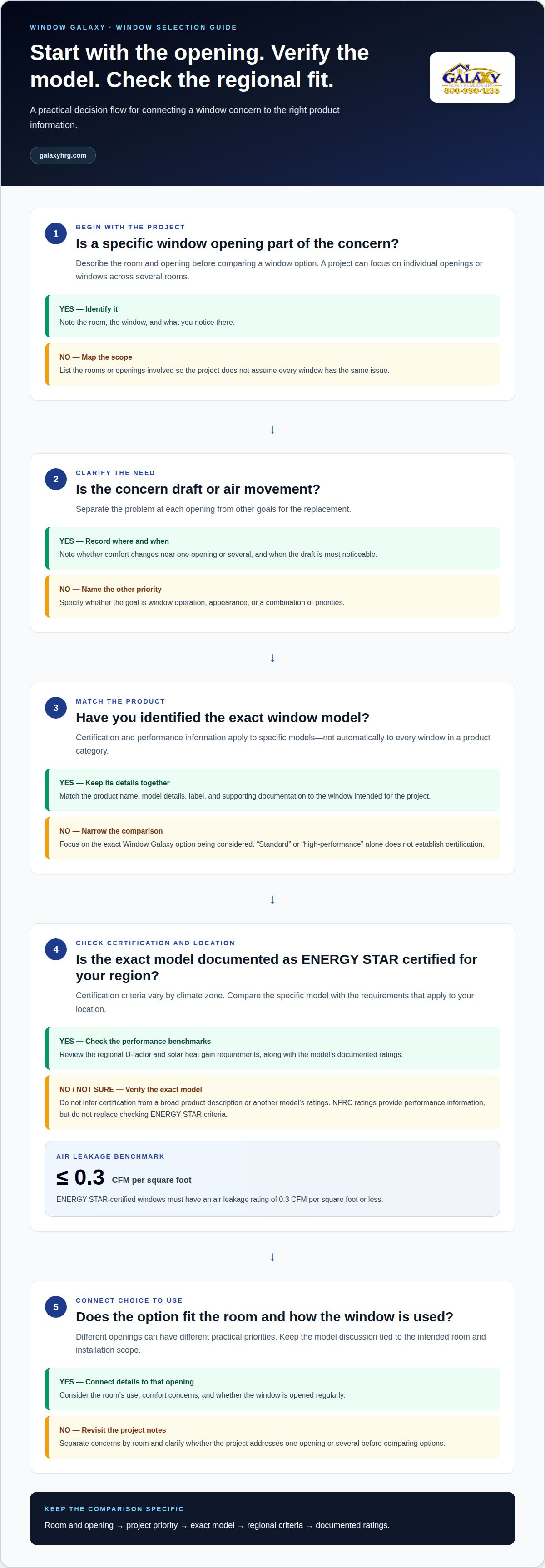
For a Window Galaxy replacement project, air leakage is one performance consideration to weigh against the needs of each opening. You might notice a draft beside a frequently used window, uneven comfort near a seating area, or air movement around a room used less often. These observations help define what the project needs to address without assuming every window in the home has the same issue.
Galaxy Vinyl Windows are one option for a replacement project. Compare the specific model with the opening it is intended to serve. A bedroom window, for example, may need to balance comfort with how the room is used. A window in a main living area may have different priorities, such as frequent operation or a particular view.
Keep the project focused on the problem you want to solve. Note which rooms feel drafty, when the discomfort is most noticeable, and whether it occurs near one opening or several. These observations give the window-selection discussion a clear starting point and help distinguish air movement concerns from other goals, such as changing a window’s appearance or operation.
For a Window Galaxy project, consider these points together:
- Identify the affected openings: Describe the room and window where you notice drafts or changing comfort.
- Explain how the room is used: A window opened regularly may have different practical priorities than one rarely operated.
- Keep model information specific: Connect product details to the particular Galaxy Vinyl Windows option being considered.
- Separate project goals: Note whether the priority is comfort, window operation, appearance, or a combination.
- Consider the installation scope: A project may focus on individual openings or address windows across several rooms.
These details make it easier to discuss the right scope for Window Installation Services. For example, describe a draft beside a bedroom window separately from a different concern with a living-room window. That distinction keeps the product discussion tied to the rooms and their intended use, rather than treating every opening as identical.
Air leakage limits are one part of evaluating a window project, not a substitute for identifying what matters in your home. Use the concern at each opening to guide the discussion of suitable Galaxy Vinyl Windows and project scope. This gives Window Galaxy a practical basis for planning the replacement and keeps product choices connected to your priorities rather than assumptions about a model’s performance.
What is ENERGY STAR Certification for Windows?
For a Window Galaxy replacement project, ENERGY STAR criteria can help frame the performance questions. The label applies to specific window models, so focus product selection on the exact option and your home’s needs.
Certification Criteria and Window Comparisons
ENERGY STAR certification is a model-specific performance designation, not a blanket claim about every window a company offers. For a Window Galaxy project, that distinction keeps comparisons precise. A general description such as “efficient” does not establish certification, and a rating for one model should not be applied to another. Compare the exact product information with the requirements for your home’s location.
“Standard” and “high-performance” are broad descriptions; neither proves that a window is ENERGY STAR certified. When discussing Galaxy Vinyl Windows or Specialty Windows, focus on the model under consideration and its documented performance. This grounds selection in product details rather than assumptions based on category or appearance.
Federal tax-credit information also needs a clear time context. The eligibility period described for certain ENERGY STAR windows ran through 2020, so that information does not establish current eligibility for a Window Galaxy project. Local incentives depend on the terms of the applicable program, and certification alone does not establish that a specific purchase qualifies.
Labels, Ratings, and Certification Checks
A product label identifies a window, while performance ratings describe its characteristics. In a Window Galaxy selection discussion, match the label and ratings to the exact model. NFRC ratings provide performance information, but they do not replace checking whether that model meets the applicable ENERGY STAR criteria.
Keep the product name, model details, and supporting documentation together as you narrow your options. Make sure the information refers to the window intended for the project, not a similar model. Installation instructions also matter: ENERGY STAR-certified products must include them with the window or make them readily available online. Window Galaxy’s Window Installation Services connect product selection with the installation project.
Common pitfalls include treating “high-performance” as proof of certification, applying one model’s ratings to another, and assuming a past incentive still applies. A focused Window Galaxy project discussion can keep these issues separate. Discuss the window’s intended room, product documentation, and installation scope together. This gives selection a clear basis without assuming certification from a broad product description.
This distinction is useful when reviewing older product material or incentive references. Applicable criteria can depend on when the information was published, so verify the requirements for the specific model rather than relying on an outdated summary.
ENERGY STAR updated its window certification criteria and requirements in 2016. The current ENERGY STAR criteria for residential windows, doors, and skylights were finalized in October 2022. These milestones help explain why a prior listing or description may not reflect current requirements. For a project, use documentation that identifies the selected model and check it against the criteria that apply now; do not infer current certification from an older claim.
ENERGY STAR-certified window brands and models
For a Window Galaxy project, start with the opening and the role the replacement window needs to serve. Galaxy Vinyl Windows and Specialty Windows are options to consider. The right choice depends on the home, the existing opening, and your priorities. A window’s category alone does not establish its certification status, so treat ENERGY STAR qualification as a separate product-selection consideration.
Window choice also depends on how the room is used and the project’s visual goals. Replacing a prominent front-facing window may involve different design priorities from replacing one in a less visible room. Existing openings and the appearance you want can help narrow down which Galaxy option fits. These considerations guide selection without assuming every option serves the same purpose.
If ENERGY STAR qualification is a requirement for your project, tie it to the specific Galaxy window model under consideration. The product category or company name alone does not establish whether an individual model qualifies. Treat certification as one selection criterion alongside the opening, room, and desired appearance, rather than inferring it from the product name.
As you consider Galaxy window options, organize the project around these practical points:
- Describe the opening: Note where the window is located and what the replacement needs to address.
- Set the room’s priorities: Consider how the space is used and what matters most in that setting.
- Choose the product category: Consider Galaxy Vinyl Windows or Specialty Windows in relation to the project’s needs.
- Include the appearance: Think about how the selected window should fit the home’s existing look.
- Keep certification as a model-level criterion: Evaluate ENERGY STAR status for the specific Galaxy model being considered.
This approach connects product selection to your home, not just a general label. For example, if you’re replacing windows in several rooms, identify each opening and its priorities separately. That creates a clearer basis for considering Galaxy Vinyl Windows or Specialty Windows across the project without assuming one choice suits every room.
Window Galaxy’s window-selection discussion can bring these priorities together: the opening, the room’s use, the desired appearance, and any model-specific certification requirement. This makes it easier to focus on which Galaxy option fits the project. Keeping the factors distinct also avoids treating a product category or broad brand description as a substitute for the exact model under consideration.
Potential energy-bill savings
ENERGY STAR links potential household energy savings to replacing single-pane windows with certified models. According to ENERGY STAR, replacing single-pane windows with ENERGY STAR certified windows can lower household energy bills by an average of up to 13% nationwide in the United States. That figure is a nationwide average, not a fixed reduction for every household. It describes potential savings from a specific replacement scenario, not a promise that all homes will see the same result. When considering Window Galaxy window options, use this figure as a general reference rather than a forecast for a particular home.
The starting point matters when considering Window Galaxy windows. A home replacing single-pane windows has a different baseline from one replacing newer windows. Existing window performance affects how much heat moves through the glass and frame. Climate also shapes the energy impact: homes where heating or cooling is the main seasonal demand face different conditions. So the national figure is best understood as a broad reference, not a personalized forecast for a Window Galaxy product.
Household energy use depends on more than window choice. Insulation, air movement, heating and cooling equipment, thermostat settings, and daily routines all influence demand. For example, a room with substantial sun exposure may gain more heat than a shaded room. Window Galaxy window options can be considered alongside these factors, since changes in energy use reflect how windows interact with the rest of the home.
To interpret the potential benefit when considering Window Galaxy windows, consider the comparison carefully:
- Identify the starting window type: The ENERGY STAR figure specifically compares replacement of single-pane windows.
- Consider local conditions: Climate affects whether limiting heat transfer or solar heat gain matters more.
- Look at the whole home: Insulation, drafts, equipment, and household settings also shape energy use.
- Interpret the percentage carefully: A percentage reduction doesn’t indicate an identical result across households, since energy use differs.
- Review the specific product: Certification criteria vary by climate zone, so regional suitability matters when considering Window Galaxy options.
Using those factors helps put the 13% figure in context when evaluating Window Galaxy windows. It gives households a national benchmark for replacing single-pane windows, while their own savings depend on baseline performance and home conditions. A household already using efficient windows may not have the same opportunity as one replacing single-pane units. Local weather patterns and how the home is heated or cooled also influence the outcome.
For a practical decision about Window Galaxy windows, consider potential energy savings alongside regional efficiency ratings and the condition of existing windows. ENERGY STAR certification identifies products that meet applicable performance criteria; it does not calculate a household’s future energy use. Consider the existing windows, climate, and whole-home energy demands together to understand what replacement may change.
Regional U-factor requirements for Window Galaxy
When comparing Window Galaxy windows with ENERGY STAR criteria, use the U-factor requirements for the applicable climate zone. U-factor measures how readily heat passes through a window; a lower value means less heat transfer. This regional approach recognizes that window performance needs differ across the United States. Read a Window Galaxy window’s rating against the climate zone where it will be installed, rather than treating it as a universal pass-or-fail number.
The listed limits show how the criteria apply to Window Galaxy window comparisons. ENERGY STAR-certified windows in northern zones must have a U-factor of at most 0.27. In southern zones, certified windows can have U-factors as high as 0.40. These figures are regional thresholds, not a ranking in which every home should automatically choose the lowest number. The applicable zone determines which criterion to use when reviewing a Window Galaxy window.
U-factor is only one part of regional window performance to consider when assessing a Window Galaxy model. ENERGY STAR criteria also set Solar Heat Gain Coefficient requirements where applicable. SHGC describes how much solar heat enters through a window, so it matters alongside heat transfer when assessing a model for its climate. For example, a Window Galaxy window intended for a colder northern zone may be evaluated under different criteria from one intended for a southern zone.
Use this comparison when reviewing Window Galaxy windows against the requirements:
- Northern zones: The maximum U-factor for certified windows is 0.27.
- Southern zones: Certified windows can have U-factors as high as 0.40.
- Climate zone: Identify the zone for the installation location before comparing a Window Galaxy model’s rating with the applicable criteria.
- SHGC: Include this rating when regional criteria apply, since it addresses solar heat gain rather than heat transfer.
- Model details: Use the rating for the specific Window Galaxy window model being considered, not a general brand-level description.
For a practical comparison of Window Galaxy windows, first establish the home’s climate zone. Then compare the window’s U-factor with that zone’s threshold and consider SHGC where required. This grounds the comparison in local criteria. A Window Galaxy model’s rating cannot be fully interpreted without knowing which regional requirements apply, and the lowest U-factor alone does not establish that a window meets every relevant criterion.
Regional thresholds also help explain why Window Galaxy windows may have different ratings. A U-factor of 0.40 may fit the stated maximum for southern zones, while northern zones have a stricter maximum of 0.27. The relevant question is whether the specific Window Galaxy model meets the criteria for its intended climate zone. For support planning Window Galaxy windows around regional performance needs, discuss your window project.
Galaxy Home Remodeling: Window Installation Services
Galaxy Home Remodeling provides Window Installation Services for homeowners planning a replacement project. After comparing regional criteria and model ratings, professional installation brings the selected window into your home. Galaxy Vinyl Windows and Specialty Windows are options to consider for the project.
Window selection and installation need to work together. The right product depends on the opening, your home’s needs, and the performance criteria you’re considering. Galaxy Home Remodeling manages window replacement projects with constant interaction, clear communication, and hands-on quality control.
If you’re planning a window replacement, contact Galaxy Home Remodeling to discuss your project. For homeowners pairing energy upgrades with wider home cleanouts, organizations like era.ca provide convenient options across Canada to recycle and donate unwanted electronics responsibly.
Turn your window plans into a clear next step
Use ENERGY STAR windows certification criteria as a starting point for a project shaped around your home. A useful next step is to connect performance goals with window style, existing openings, and the look you want to maintain. This discussion can turn technical ratings into a practical plan for your home.
Galaxy Home Remodeling offers Galaxy Vinyl Windows and Specialty Windows, along with Window Installation Services. Discuss product selection and installation as part of the same project. Share what you hope to improve, and the team can talk through a suitable direction with clear communication throughout.
Thoughtful planning makes it easier to move forward with confidence and a clear understanding of the project. Contact Galaxy Home Remodeling today to discuss your window plans and take the next step.
Window Galaxy Frequently Asked Questions
What does ENERGY STAR certification mean when choosing Window Galaxy windows?
ENERGY STAR certified windows are models that meet the program’s applicable energy performance criteria. Certification applies to a specific model, not automatically to every window from a manufacturer. For example, two models from the same product line may have different ratings or regional eligibility. The label identifies qualifying products, while model-specific performance information shows how a particular Window Galaxy window fits your home’s climate and project.
What are the current ENERGY STAR window certification requirements in the United States for Window Galaxy customers?
The current ENERGY STAR performance levels for residential windows took effect on October 23, 2023. Requirements include U-factor limits that depend on climate zone, SHGC criteria where applicable, and an air leakage rating of 0.3 CFM per square foot or less. For instance, hot southern regions have an SHGC limit of 0.4 or less. A model must meet the criteria applicable to its region to qualify.
How do ENERGY STAR window criteria affect Window Galaxy customers in different climate zones?
ENERGY STAR sets different performance criteria for different climate zones because window needs depend on local conditions. Northern zones require a U-factor of at most 0.27, while southern zones allow values as high as 0.40. In hot southern regions, the SHGC limit is 0.4 or less. These thresholds help determine whether a model fits its intended region; the same rating should not be treated as universally suitable when considering Window Galaxy windows.
How much energy can ENERGY STAR windows save for Window Galaxy customers?
According to ENERGY STAR, replacing single-pane windows with certified models can lower household energy bills by an average of up to 13% nationwide in the United States. The resulting bill reduction varies with household energy use and the windows being replaced, so the national percentage does not translate into one savings amount for every home. Homes replacing different window types may have a different starting point for potential energy savings.


