

Galaxy Home Remodeling offers windows with different solar heat gain coefficient (SHGC) ratings. SHGC measures how much of the sun’s heat a window allows indoors, on a scale from 0 to 1. A lower number means less solar heat passes through.
When considering Galaxy Home Remodeling windows, comfort depends on how several factors work together. SHGC affects solar heat; U-factor describes how well a window resists heat transfer; and visible transmittance indicates how much daylight comes through. Shading and window orientation also influence how a room feels.
This guide explains what SHGC measures and how to interpret the rating for Galaxy Home Remodeling windows. You’ll learn how to weigh it alongside U-factor and visible transmittance, and how shading, sunlight, and seasonal comfort shape the choices that may suit your home.
Key Takeaways
- Understand how a window’s rating indicates the solar heat that enters your home, including heat absorbed and released indoors.
- Compare solar heat gain with insulation and daylight performance instead of choosing a window by one rating alone.
- Consider window direction, climate, and shading to assess how glazing may affect comfort across the seasons.
- Learn how the shading coefficient relates to SHGC and why the two ratings aren’t interchangeable without context.
- See how window design and frame area can influence overall performance, beyond the glass itself.
What Is Solar Heat Gain Coefficient (SHGC)?
Solar heat gain coefficient, or SHGC, measures how much solar heat a window admits indoors. When considering Window Galaxy offerings, SHGC provides a way to compare how much solar heat different windows admit. The solar heat gain coefficient explained in practical terms is a rating that helps you assess Window Galaxy windows for a particular space.
How SHGC Measures Solar Heat Through Windows
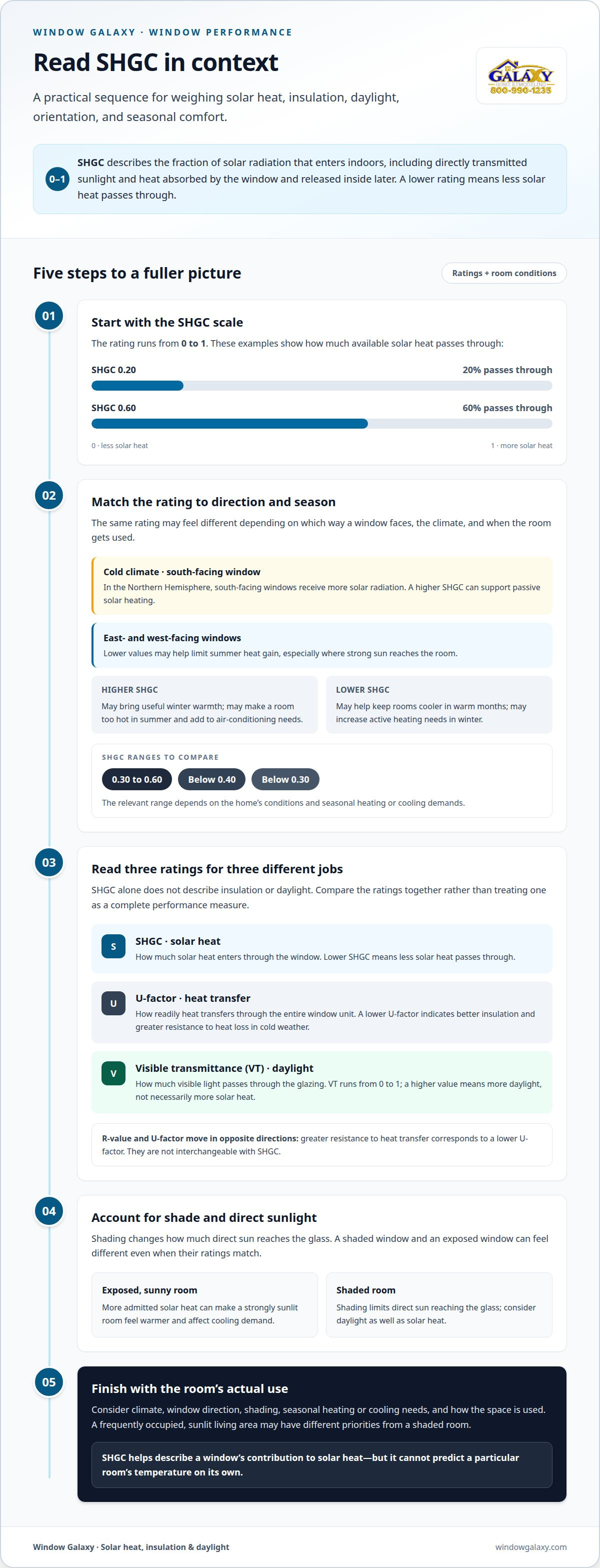
SHGC is the fraction of solar radiation that enters through a window, including sunlight transmitted directly and heat absorbed by the window and released indoors later. Its rating runs from 0 to 1, making it a practical way to compare how Window Galaxy glazing affects indoor heat.
For example, a Window Galaxy window rated 0.20 allows 20% of available solar heat to pass through. A 0.60 rating allows 60%. The lower rating admits less solar radiant heat, which can help limit unwanted warmth in sunny rooms. The higher rating admits more, which may benefit a space that needs winter sun.
That distinction matters because sunlight can affect comfort even when indoor heating is off. A room with strong direct sun may feel warmer than one with less exposure. SHGC helps describe a Window Galaxy window’s contribution, but it cannot predict the temperature of a particular room on its own. To understand the solar heat gain coefficient for a specific room, consider its exposure and seasonal use alongside the rating.
Ratings Across Orientations and Seasons
Window orientation affects how solar heat enters a home, so one SHGC may not suit every façade. When considering Window Galaxy windows, account for the orientation of each façade. In the Northern Hemisphere, south-facing windows receive more solar radiation. In a cold climate, a higher SHGC on a south-facing window can support passive solar heating, while east- and west-facing windows may need lower values to limit summer heat gain.
Season also changes the trade-off when selecting Window Galaxy windows. A high SHGC can bring useful warmth in winter, but may make rooms uncomfortably hot in summer and increase air-conditioning needs. A low SHGC can help keep rooms cooler in warm months, but may increase active heating needs in winter.
When comparing Window Galaxy offerings, consider the SHGC ranges relevant to your needs: 0.30 to 0.60, below 0.40, or below 0.30. The right rating depends on the home’s conditions and seasonal heating or cooling demands.
Efficiency, Energy Savings, and Comfort
Energy-efficient windows from Window Galaxy can support comfort by managing solar heat and reducing unwanted heat transfer. SHGC describes solar heat entering the home; it doesn’t measure insulation by itself. A Window Galaxy window’s performance also depends on factors such as U-factor, which measures resistance to heat transfer across the window unit.
Choosing the right SHGC from Window Galaxy offerings depends on the home’s climate, the window’s direction, and whether heating or cooling is the bigger seasonal demand. A higher SHGC may suit a sun-facing window in a cold climate, while a lower rating may help reduce solar heat in a warm, sunny room. Shading also affects how much direct sun reaches the glass.
Consider Window Galaxy window efficiency in the context of the room and its use. For example, the priorities for a frequently occupied, sunlit living area may differ from those for a shaded room. Matching Window Galaxy window performance to those conditions keeps comfort and energy efficiency in view without relying on one rating alone.
Balancing SHGC with U-factor and visible transmittance
SHGC, U-factor, and visible transmittance describe different aspects of Window Galaxy window performance. Comparing all three helps you relate Window Galaxy’s ratings to your climate, orientation, and comfort priorities.
How SHGC Relates to U-Factor and R-Value
For Window Galaxy windows, SHGC measures solar heat entering through the window, while U-factor measures how readily heat transfers through the entire window unit. A lower U-factor indicates better insulation, including greater resistance to heat loss in cold weather.
R-value describes resistance to heat transfer, so it moves in the opposite direction from U-factor: greater resistance corresponds to a lower U-factor. The values aren’t interchangeable. A Window Galaxy window can, for example, limit heat transfer well while admitting substantial solar heat, or resist solar gain while providing a different level of insulation.
Reading both ratings for Window Galaxy windows gives a fuller picture than relying on either alone. In a heating-focused climate, insulation may be a priority; in a sunny room, solar gain may matter more. The right balance depends on the home’s seasonal needs.
Effects on Indoor Comfort and Cooling
SHGC for Window Galaxy windows influences how much sunlight contributes heat to a room, which can affect comfort and cooling demand. A west-facing room with strong afternoon sun, for example, may feel warmer when its Window Galaxy windows admit more solar heat.
Visible transmittance, or VT, measures how much visible light passes through Window Galaxy glazing. It is expressed as a ratio from zero to one. A higher VT means more daylight enters, but VT doesn’t measure solar heat. Considering both ratings helps distinguish a bright room from one that gains unwanted warmth.
Orientation and shading affect the experience of Window Galaxy windows, too. A shaded window and an exposed window can perform differently even when their ratings match. In summer, limiting solar heat can ease cooling demand, while preserving daylight helps keep the interior bright.
Effects on Indoor Heat and Energy Use
Solar heat entering through Window Galaxy glazing affects how much warmth a home gains from sunlight. In a cold season, that gain may support indoor warmth; during hot weather, the same heat can add to the cooling load.
U-factor adds another part of the energy picture by describing heat transfer through a full Window Galaxy window. A low U-factor helps reduce heat movement through the unit, while SHGC describes solar gain. Together, these ratings explain why a Window Galaxy window’s overall effect depends on both sunlight and insulation.
For example, a sunny room may benefit from less solar gain in summer, while a cooler room may benefit from winter sunlight. Choose Window Galaxy windows to suit these contrasting conditions rather than assuming one rating alone predicts energy use.
Trade-Offs Between Lower and Higher SHGC
A lower SHGC in a Window Galaxy window admits less solar heat, which can help limit summer overheating. The trade-off is less passive warmth from sunlight during colder periods. A higher SHGC admits more solar heat, which may be useful during the heating season but can make cooling more demanding in sunny weather.
Climate and orientation help determine which trade-off matters most for Window Galaxy windows. A south-facing window in a cold region, for instance, has different priorities from an exposed window facing afternoon sun in a warmer climate. Compare SHGC with U-factor and VT, then consider how the room is used throughout the year.
For a Window Galaxy window replacement project, window replacement planning can help connect these performance considerations with the home’s window needs.
Balancing glazing with comfort and design needs
Window Galaxy’s glazing choices shape daylight, solar heat, and a home’s appearance. Its low-E coatings, tints, and window designs can change SHGC, so their effects matter for comfort in both summer and winter.
Window Galaxy Glazing and Design Needs
Glazing is the glass portion of a window, and the SHGC of Window Galaxy’s windows affects how much solar heat enters the home. This matters in rooms with large glass areas, where sunlight can influence comfort and heating needs.
Some Window Galaxy designs use glazing across almost 90% of a façade. In that example, the ability of each Window Galaxy window to manage solar gain becomes an important part of the room’s overall comfort. The frame also matters: a Window Galaxy window’s total system SHGC partly depends on the proportion of glass to frame.
Window Galaxy’s window styles can affect the system rating, too. Its awning, casement, and louvre windows typically have total system SHGC values 10-15% lower than its fixed or sliding windows. That difference can help explain why two Window Galaxy windows with similar glazing may not perform identically as complete units.
Consider the room’s use alongside the design of Window Galaxy’s windows. A living area that needs winter sunlight may have different priorities from a bedroom exposed to strong afternoon sun. The glazing, frame, orientation, and shading of a Window Galaxy window all contribute to the result; no single visual feature describes the whole window’s solar performance.
How Window Galaxy Coatings and Tints Affect SHGC
Window Galaxy’s low-E coatings, window tints, and glazing construction influence how solar energy passes through its windows. Their effect on the finished unit’s SHGC matters because heat control, daylight, and views need to work together.
Window Galaxy’s modern window panes commonly use low-emissivity glass to reduce radiant heat and UV-ray penetration. A coating can therefore affect the solar heat admitted, but the SHGC rating applies to the complete Window Galaxy window assembly, not the coating on its own.
Window Galaxy’s tinted glass changes the light and solar energy that pass through the glazing. The balance depends on the glass assembly: reducing incoming solar heat may also change how much visible light enters the room. Compare the complete Window Galaxy window’s ratings instead of assuming tint alone indicates its heat performance.
For example, clear glass with an SHGC of 0.6 can produce high solar heat gains, especially on east- and west-facing façades. That example shows why the appearance of Window Galaxy’s glazing alone cannot establish summer comfort. Coatings, tints, glass area, frame proportion, and shading work together, while insulation remains a separate part of Window Galaxy window performance.
Shading coefficient and its limitations
When reviewing Window Galaxy window information, the shading coefficient compares solar radiation passing through a glass unit with radiation passing through reference glass. It offers another way to describe solar control, but its reference differs from SHGC’s measurement, so the ratings aren’t identical.
For a Window Galaxy window, exterior shading can reduce solar heat before it reaches the glass. Adding shade is one of the most effective short-term ways to limit solar heat entering a home without replacing windows. For tailored solar control, solutions from Luxe Drapery and Shades can help manage sunlight and comfort alongside high-performance glazing. The effect depends on the window’s exposure and the shade provided.
To understand a shading coefficient in the context of Window Galaxy, note that it uses a reference window made from frameless 3-millimeter clear float glass. Its rating ranges from 0 to 1, with a lower value indicating less solar heat transmitted through the glass. This comparison can help describe glazing performance, but it doesn’t capture every feature of a complete window system.
When comparing Window Galaxy window ratings, remember that SHGC and shading coefficient use different reference approaches. An approximate conversion is to multiply the shading coefficient by 0.87. For example, a shading coefficient of 0.50 converts to an estimated SHGC of 0.435. That result is an approximation, not a substitute for the window’s own SHGC rating.
For a Window Galaxy window, the reference glass creates an important limitation: a shading coefficient describes performance relative to that specific clear-glass benchmark. The finished window may include different glazing and a frame. Its overall solar heat gain also depends partly on the ratio of glass area to frame area, which a glass-only comparison doesn’t fully represent.
Use the shading coefficient when considering Window Galaxy as a point of comparison, not a complete prediction of room temperature. Identical glass ratings can, for example, feel different in rooms with different sun exposure or exterior shade. A solar-control rating also doesn’t tell you how much daylight passes through; visible transmittance describes that separate quality.
For Window Galaxy windows, exterior shade and low-SHGC glass manage sunlight at different points. An awning or external shade solution—such as those designed by Best Outdoor Blinds—can intercept sunlight before it strikes the glass, while low-SHGC glazing reduces solar heat transmitted through the window. In a warm region, combining shade with suitable glazing may reduce heat gain; in a colder region, excessive shade can also limit useful winter sun.
For a practical Window Galaxy comparison, identify the rating type first, then compare like with like. Treat a shading coefficient of 0.40 as a reference-glass comparison, not as an SHGC of 0.40. Use the approximate 0.87 conversion only for orientation, and rely on the complete window’s SHGC when assessing solar heat performance.
Solar heat gain coefficient for Window Galaxy windows
For Window Galaxy windows, solar heat gain coefficient (SHGC) is the fraction of solar radiation admitted through a window, including sunlight transmitted directly and heat absorbed by the window and later released indoors. This means the rating describes more than the sunlight visible through the glass: it also includes delayed heat transfer into the room.
SHGC calculations for Window Galaxy windows account for solar energy transmitted through the window. The standard calculation assumes sunlight strikes the window at normal incidence, meaning it approaches straight on. It generally provides a good estimate for angles up to 30 degrees from normal, but actual sunlight direction changes during the day.
This distinction explains why an SHGC rating for a Window Galaxy window measures a product, not a room-temperature forecast. Two rooms with the same window rating can feel different because their orientation, shading, and sunlight exposure differ. A lower SHGC means less solar radiant heat passes through the window, but it doesn’t describe insulation or air leakage.
When considering a Window Galaxy window, separate solar gain from heat transfer. SHGC describes solar energy entering through the window, including absorbed heat released indoors. U-factor describes heat transfer through the entire window unit. Heating and cooling needs depend on both, along with sunlight, climate, and how the room is used.
Consider a sunlit room in winter with a Window Galaxy window. A window that admits more solar heat can contribute passive warmth, while the same gain may be unwelcome during summer cooling. A lower SHGC can help keep a sunny room cooler, but it also reduces solar warmth in colder periods. The best interpretation depends on when and where the window receives direct sun.
The cited uniform method for measuring window, door, and skylight efficiency was developed by the National Fenestration Rating Council. The cited procedure for determining SHGC and visible transmittance is ANSI/NFRC 200-2017. This gives readers a consistent basis for comparing Window Galaxy window ratings, although it doesn’t make every window suited to every orientation or heating and cooling pattern.
Use the definition to understand what a Window Galaxy window’s rating includes, not as a stand-alone verdict. Consider the complete window’s SHGC with its U-factor, visible transmittance, and intended placement. The same solar-gain rating, for example, may work differently for a shaded opening than an exposed one. That context makes the rating more useful when choosing Window Galaxy windows.
For help matching Window Galaxy window options to your home’s needs, discuss your window project.
Window Galaxy
Window Galaxy can help you relate window ratings to your home’s needs when you’re considering replacement windows. SHGC is one part of the decision; orientation, seasonal comfort, daylight, and insulation also shape how a window may perform in a room. Discussing these factors alongside window options and installation can make the selection process clearer.
Window Galaxy offers window installation services, Window Galaxy vinyl windows, and specialty windows. The right fit depends on the opening and your performance priorities, such as managing strong sunlight or retaining winter warmth. Constant interaction and clear communication help keep those priorities in view from selection through installation.
If you’re considering new windows, contact Window Galaxy to discuss your project.
Make your next window decision with confidence
With the solar heat gain coefficient explained in context, you can use window ratings as part of a broader conversation about how each room should feel and function. Consider when a room receives sunlight, how you use it, and what balance of daylight and comfort matters most. Those priorities can guide a window project without making one rating the only measure of success.
Window Galaxy offers Galaxy Vinyl Windows and Specialty Windows. Discussing your home’s window needs and design preferences can help clarify which options to consider and how the project should move forward. A thoughtful conversation can connect your priorities with window selection and installation while keeping the needs of each opening in view.
Ready to discuss your window project? Contact Window Galaxy today. A clear next step can make planning feel more manageable.
Frequently Asked Questions
How Can You Tell If Window Galaxy Windows Have a High SHGC?
Look for the SHGC rating on Window Galaxy window product information or its rating label. A rating from 0.60 to 0.85 is identified as high. For example, a room that gets strong afternoon sun may gain substantial solar heat through high-SHGC Window Galaxy windows. Use the rating for the complete window when comparing options, since frame area affects total system performance. A room’s warmth alone can’t tell you its SHGC.
Does a low SHGC indicate better performance for Window Galaxy glazing?
No. A lower SHGC means less solar heat enters through Window Galaxy windows, but that isn’t automatically better for every room or climate. In a sunny space that overheats during summer, limiting solar gain may help. In a colder home that benefits from winter sunlight, a higher SHGC may be useful. Consider the window’s U-factor and visible transmittance too, since solar heat control doesn’t describe insulation or daylight.
What are Window Galaxy window efficiency ratings?
Window Galaxy window efficiency ratings describe separate performance qualities, rather than giving one complete score. SHGC describes solar heat admitted; U-factor measures heat transfer through the whole window; visible transmittance indicates how much visible light passes through. A Window Galaxy window could, for example, provide strong insulation but admit more solar heat. These ratings use a uniform method for measuring window efficiency, helping make Window Galaxy window ratings comparable.
Why Use SHGC Ratings for Window Galaxy Windows?
SHGC ratings help you compare how Window Galaxy windows may affect solar heat in a particular room. A sun-exposed living room and a shaded bedroom, for example, may have different needs even within the same home. The rating gives a consistent point of comparison, but it doesn’t account for every room condition. Pair it with orientation, exterior shading, and the Window Galaxy window’s other performance ratings to make a more informed decision.
How is SHGC measured for Window Galaxy windows, and what do its values mean?
SHGC expresses the fraction of solar radiation admitted by a Window Galaxy window, including heat absorbed and later released indoors. The scale runs from 0 to 1: a rating of 0.30 means 30% of available solar heat passes through. The calculation covers solar wavelengths from 350 to 3500 nanometers. Treat the rating as a comparison of Window Galaxy window performance, not a prediction of a room’s exact temperature.
What is a good SHGC for Window Galaxy windows in different U.S. climates?
A suitable SHGC for Window Galaxy windows depends on whether a home needs more winter warmth or summer heat control. For colder, heating-dominated northern U.S. climates where air conditioning generally isn’t a concern, the cited recommendation is 0.30 to 0.60. For mixed climates in the North and Midwest, values below 0.40 are recommended, and below 0.30 may help where warm-season cooling demand is a concern. Warmer climates generally favor lower SHGC.
How does SHGC affect heating and cooling energy use for Window Galaxy windows?
Solar heat entering through a Window Galaxy window can contribute warmth during the heating season or add to indoor heat during the cooling season. Sunlight entering a west-facing room late in the day, for example, may increase its cooling demand. A lower SHGC can reduce incoming solar heat while also limiting useful solar warmth in colder weather. U-factor matters separately because it describes heat transfer through the window unit.
What SHGC should Window Galaxy windows have for north-, south-, east-, and west-facing walls?
There isn’t one orientation-based SHGC target for Window Galaxy windows that suits every U.S. home. In the Northern Hemisphere, south-facing windows receive more solar radiation, and a higher SHGC may help in cold climates. East- and west-facing windows may benefit from lower values to limit summer heat gain. North-facing windows generally need a choice suited to the local climate and room needs; shading and seasonal use matter too.


