

The common siding installation mistakes that deserve attention often happen where water, material movement, and transitions meet, not across the middle of a panel. The siding material and finish matter, but so do the details behind the surface and around windows, doors, corners, and trim.
For New Jersey homeowners, knowing what to watch for can make a siding project easier to follow. This guide covers preparation, moisture management, fastening, and material-specific considerations for insulated vinyl and Hardie plank siding. It also explains how Window Galaxy approaches siding projects with project management, quality control, and clear communication.
Reliable siding installation depends on more than a neat-looking surface. Understanding how the layers and connections work together can help you spot details worth discussing with Window Galaxy during your project.
Key Takeaways
- Learn why siding installation concerns can involve more than panel alignment, and which visible details deserve attention.
- Understand why assessing the existing exterior and planning the layers behind the siding are important parts of preparation.
- Compare general considerations for insulated vinyl and Hardie plank siding, while keeping product-specific instructions in view.
- Use a simple checklist to follow planning, installation, and the final walkthrough, and note questions as they arise.
- See how Window Galaxy’s project management, quality control, and communication help homeowners stay informed throughout a siding project.
Common Siding Installation Mistakes That Can Undermine a New Jersey Home
Knowing what can go wrong helps you follow a siding project with more confidence. Common siding installation mistakes aren’t always obvious from the curb. Straight, evenly spaced panels matter, but so do the existing exterior conditions, the siding material, and the way different surfaces connect.
Window Galaxy installs Hardie plank siding and insulated vinyl siding. Each project needs to account for the home’s existing exterior and details around windows, doors, corners, and trim. Rather than assume every wall or material calls for the same approach, consider three connected factors: water management, material movement, and transitions between surfaces.
Why siding installation details matter
Installation quality affects the finished appearance and how the siding system performs as intended. Uneven panels may be a visible finish concern, while gaps or poorly finished connections around an opening may deserve closer attention. A single visible issue does not show what is behind it, but it can be a useful prompt to ask how that detail is being handled.
Siding or wall cladding is the exterior covering attached to a building. Siding is designed to shed water, not serve as the only protection against moisture. The supporting layers and connections matter, too. Material movement is another consideration, so installation needs to follow the handling requirements of the selected siding rather than treating every panel the same way.
The three recurring sources of siding mistakes
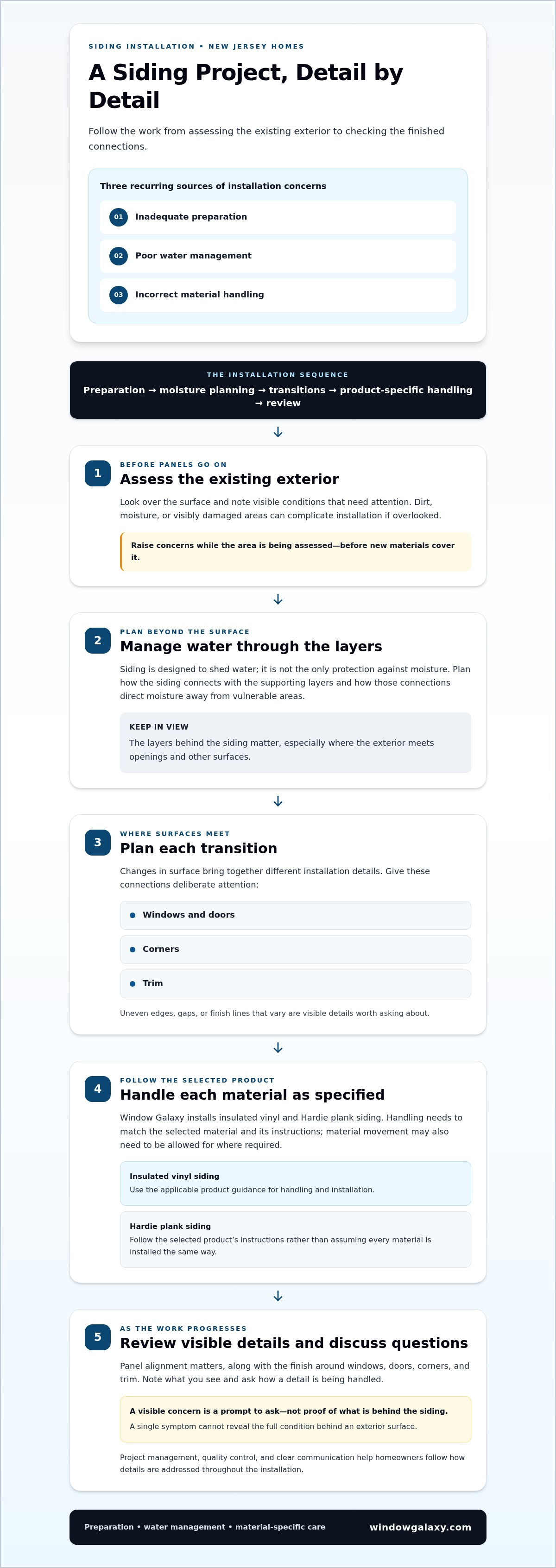
Many installation concerns relate to inadequate preparation, poor water management, or incorrect material handling. Preparation means assessing the existing surface before installation. Water management means planning how the siding and the layers behind it work together to direct moisture away from vulnerable areas. Material handling means following the instructions for the selected product and allowing for movement where required.
Pay particular attention to transitions, where siding meets windows, doors, corners, and trim. These junctions bring together different surfaces and installation details, so they need deliberate planning. New Jersey homes vary in layout, existing exterior condition, and selected material, making project-specific planning more useful than broad assumptions about local conditions.
Reliable siding work starts with sound preparation, manages water at the layers and connections, and handles each material according to its instructions. Window Galaxy’s project management, quality control, and clear communication help homeowners follow how these details are addressed throughout a siding installation.
How Poor Preparation and Water Management Create Siding Installation Problems
Preparation starts before the first panel is fitted. It includes assessing the existing exterior, noting visible areas that need attention, and planning how the new siding will meet openings, corners, and trim. If a concern is covered before it is understood, it may be harder to assess the exterior later.
Start with the existing exterior
The surface beneath new siding matters. Dirt, moisture, or visibly damaged areas can complicate installation if overlooked. A careful project plan accounts for observable conditions before work proceeds and how the installation will address them.
A mark or uneven area does not prove structural damage, and a photograph or single symptom cannot reveal the full condition behind an exterior surface. Note what you see and raise it while the existing siding is being assessed. Discussing concerns before new materials cover the area makes it easier to focus on the same detail.
Plan for water beyond the siding surface
Siding helps shed water, but it is not a waterproof barrier on its own. The details behind and around it matter, especially where the exterior meets windows, doors, and other openings. Water-management planning considers how the siding connects with the layers beneath it and how those connections direct moisture away from vulnerable areas. Exact installation methods depend on the product and its instructions.
Look closely at transitions. Uneven edges, gaps, or finish lines that vary around a window, corner, or trim board are visible details worth asking about. They do not reveal what is behind the siding, but they can prompt a practical discussion about how the connection is being finished.
Transitions deserve attention because changes in surface bring together details that need to work as one exterior system.
Use preparation and product guidance together
New Jersey homes differ in their existing exterior conditions, layouts, and siding materials, so installation planning should reflect the specific project. For vinyl siding, the Vinyl Siding Institute installation manual offers material-specific guidance. Following the applicable manufacturer instructions keeps handling and installation aligned with the product.
These steps cannot guarantee that an exterior will never need attention, but they give homeowners a clear way to follow the work: understand what is being assessed, notice how openings and trim are addressed, and raise questions as the project progresses. Window Galaxy manages siding installation projects with an emphasis on communication, so homeowners can discuss preparation and water-management details along the way. Learn about Window Galaxy siding installation.
Material-Specific Siding Installation Mistakes: Vinyl and Hardie Plank
Some installation concerns apply to any siding project, but the right handling depends on the material. A detail that matters for insulated vinyl siding may not apply in the same way to Hardie plank. Installation should follow the instructions for the specific product rather than rely on the same assumptions for every exterior.
Common siding installation mistakes homeowners can watch for include uneven layout, poorly finished transitions, and inconsistent work across a wall. These observations can help you raise questions, but they do not establish what caused an issue or whether the installation is incorrect.
Consideration
What to keep in mind
Shared concerns
Consistent alignment, careful preparation, and neat connections at openings, corners, and trim matter across materials.
Insulated vinyl siding
Fit and material movement should follow the applicable product instructions. Homeowners may notice uneven courses or gaps that vary along a wall.
Hardie plank siding
Cutting, fastening, and joint details should follow the applicable product instructions. Consistent plank layout and clean transitions contribute to a uniform finish.
Insulated vinyl siding: fit and movement
Vinyl siding needs to be installed according to the product’s handling and movement guidance. Overly tight or inconsistent fitting can be a concern, but there is no universal measurement for every product. Exact clearances and fastening details depend on the instructions for the siding being installed.
From the ground, look for courses that appear uneven or gaps that change noticeably from one area to another. These are observations to document, not a diagnosis. Ask how the material’s fit and layout are being managed.
Hardie plank siding: cuts, fastening, and layout
For Hardie plank siding, cutting methods, fastening, and joint details must follow the applicable product instructions. Homeowners do not need to assess technical specifications themselves. Instead, look at whether plank lines appear consistent and whether edges meet trim and openings with a tidy, considered finish.
For both materials, visible details need to be considered in context. Window Galaxy’s project management and quality control keep material-specific considerations in view, while clear communication gives homeowners a way to discuss observations as the work progresses.
How to Spot Siding Installation Mistakes During a New Jersey Project
You do not need to diagnose what is behind the siding to follow a project with confidence. Focus on visible workmanship, progress on the agreed project areas, and whether your questions receive clear answers. These practical checkpoints can help keep the conversation organized without relying on assumptions about local requirements.
Use this checklist from planning through the final walkthrough:
- At planning: Review which areas are included in the project and note visible concerns you want to discuss. Ask how the work will account for the home’s layout and selected siding material.
- As installation progresses: Look for consistent courses and an orderly layout. Notice how the siding meets windows, doors, corners, and trim. Document uneven edges or varying finish lines, but do not assume they establish the cause of a concern.
- Observe project organization: Notice whether materials and the work area appear orderly. If something is unclear, raise the question early through Window Galaxy’s project communication process.
- At the final walkthrough: Review the overall appearance, trim transitions, and completion of the agreed project areas. Point out details that differ from your expectations and ask for an explanation.
What to observe as work progresses
Step back periodically to view the exterior as a whole, then look at individual transitions from a safe vantage point. Are the lines generally consistent? Do edges around openings and corners appear orderly? Write down specific locations and questions instead of trying to determine whether a hidden layer or building component is at fault. Photos can help you remember what you noticed and explain your concern clearly.
Common siding installation mistakes can be difficult to judge from appearance alone. A visible irregularity is a prompt for conversation, not proof of an installation failure. Window Galaxy’s project management and customer communication give homeowners a way to raise observations and understand the work as it progresses.
What to review at the final walkthrough
Look across the completed areas and around trim, windows, doors, and corners. Compare the finished work with the agreed project scope. If a detail is unclear or does not match what you expected, describe what you see and ask how it was addressed. A calm, specific discussion helps everyone focus on the same detail.
For more information about Window Galaxy’s exterior projects, explore Window Galaxy siding services.
How Window Galaxy Helps Prevent Common Siding Installation Mistakes
A carefully managed siding project gives homeowners a clearer view of what is happening and a straightforward way to raise questions. Window Galaxy USA emphasizes quality control, project management, and clear customer communication. These practices keep project details in view, from discussing the selected siding to addressing questions about visible work as it progresses.
Common siding installation mistakes can involve different parts of the job, from preparation and material handling to transitions around openings and trim. Project management helps organize the work and maintain attention to those details. It cannot guarantee that no issue will occur, but it supports a deliberate process and gives homeowners a clear point of connection throughout the project.
A managed process keeps project details visible
Good communication works both ways. Homeowners should have room to explain their priorities, ask what a project stage involves, and raise an observation while the work is underway. Clear responses help set expectations and make it easier to discuss details before they become a source of confusion.
Window Galaxy USA’s focus on project management and quality control provides a practical framework for keeping the work organized. Homeowners do not need to judge hidden layers or technical installation details on their own. The conversation can stay grounded in the project, the chosen material, and what they can observe. Window Galaxy USA installs insulated vinyl siding and Hardie plank siding, following product-specific instructions for each material.
Make communication useful by keeping a short list of priorities and noting questions as they arise. If a trim transition looks different than expected, describe its location and ask for an explanation. This gives everyone a clear detail to discuss without assuming a visible difference proves an installation problem.
Discuss your siding project with Window Galaxy USA
Before discussing your project, consider what matters most to you: the overall appearance, the areas being updated, or how the finished siding meets windows, doors, and trim. Bring your questions about the project details. A two-way conversation helps you understand what to expect and share concerns clearly.
Knowing what to watch for is a useful first step. Pair that knowledge with attentive project management and open communication to take part in the process with greater confidence. Talk with Window Galaxy USA about your siding project.
Move Forward With Confidence on Your Siding Project
Recognizing common siding installation mistakes can help you follow a project with confidence. Look beyond panel alignment: preparation, water management, material-specific handling, and transitions around openings all deserve attention. Visible concerns are a reason to ask clear questions, not proof of what is happening behind the siding.
Window Galaxy installs insulated vinyl siding and Hardie plank siding, following product instructions for each material. The company emphasizes quality control, project management, and customer communication, helping homeowners stay informed and raise questions throughout the process. A conversation about your priorities and the details you have noticed is a practical place to begin.
Talk with Window Galaxy about your siding project and discuss the next steps for your home. Clear communication and careful project oversight help you approach the work feeling prepared.
Frequently Asked Questions
What are the most common siding installation mistakes?
Common siding installation mistakes include inadequate surface preparation, poor moisture management, incorrect fastening or material handling, and careless transitions around windows, doors, corners, and trim. These issues can affect appearance and how the siding system performs as intended. The right approach depends on the material and project conditions. Window Galaxy installs insulated vinyl siding and Hardie plank siding, with attention to product instructions and the details of the home’s exterior.
How can you tell if siding was installed incorrectly?
Uneven courses, inconsistent gaps, or untidy edges around windows, doors, corners, and trim are signs worth asking about. They do not prove that the siding was installed incorrectly or reveal what is behind it. Note the location and describe what you see to the project team. A clear explanation can help you understand the visible detail without diagnosing hidden layers or assuming one irregularity has a particular cause.
What happens if siding is installed incorrectly?
Incorrect installation can affect the siding’s appearance and how the exterior system performs. Depending on the issue, panels may look uneven or may not remain properly secured. Poor moisture management can also allow water to reach materials behind the siding. The outcome depends on the installation detail and the home’s conditions. A visible concern alone cannot establish the cause, so document what you notice and discuss it through the project communication process.
Does siding need room to expand and contract?
Some siding materials, including vinyl, need to be installed in a way that accommodates material movement. The required fit, clearances, and fastening approach depend on the specific product’s instructions, so one measurement does not apply to every installation. Hardie plank siding also has product-specific handling and installation requirements. Ask how the selected material’s instructions guide the work without needing to assess technical details yourself.
Can siding be installed over existing siding?
Whether new siding can go over existing siding depends on the exterior’s condition, the selected product’s instructions, and the project plan. Assess the existing surface before installation, since covering unresolved concerns can make the exterior harder to evaluate later. A photograph or single visible symptom cannot establish the condition beneath the surface. Discuss the existing siding and planned approach with Window Galaxy as part of the project conversation.
What should I check during a siding installation walkthrough?
Review the overall alignment, trim transitions, and completion of the areas included in the project. Look at how the siding meets windows, doors, and corners, and note any finish lines or gaps that seem inconsistent. These are observations, not proof of an underlying problem. Write down questions and their locations, then discuss them with Window Galaxy during the walkthrough to understand how the details were handled.
Are siding installation mistakes different for vinyl and Hardie plank siding?
Some concerns are shared, such as poor preparation, inconsistent layout, and untidy transitions. Others depend on the material. Vinyl siding installation needs to account for the product’s movement and fit, while Hardie plank installation calls for product-specific attention to cutting, fastening, and joints. Exact methods vary by product. Window Galaxy installs both insulated vinyl siding and Hardie plank siding, with applicable instructions guiding material-specific details.


