

What if the fog on your window isn’t on the surface at all? If you’re wondering how to know if window seals are broken, start by checking where the moisture sits. Condensation on the room-side or outdoor glass may wipe away. Haze or droplets that appear trapped between panes can’t be reached from either side and may point to a failed seal.
It’s understandable to worry that a damaged seal could affect your home’s comfort or mean you need a new window. But one cloudy patch alone doesn’t tell the whole story. A careful look can help you distinguish surface condensation from signs that deserve closer attention.
This guide explains what to look for, how to inspect a window safely, and what to record as you monitor changes. You’ll also learn how clues such as persistent moisture, a hazy view, or a draft near the frame may point to different concerns. With those observations in hand, you can decide whether to keep monitoring the window or consider an assessment and, if appropriate, window replacement.
Key Takeaways
- To understand how to know if window seals are broken, look for persistent haze or moisture that seems trapped between the panes.
- A sealed space between panes helps protect the insulated glass unit from outside moisture. Changes in that space can be a clue to investigate.
- Inspect both accessible glass surfaces and note whether haze remains after cleaning, so surface residue is less likely to be mistaken for a seal issue.
- Record which window is affected and how its appearance changes. An assessment can help clarify whether the concern involves the glass unit or the wider window.
- If replacement is appropriate, Galaxy Home Remodeling installs energy-efficient Galaxy vinyl windows.
How to Know If Window Seals Are Broken: Signs to Look For
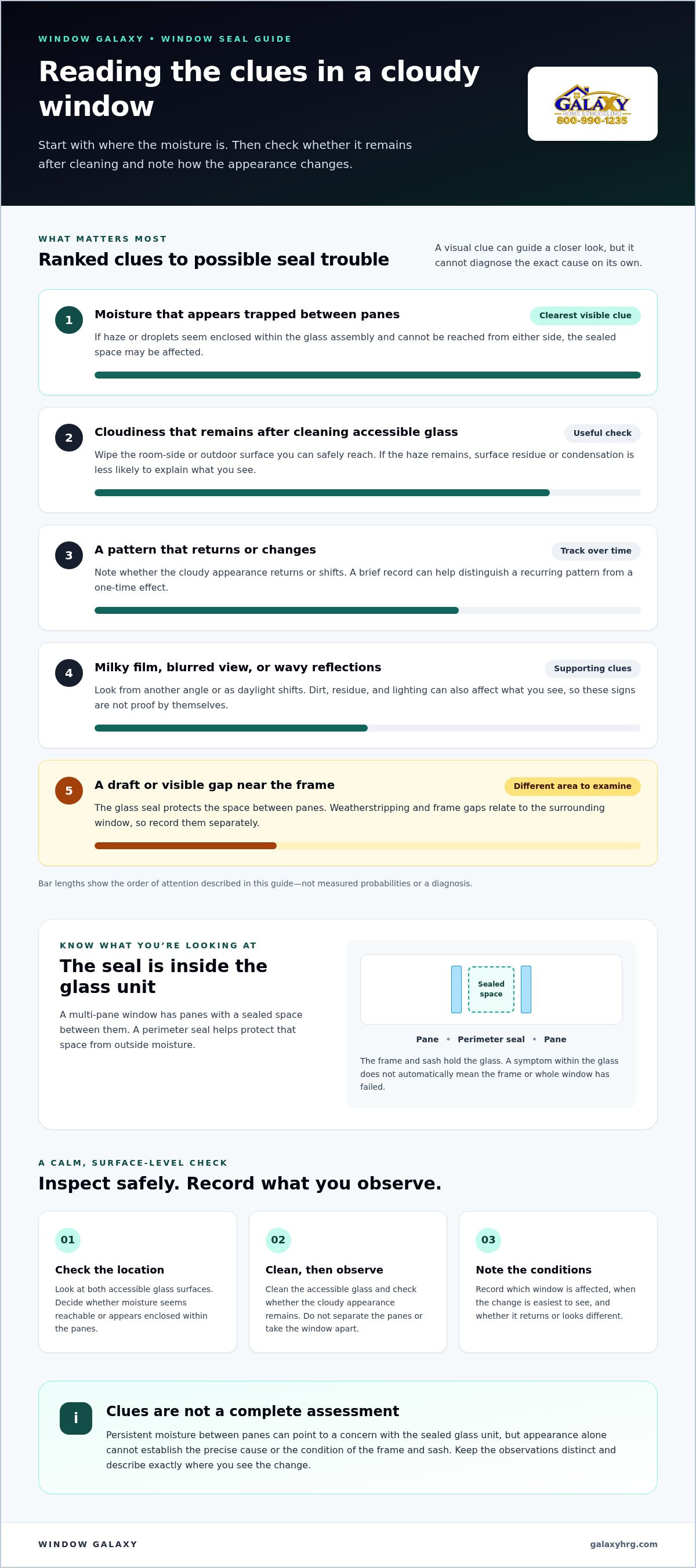
Persistent haze or moisture that seems trapped between glass panes is the clearest visible clue of possible window seal failure. Check its location: droplets on the room-facing surface may wipe away with a soft, dry cloth. If the cloudiness remains after you clean the accessible glass and appears to be within the unit, the sealed space may be affected.
A broken window seal is a failure of the barrier that protects the sealed space between panes of insulated glass. That explains why the location of the moisture matters, but appearance alone can’t confirm the exact cause. Treat what you see as a reason to observe more closely, not as a definitive diagnosis.
Fog or moisture between window panes
Look through the glass at the haze or droplets from different positions. Moisture on the room-facing surface should be reachable from inside. Moisture between panes appears enclosed within the glass assembly, beyond either accessible surface. Don’t try to separate the panes or take the window apart to investigate.
Cleaning the surface can help rule out ordinary residue or condensation. If the cloudy appearance remains, note it and check whether it returns or changes. This visual sign can suggest a concern with the sealed glass unit, but it doesn’t reveal the precise cause on its own.
Other visible changes that may raise concern
A persistent milky film, a blurred view, or reflections that look wavy or uneven may also warrant attention. These changes can be easier to notice as daylight shifts or when you view the glass from another angle. They are clues, not proof: dirt, surface residue, and lighting can affect what you see.
Make your observations more useful by noting the window’s location and how the glass looks under different conditions. A brief record can help you tell a recurring pattern from a one-time effect.
- Write down whether the haze or moisture appears on a surface or within the panes.
- Note whether it remains after you clean the accessible glass.
- Record when the change is easiest to see, such as in direct light or from a particular viewing angle.
Keep the glass seal distinct from the materials around the frame. Weatherstripping is used around moving parts or frame gaps, while the seal discussed here protects the space between panes. A visible gap around the frame and haze inside the glass point to different areas to examine. Recording exactly what you notice can help guide the next step.
What a Window Seal Does, and What Changes When It Fails
A multi-pane window is made up of more than separate sheets of glass. The panes and the sealed space between them form an insulated glass unit, often shortened to IGU. A perimeter seal closes around that space and helps protect it from outside moisture. The enclosed space may contain air or gas, depending on the unit. In either case, the seal helps create a contained layer between the panes.
The sealed glass unit is the pane assembly, while the frame and sash are the parts that hold and move it within the window opening. This distinction matters because a symptom within the glass doesn’t automatically mean the frame or the whole window has failed. Different components have different roles, so describe the area where you see a change as clearly as possible.
How the sealed space between panes works
At the edge of an insulated glass unit, a spacer keeps the panes apart, and the perimeter seal closes the space around them. Together, these parts help maintain separation between the glass surfaces and limit moisture entering the enclosed area. Some units use gas in that space, but you don’t need to know its contents to understand the seal’s basic job.
The seal isn’t the same as material around the window frame. It protects the space inside the glass assembly rather than closing gaps between the window and the surrounding opening.
What a failed seal can and cannot tell you
If the seal is compromised, outside moisture may enter the space between panes. Haze or moisture there is consistent with a seal problem, but it doesn’t tell you why the seal changed or whether other window components are affected. A cloudy appearance can have other explanations, too, so don’t treat one visual clue as a complete assessment.
Think of what you see as evidence about one part of the window. It can help you explain the concern, but it can’t establish the condition of the frame, sash, or entire assembly by itself. Knowing how to know if window seals are broken means distinguishing the glass unit from the surrounding window and documenting the symptom clearly.
- Glass unit: The panes, spacer area, and perimeter seal.
- Frame and sash: The structure that holds the glass and, for an operable window, allows it to open or close.
If an assessment points to broader window concerns or replacement is appropriate, Galaxy Home Remodeling professionally installs energy-efficient Galaxy vinyl windows. A dedicated project manager, hands-on quality control, and ongoing communication guide replacement projects. Learn about Galaxy window replacement as a possible next step for a window that needs attention.
How to Check a Window for Seal Failure Without Misreading Condensation
A calm, surface-level check can help you describe what you see without taking the window apart or treating one cloudy patch as a diagnosis. The goal is to find out whether the moisture is on an accessible glass surface or appears to remain within the sealed glass unit. You don’t need special tools. Don’t press on the glass or force any part of the window.
A simple visual inspection sequence
Use this sequence to make your observations clearer and easier to share:
- Look at both accessible surfaces. From a safe position, inspect the room-facing glass, then view the outside surface only if you can do so without leaning out or climbing. If it’s unsafe or out of reach, don’t try to access it.
- Note where the moisture appears. Surface droplets or residue may be reachable from one side. Haze that seems enclosed between the panes may remain visible even when both accessible surfaces are clean.
- Clean gently and look again. Use a soft cloth on accessible glass, following any care guidance for the window. Don’t scrape, push, or use tools to probe the pane or its edges.
- Observe under different light. Check the glass from a safe position as daylight changes or from another normal viewing angle. A reflection or haze can look more noticeable in certain lighting, so compare observations rather than relying on one quick glance.
- Record what you find. Note the window’s room or location, what the moisture looks like, which surface you cleaned, and whether the haze remained. Photos can help show a recurring change, especially when taken from a similar position.
Moisture that still appears between panes after you’ve cleaned the accessible surfaces warrants further assessment. This is a useful reason to seek a closer look, not proof of a specific cause. A visual check can help identify and document a symptom, but it can’t determine the condition of every part of the window.
When condensation may be a separate issue
Moisture on the room-facing glass is on the surface inside your home. If it wipes away, that observation alone doesn’t establish that the seal between panes has failed. By contrast, haze that appears enclosed within the glass and remains after surface cleaning may point to a concern with the sealed unit. The location is the key distinction.
Conditions can change, so note whether surface moisture comes and goes or whether the same cloudy area remains after cleaning. For more context on moisture forming on glass surfaces, see the article about condensation on windows. If you’re still unsure how to know if window seals are broken, keep your notes and photos. They’ll help explain what you observed during an assessment.
What to Do After You Spot Possible Window Seal Damage
Once you’ve noticed a recurring change, focus on collecting clear observations instead of trying to diagnose the window. A short record can help distinguish a concern with the insulated glass unit from one involving the wider window. You don’t need to decide what has failed before arranging a closer look. Describe what you observed and let the condition of the window guide the next step.
Information to note before arranging an assessment
Record the window’s location, what the haze or moisture looks like, and when it’s easiest to see. Note whether you cleaned the accessible glass and whether the symptom remained. Keep the description factual: “cloudy patch still visible after cleaning” is more useful than a definite diagnosis based on appearance alone.
- Identify the room and which window is affected.
- Describe whether moisture appears on a glass surface or within the panes.
- Note whether the appearance changes with light, viewing angle, or cleaning.
- Save dated photos if they help show a recurring or changing symptom.
This information gives you a useful starting point for a conversation or assessment. If several windows show changes, record each one separately rather than assuming they share the same cause. A clear account for each window helps keep the focus on what can actually be seen.
Understanding possible repair or replacement routes
Possible next steps depend on which part of the window is affected. If the concern appears limited to the insulated glass unit, an assessment may consider addressing that unit. If the frame, sash, or wider assembly also has concerns, replacing the full window may be considered instead. These are different approaches, and visible haze alone can’t establish which one fits.
Keep the distinction in mind: an observation can raise a question, but it doesn’t determine the solution. A closer assessment can help clarify the condition of the glass unit and surrounding window, then inform whether further monitoring or replacement is appropriate. Avoid applying sealant or trying to open the unit yourself. That won’t establish the cause and may complicate evaluation.
If the assessment indicates that window replacement is appropriate, Galaxy Home Remodeling installs energy-efficient Galaxy vinyl windows. Its replacement projects are managed with a dedicated project manager, hands-on quality control, and ongoing communication. The company is licensed and insured. Explore professional window replacement as a possible next step for a window that needs attention.
When Window Replacement May Be the Next Step, and How Galaxy Helps
A possible seal issue doesn’t automatically mean the entire window needs replacing. The next step depends on what an assessment finds. If concerns extend beyond the insulated glass unit, or the window is otherwise a candidate for replacement, a new window may be worth considering. Your observations can start the conversation, but they can’t determine the condition of the full assembly on their own.
If you’re still sorting out how to know if window seals are broken, focus on what you can establish: where the symptom appears and whether there are broader concerns with the window. A measured decision helps you consider replacement when it’s appropriate, rather than assuming every cloudy pane calls for the same response.
How Galaxy Home Remodeling manages window replacement
Galaxy Home Remodeling professionally installs energy-efficient Galaxy vinyl windows for residential homeowners in its Mid-Atlantic service area. Each replacement project has a dedicated project manager, providing a clear point of communication as the work moves forward. Hands-on quality control and ongoing communication are part of the company’s approach, so homeowners stay informed throughout the project.
Galaxy’s crews are licensed and insured. The company offers advice to help homeowners discuss their concerns and understand whether replacement is a suitable next step. A discussion about replacement can help address the window needs identified for the home, but a visual symptom alone doesn’t establish the cause of a seal issue.
A clear next step for homeowners
Before discussing replacement, gather the notes and photos you’ve made about the window. Share what you’ve observed, including whether the concern seems limited to the glass or whether you’ve noticed other changes. That context helps keep the conversation specific and gives the project team a clearer picture of what matters to you.
Galaxy supports homeowners through replacement with a dedicated project manager, careful quality oversight, and communication along the way. You can discuss the window concern and get advice before deciding whether replacement is appropriate. If it is, Galaxy can help you consider its professionally installed window options and plan the project around your home’s needs.
Homeowners in Galaxy’s Mid-Atlantic service area who are ready to discuss a replacement can contact Galaxy Home Remodeling. There’s no need to decide what caused the symptom before reaching out. Start with what you’ve noticed and use the conversation to understand whether a new window is the right path forward.
Take the Next Step With Confidence
You don’t have to identify the exact cause of a cloudy pane before deciding what to do. If a window’s appearance keeps concerning you, use your observations to start a conversation about whether replacement makes sense for your home. A careful, informed next step can help you move forward without rushing into a decision.
Galaxy Home Remodeling has a 4.8-star average on Google from 407 reviews. If you’re considering replacement, you can discuss your window concerns with the team and explore the options available for your project. Knowing how to know if window seals are broken can help you describe what you’ve noticed, while an assessment can help clarify whether replacement is appropriate.
Discuss your window replacement options with Galaxy Home Remodeling. Start with what you’ve observed and take the next step when you’re ready.
Frequently Asked Questions
Can a broken window seal be repaired without replacing the whole window?
Yes, a failed seal doesn’t automatically mean the entire window must be replaced. Depending on the unit’s construction and the window’s overall condition, a possible response may focus on the insulated glass unit, or replacement of the full window may be considered. For example, a concern limited to the glass may lead to different options than damage affecting the surrounding assembly. An assessment helps determine which route fits.
How long can you leave a window with a broken seal?
There’s no single timeframe that applies to every window. A visible symptom may stay much the same or change, and its appearance alone can’t show the condition of the full window. Keep a record of changes, such as haze becoming more noticeable or new visible damage appearing. If the symptom persists or you’re concerned about how the window performs, arrange an assessment rather than relying on a fixed wait period.
Can a broken window seal cause mold?
Moisture between panes doesn’t, by itself, establish that mold is growing in your home. It’s a sign associated with a possible issue in the sealed glass unit, while mold concerns depend on conditions beyond what you can see inside the glass. If you notice mold or ongoing dampness on nearby surfaces, treat that as a separate concern. Note where it appears and seek an appropriate assessment of the affected area.
Does a broken window seal mean the window is unsafe?
No, a foggy appearance alone doesn’t prove that the window is unsafe. It may suggest a concern with the glass unit, but it doesn’t establish the condition of the rest of the window. A cracked or loose pane is a different and more immediate visible concern. Don’t handle damaged glass or try to test whether it’s secure. Keep clear of the area and arrange a professional assessment of the specific damage.
Can you fix a foggy window by wiping the glass?
Wiping can clear moisture or residue on an accessible glass surface, but it won’t remove haze enclosed within the unit. Clean gently with a soft cloth, then check whether the cloudy area remains. Avoid scraping or pressing on the pane. If the appearance stays after cleaning, record what you observed and where it appears. That can help explain the concern, though the observation alone can’t confirm its cause.
Are window seals the same as the seal around a window frame?
No, they refer to different parts of the window. The seal around the insulated glass unit protects the space between panes; sealing at the frame concerns the connection between the window and its surrounding opening. As you describe a concern, note whether you see moisture on the glass, haze within the unit, or a visible issue near the frame. Identifying the location helps keep the assessment focused on the relevant area.
Can weather cause a window seal to fail?
Exposure to the elements and changes in temperature can place stress on window seals, but a symptom doesn’t reveal its cause. Age, installation, and other conditions may also be relevant. If the haze seems more noticeable after a change in weather, record that timing as an observation, not proof of what caused it. A closer assessment can consider the window’s condition without relying on appearance or timing alone.


