

A quote is an invitation to consider a project, not a commitment to accept it. To say no to a high-pressure quote, ask for the details you need, compare the proposal with your priorities, and give a clear, polite refusal if it doesn’t fit. You can take time to decide instead of agreeing under pressure.
It can feel uncomfortable to push back, especially when someone urges you to act quickly. A calm response helps protect your plans and lets you make a decision you feel confident about.
Learn how to ask for clarification, weigh the work against your goals, and respond when the pressure continues. You’ll also find simple ways to decline without overexplaining, and to stay firm while keeping the conversation respectful.
Key Takeaways
- Ask what the request involves and when a decision is needed before you respond.
- Weigh the proposal against your priorities, commitments, and project goals.
- If you feel rushed, give yourself time to consider your options before answering.
- Use a calm, direct refusal and repeat it politely if the pressure continues.
- Keep your response brief, and offer an alternative only if it genuinely works for you.
1. Asking for details before responding to a vague request
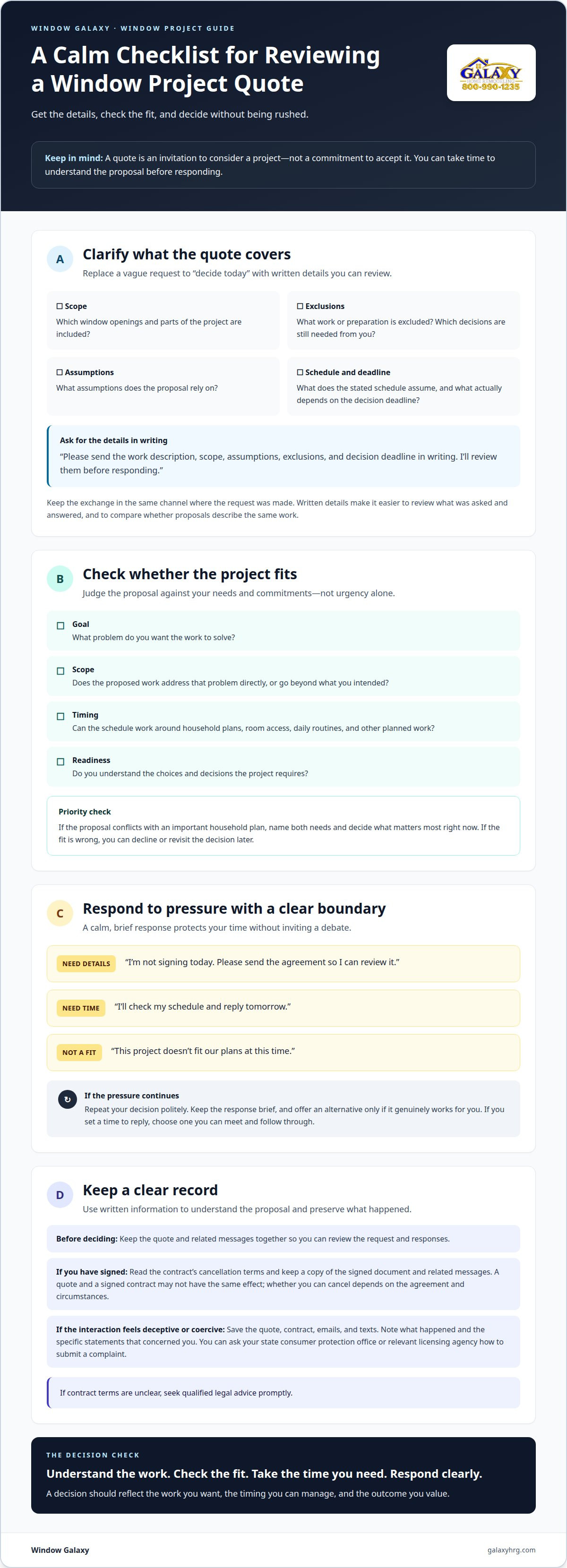
A contractor’s request to “decide today” doesn’t explain what you’re agreeing to. Before answering, ask what work the quote covers, what assumptions it relies on, and when a decision is actually needed. A clear timeline can help distinguish a genuine scheduling question from pressure to commit before you understand the proposal.
Ask for details through the same channel where the request was made. If the salesperson called, ask them to email the scope; if they texted, reply there and request the details in writing. Keeping the exchange together makes it easier to review what was asked and answered. For example: “Please send the work description and decision deadline in writing. I’ll review them before responding.”
Ask specific questions to clarify gaps instead of agreeing to a vague summary. For a window project, ask which openings are included, what work is covered, and what the stated schedule assumes. Ask the salesperson to identify any exclusions or decisions still needed from you. These details make the proposal easier to understand and compare with other written proposals, without relying on a verbal summary.
- “Which parts of the project does this quote include?”
- “What work or preparation is excluded?”
- “What is the decision deadline, and what depends on it?”
- “Can you send the scope and any assumptions in writing?”
To get a written quote, ask for the complete scope, assumptions, exclusions, and schedule by email or another written format. Compare those elements across proposals to see whether they describe the same work, rather than focusing on a single summary.
To ask for time to review, say, “Please send the written details. I need time to read them, and I’ll respond after I’ve reviewed the scope.” If pressed for a deadline, ask what event or project decision makes that date necessary. You can acknowledge the request without agreeing on the spot.
If you’ve signed, read the contract’s cancellation terms and keep a copy of the signed document and related messages. Whether you can cancel depends on the agreement and circumstances, so don’t assume a quote and a signed contract have the same effect. If the terms are unclear, seek qualified legal advice promptly.
If a sales interaction feels deceptive or coercive, save the quote, contract, emails, and texts. Write down what happened, including the date and the specific statements that concerned you. You can contact your state consumer protection office or the relevant licensing agency to ask how to submit a complaint.
These steps help you keep a clear record before deciding. Knowing how to say no to a high-pressure quote starts with replacing urgency and vague promises with written details you can assess.
2. Assessing whether a request fits your priorities
A quote can describe useful work and still arrive at the wrong time. Before accepting, compare the proposed project with your household’s current needs, schedule, and goals. For example, if drafty rooms are your main concern, consider whether the quoted work addresses those rooms or includes changes you don’t need right now. Clear priorities help you judge the fit without being swayed by urgency alone.
Separate essential outcomes from preferences. Write down what prompted you to seek a quote, such as a window that’s difficult to open or work you’re planning before a room renovation. Then consider whether the proposal addresses that goal directly. If the work goes beyond what you intended, ask whether those additional elements support a priority or simply make the decision harder.
Consider the practical demands on your household. A project may affect room access, daily routines, or the timing of other planned work. If a family member works from home, for instance, ask whether the proposed schedule would conflict with calls or quiet hours. A quote that fits your goals should also work with the commitments already on your calendar.
- Goal: What problem do you want the work to solve?
- Scope: Does the proposed work address that problem directly?
- Timing: Can the project fit around household plans?
- Readiness: Do you understand the decisions the project requires?
Use the same priority test when someone pressures you to decide quickly. If you’re already managing a full workload, ask a manager which existing deadline should move before accepting another task. The same principle applies at home: identify which planned commitment would need to change before agreeing to a project date. If the tradeoff doesn’t work, you can decline or ask to revisit the decision later.
Conflicting goals call for a pause, not an automatic yes. You may want to address a specific problem while preserving access to a room for an upcoming family event. Name both needs, then decide which matters most right now. If the quote doesn’t align with that priority, a brief response is enough: “This project doesn’t fit our plans at this time.”
Finally, distinguish your own reasons from the salesperson’s urgency. A deadline may sound decisive, but your decision should still reflect the work you want, the timing you can manage, and the outcome you value. If the proposal doesn’t meet those priorities, you can say no without judging the contractor or the quality of the proposal.
3. Responding to pressure
A pressured conversation can make a routine decision feel urgent. Slow things down with one clear boundary, then choose your next step. You might say, “I’m not signing today. Please send the agreement so I can review it.” This acknowledges the request without promising to accept or debating your reasons.
If you need time because of a family commitment or a busy schedule, use a specific holding phrase: “I’ll check my schedule and reply tomorrow.” Choose a time you can meet, then follow through. If you don’t want the project, say so directly instead of implying you may reconsider.
In the United States, pressure alone doesn’t establish what rights apply to a quote or signed agreement. Read the written terms, keep a copy, and seek guidance from a qualified attorney or state consumer protection office about your situation.
Look for sales behavior that interferes with an informed choice. Warning signs include refusing to explain a document, repeatedly interrupting your questions, or insisting that you sign before reading. A salesperson may also dismiss your request to discuss the proposal with another household decision-maker. Note the exact words and actions rather than relying only on a general impression.
If the salesperson keeps pushing, try a short, repeatable response: “I understand you want an answer, but I’m not ready to sign.” If they continue, end the conversation: “I’m ending this meeting now. Please communicate with me in writing.” You don’t have to keep explaining after stating your decision.
If you feel uncomfortable during an in-person meeting, pause the discussion and move somewhere you feel at ease. You can say, “I need to stop here. Please leave the documents with me.” If another household member is present, agree beforehand that either of you can call for a break when the conversation becomes difficult.
If you paid a deposit under pressure, save the receipt, signed paperwork, and messages, then contact the business in writing. Ask for the deposit terms and the steps for cancellation or a refund under your agreement. Keep the response with your records. If the terms remain unclear, ask a qualified legal professional or state consumer office what options apply.
Pressure can continue through calls or texts after the meeting. Choose one channel for your reply, state your decision, and keep a copy. For example: “I’m declining the proposal. Please stop contacting me by phone and send any necessary follow-up in writing.” A direct message gives the conversation a clear endpoint.
4. Staying firm when someone applies pressure
When a salesperson repeats the same request, you don’t need a new reason each time. Repeat your decision politely and firmly: “I understand you’d like me to sign, but I’m declining.” A steady response keeps the conversation focused on your answer, not on finding a weakness in your explanation.
Prepare a short response before a follow-up call or meeting. Choose one sentence for your decision and another for ending the discussion. For example: “I’m not moving forward. I’m ending this conversation now.” Practicing those words aloud can make them easier to use if the salesperson interrupts or changes the subject.
Avoid giving reasons you don’t want to debate. Saying, “I can’t decide because I need to talk with my family,” may invite another attempt to persuade you. If your decision is final, say, “I’ve decided not to proceed.” If you genuinely need input, name the next step without promising acceptance: “I’ll discuss it with my family and contact you if we want to continue.”
- Repeat the same decision without raising your voice.
- Don’t answer a new sales argument with a new explanation.
- End the call or meeting if the conversation ignores your boundary.
- Ask someone you trust to be present if you expect a difficult discussion.
Separate a genuine change in your decision from pressure to reconsider. If a new written detail answers a concern, you can choose to review it. But a repeated claim that an offer is available “only right now” doesn’t require you to change your mind immediately. Say, “I’ve heard your point, and my decision remains the same.”
If the salesperson makes your refusal feel rude, return to your decision instead of defending your character. You might say, “I appreciate your time, but I’m not proceeding.” Courtesy doesn’t require agreement, a lengthy explanation, or continued discussion after you’ve clearly declined.
For a household decision, agree on a shared phrase before the next conversation. One person can say, “We’re not making a decision today,” while the other avoids contradicting that boundary under pressure. If one person wants to reconsider later, discuss it privately after the meeting, not while someone is urging an answer.
After a difficult conversation, write down the date, what was said, and whether you clearly declined. If another call comes, use your prepared sentence again rather than reopening the decision. A calm, repeated refusal helps you stay consistent without turning a simple no into an argument.
5. What exact phrases can I use to say no without explaining why?
A useful refusal is direct, brief, and in your own voice. Try, “I’ve decided not to move forward with this proposal.” That answers the contractor without blaming them or inviting discussion of your personal reasons. You can use the same wording by phone, email, or text.
Use an “I” statement to keep the focus on your decision. “I’m not comfortable signing today” states your limit without accusing the salesperson of wrongdoing. If your decision is final, make that clear. “I’m declining the proposal” is less likely to invite more persuasion.
- “I’m not moving forward with this project.”
- “I’ve decided this proposal isn’t right for me.”
- “I’m declining, and I don’t want to discuss it further.”
- “Please record that I’m not proceeding.”
- “I’m not ready to make a decision, so I won’t sign today.”
Choose a phrase that matches your actual decision. If you’re still considering the work, say, “I need more time before deciding.” If you’ve decided against it, avoid “maybe later” unless you want the contractor to follow up. Clear wording helps prevent an unintended invitation to continue the sales conversation.
You don’t need to give a long explanation. Reasons such as “I need to ask my family,” “I’m busy this week,” or “I’m unsure about the schedule” can invite the salesperson to address each objection. A concise response leaves less room for negotiation: “I’ve made my decision, and I’m declining.”
For a text message, keep the refusal short and complete. For example: “Thank you for the proposal. I’ve decided not to proceed.” If the salesperson asks why, reply, “I’m not discussing my reasons, but my decision is final.” You can end the exchange there.
If the salesperson keeps asking, repeat your original words instead of coming up with new explanations. Say, “As I mentioned, I’m not moving forward.” If the conversation continues, set an endpoint: “Please don’t call again about this proposal.” A calm, consistent reply helps protect your boundary without turning the refusal into an argument.
Before a call with a contractor, write one sentence on a note and keep it nearby. Read it if you feel pressured or lose your train of thought. A prepared line such as “I’m declining the proposal, and I’m ending this conversation now” gives you a clear way to finish respectfully.
A simple response keeps your boundary clear. Excessive explanation may weaken a refusal and leave room for negotiation, so you can stop once you’ve stated your decision.
Galaxy Home Remodeling
Galaxy Home Remodeling can help when your next home improvement priority involves windows or siding. Its offerings include Galaxy Vinyl Windows, Specialty Windows, Window Installation Services, and Hardie plank siding. If you’re considering one of these projects, clear communication and project management can help you understand the work involved and decide whether it fits your plans. You can share what matters most to your household and discuss the project scope without treating an initial conversation as a commitment. If your immediate concern falls outside these offerings, this may not be the right next step. For a window or siding project that aligns with your priorities, contact Galaxy Home Remodeling to discuss your needs.
Choose the Next Step on Your Terms
A clear decision gives you room to focus on the home improvements that matter to you. Saying no to a proposal that doesn’t fit isn’t a rejection of every future project. It keeps you in control of what happens next. Knowing how to say no to a high-pressure quote can help you approach a later conversation with clearer priorities and more confidence.
If you’re ready to explore a window project on your own terms, Galaxy Home Remodeling offers Galaxy Vinyl Windows and Specialty Windows. Start with the outcome you want for your home, then have a conversation centered on your needs rather than pressure to decide immediately. Take the next step when it feels right for you.
Contact Galaxy Home Remodeling to discuss your window project. Your next decision can be thoughtful, comfortable, and entirely your own.
Frequently Asked Questions
How can I build confidence in my ability to say no?
Confidence grows when you decide what you want to communicate before a conversation begins. Try rehearsing your refusal with someone you trust, or write it on a note beside your phone. For example, practice saying, “I’m not comfortable making this decision today.” Afterward, notice what helped you stay composed. Rehearsal makes the words familiar, so you can focus on your choice instead of searching for the perfect response.
How can I handle persistent requests after I've already said no?
Set a clear limit on further contact and keep a record of repeated messages. For example, send one written reply stating that you’ve declined and prefer no further calls about the proposal. Save subsequent messages rather than answering each one. If you’re receiving calls, you can silence or block the number. If the contact becomes threatening or makes you feel unsafe, seek help from someone you trust or local authorities.
Why is it hard to say no?
Saying no can feel difficult because you may worry about disappointing someone, appearing impolite, or missing an opportunity. A face-to-face sales meeting can intensify that discomfort, especially when the other person expects an immediate response. Separate courtesy from consent: you can appreciate someone’s time without accepting their proposal. Reminding yourself that a home project should fit your needs can help ground your decision.
What are polite ways to decline a high-pressure sales quote?
Learning how to say no to a high-pressure quote can start with a respectful sentence that makes your decision clear. Try, “Thank you for explaining the proposal, but I won’t be moving forward.” To close the exchange, add, “Please consider this my final decision.” You don’t need to criticize the salesperson or share personal details. Choose wording that sounds natural and reflects whether your decision is final.
How do I end a sales call or meeting when the seller won't take no for an answer?
State that the conversation is over, then take a practical step to end it. On a call, say, “I’ve made my decision. Goodbye,” and hang up. In a meeting, stand, gather your belongings, and say, “I’m ending this meeting now.” If you feel uneasy, move toward a public area or ask someone nearby for support. You aren’t required to keep debating after you’ve ended the conversation.


