

Lifetime window guarantees are real, but “lifetime” doesn’t always mean the homeowner’s lifetime. Some warranties marketed as lifetime coverage may end after 20 to 25 years, or sooner. The term can refer to the product’s life, the time the purchaser owns it, or the purchaser’s lifetime.
It’s reasonable to expect a lifetime promise to provide lasting protection. The details matter: coverage may apply to only certain window parts, while defects, installation issues, and maintenance problems may be treated differently.
This guide explains what “lifetime” can mean, which defects and maintenance problems may be excluded, and how selling your home can affect coverage. You’ll get a clearer picture of what a window warranty protects and what its limits mean in practice.
Key Takeaways
- Learn why glass, frames, installation, and labor may have different warranty terms, even when coverage is described as lifetime.
- See how ordinary wear, accidental damage, neglect, and clogged weep holes can affect a warranty claim.
- Understand why a warranty may change or end when a home is sold, and what transfer terms can mean for a new owner.
- Find out why the long-term value of coverage also depends on the availability of the manufacturer or installer.
- Explore how Galaxy Home Remodeling’s window installation services and window options can support a replacement project.
Are Lifetime Window Warranties Really Lifetime?
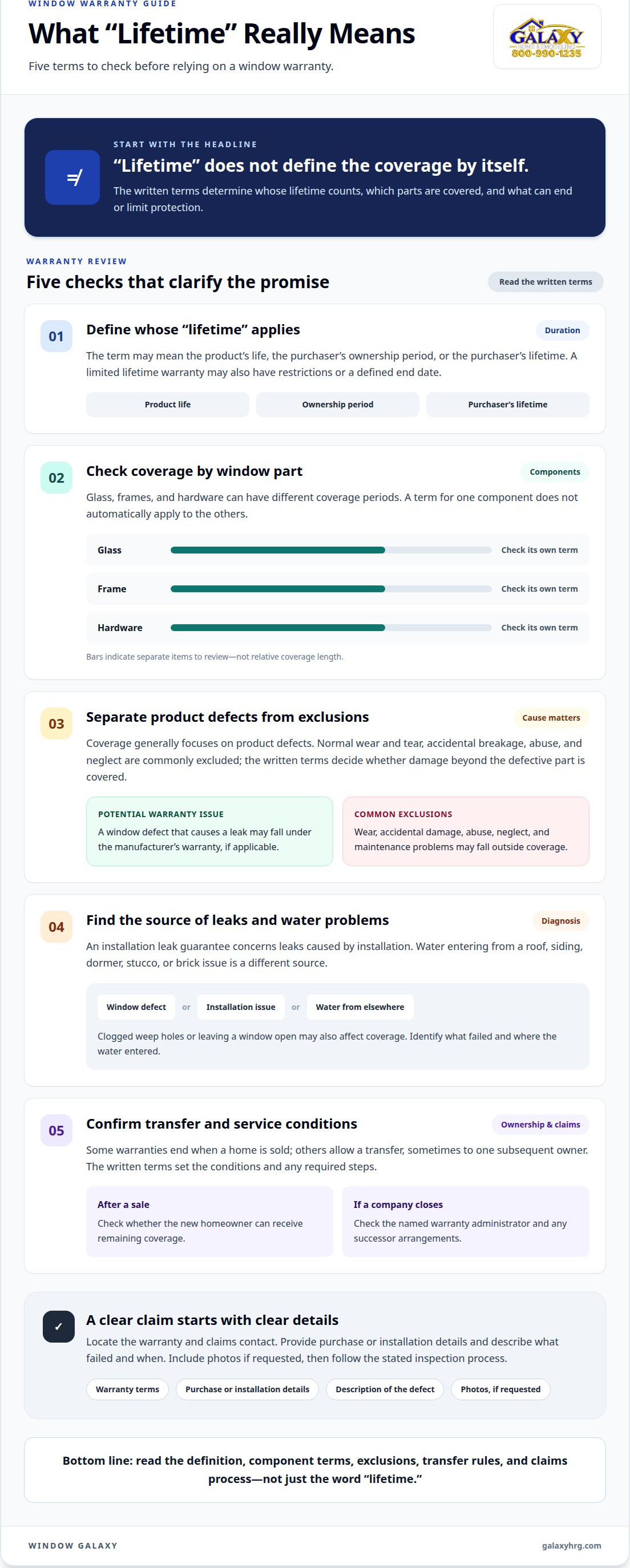
“Lifetime” doesn’t guarantee that every window part, installation issue, or repair will remain covered for as long as you own your home. The warranty’s definitions, exclusions, and claims process determine what the promise means in practice.
Coverage for Glass, Frames, and Hardware
Window warranties can assign different coverage periods to glass, frames, and hardware. Some advertised lifetime warranties last 20 to 25 years or less, and a 20- or 25-year term may apply to just one window element. That distinction matters: a frame term doesn’t automatically extend to glass, locks, or operating hardware. Read the coverage by component, not by the headline alone.
Commonly Covered Window Defects
Warranty coverage generally focuses on product defects, while normal wear and tear, accidental breakage, abuse, and neglect are commonly excluded. A window defect that causes a leak may fall under the manufacturer’s warranty, if applicable. Damage resulting from the leak is a separate question: the warranty terms determine whether coverage extends beyond the defective part.
An installation leak guarantee concerns leaks caused by installation, not water entering around a window because of a roof, siding, dormer, stucco, or brick issue. Leaving a window open or failing to maintain it, including allowing weep holes to clog, may also fall outside coverage. The leak’s source matters because a product defect and an installation problem involve different coverage.
To file a claim, identify the warranty and its claims contact, then provide the purchase or installation details and a clear description of the defect. Include photos if requested and follow the stated inspection process. Focus the claim on what failed and when. This helps distinguish a product defect from an installation, maintenance, or unrelated water-damage issue.
Warranty Transfers When Selling a Home
Transfer rules determine whether coverage continues for a new homeowner. Some warranties cover only the original purchaser and end when the property is sold; others allow a transfer, sometimes to one subsequent owner. This matters during a sale because a warranty described as lifetime may still depend on who owns the home. The written terms define transfer conditions and any required steps.
Manufacturer and Installer Business Continuity
There’s no useful average for how long window manufacturers and installers stay in business. Continuity depends on the individual company and, for warranty service, whether another entity assumes its obligations. If a manufacturer closes, the warranty alone doesn’t ensure claims will still be serviced. The named administrator and any successor arrangements determine the available claims route.
Business continuity also affects installation coverage. Some window warranties exclude labor because manufacturers usually aren’t involved in installation. A manufacturer may cover labor when it trained and certified the installers. If a leak appears, identify its source first. An inspection can help distinguish an installation issue from a window defect or water entering from elsewhere.
What “lifetime” means in window warranties
“Lifetime” describes a coverage period, but the warranty defines whose lifetime or which product life counts. That distinction affects how long homeowners can expect specific parts to remain covered.
Lifetime and Limited Lifetime Terms
A lifetime warranty uses “lifetime” as its coverage measure, while a limited lifetime warranty adds restrictions or defined terms. The FTC says “lifetime” may mean the product’s life, the purchaser’s ownership period, or the purchaser’s lifetime. This matters because a warranty may end when ownership changes, when the product reaches its defined life, or when a stated limit applies.
Some limited warranties expire within 5 to 25 years. A limited lifetime warranty for a lower-quality replacement window may last 4-5 years, while one for a higher-grade window may provide coverage for up to 50 years. These examples show why the label alone doesn’t establish a window’s coverage period.
Prorated Coverage and Time Limits
Prorated coverage describes a warranty benefit that changes over time, while a time-limited warranty ends after its stated period. The written terms determine which structure applies, so homeowners should look for a schedule showing how coverage changes and when it expires. The word “lifetime” alone doesn’t establish whether a claim is prorated.
Are lifetime window warranties prorated or limited by specific periods? They may have time limits, and the warranty terms determine whether benefits are prorated. For example, a limited lifetime warranty can set an end date rather than cover the window for the purchaser’s entire life. Read the duration and any benefit schedule together.
Comparing Warranty Terms
To compare warranty terms, examine the written coverage for each window component and the conditions attached. This matters because warranties described as lifetime can define that period differently. There’s no single duration across major window brands; each manufacturer’s written terms establish its coverage, limits, and exclusions.
Ask these practical questions while reviewing the documents:
- Does “lifetime” mean the product’s life, the purchaser’s ownership, or the purchaser’s lifetime?
- What periods apply to the frame, glass, and hardware?
- Does coverage change over time, and when does it end?
- Can a new homeowner receive the remaining coverage?
- Which conditions or maintenance issues can affect a claim?
So, are lifetime window guarantees real? They are real as written warranty commitments, but the scope and duration depend on the terms. If you’re planning a replacement, window installation planning can help connect window choices with project needs.
Exclusions for window defects and maintenance issues
A window warranty distinguishes covered product defects from damage caused by use, neglect, or outside conditions. That distinction matters when a replacement window leaks, glass breaks, or energy performance changes. The visible symptom alone doesn’t identify the cause. Coverage depends on what failed and the warranty’s stated exclusions.
Common exclusions include normal wear and tear, accidental breakage, abuse, and neglect. For example, a pane cracked by an impact may be treated differently from a defect in the glass itself. When a warranty uses broad terms like “damage,” the cause matters especially. The written terms define the boundary.
Maintenance can affect coverage too. Clogged weep holes, which help water drain from a window frame, can contribute to water problems. A warranty may exclude leaks caused by improper maintenance. Leaving a window open during rain is another example of homeowner error that may fall outside coverage.
Water near a window doesn’t prove the window itself failed. A leak from a roof, siding, dormer, stucco, or brick can appear around the opening without originating in the window. In that case, a window warranty or installation leak guarantee may not apply. Finding the source helps distinguish an unrelated building leak from a window problem.
Coverage also depends on whether the window or its installation caused the leak. A defect-related leak may fall under the manufacturer’s warranty, if applicable. An installation guarantee addresses leaks caused by the installation, not unrelated sources or homeowner error. These are separate responsibilities, so don’t assume one guarantee covers every water intrusion.
A claim diagnosis focuses on the problem’s location and cause. For example, water at the sill could relate to blocked drainage, a product defect, or water entering from nearby siding. An inspection can help identify which explanation fits. A claim consultation is most useful when you can describe the symptom, affected area, and maintenance history.
Energy concerns also need careful interpretation. A change in comfort or energy use doesn’t, by itself, establish a covered window defect. The warranty may address particular product failures rather than every change in household performance. Connect the concern to a specific component, such as the glass or frame, and compare it with the stated coverage and exclusions.
For a clear claim description, record the symptom, when it appeared, and any relevant event, such as an accidental impact or heavy rain. Note maintenance concerns, including clogged weep holes, instead of treating every leak as an installation failure. These details help distinguish covered defects from exclusions without assuming a visible leak has only one possible cause.
Are window warranties transferable when you sell your home?
Some window warranties transfer to a new homeowner, while others cover only the original purchaser and end when the home is sold. The word “lifetime” doesn’t settle the question. The written warranty defines whether coverage follows the window, stays with the first purchaser, or ends after a transfer.
For a buyer, transferability can affect the value of existing coverage. A warranty that remains active after a sale may protect against eligible window defects. A warranty tied to the original purchaser may offer no coverage to the next owner, even if its stated coverage period has time remaining. The purchaser and the window’s age are separate considerations.
Some warranties allow a transfer to one subsequent owner. Others permit a lifetime warranty to transfer under their own conditions. These differences matter in a sale: a homeowner shouldn’t assume the buyer inherits coverage automatically, and a buyer shouldn’t assume a document labeled “lifetime” applies to them.
Consider a home with windows installed by a previous owner. The warranty might allow one transfer, restrict coverage to the first purchaser, or apply only for a stated period after installation. Each scenario produces a different result for the new owner. The transfer clause, not the warranty’s headline, determines which applies.
Transfer terms may also set conditions for keeping coverage in force. The document may describe a notification process, deadline, or records needed to recognize a new owner. Some warranties require a transfer fee, but that condition is separate from the remaining coverage period. A transfer might also change coverage, so the new owner’s protection may differ from the original purchaser’s.
During a home sale, organize the window warranty with the property’s other records. Note the manufacturer, installation date, covered components, and any transfer language. These details help connect the warranty to the installed windows and show whether the new owner qualifies. If the document refers to an original purchaser, read that phrase alongside the transfer clause.
- Find whether coverage ends at sale or may transfer to a new homeowner.
- Identify how many transfers the warranty permits, if it states a limit.
- Review whether the transfer changes the coverage or its remaining term.
- Look for any stated notice, paperwork, deadline, or transfer fee.
For example, a warranty allowing transfer to one subsequent owner may cover the first buyer after the original homeowner, but not necessarily a later buyer. A warranty that ends at sale works differently, even if the window remains within its stated coverage period. These examples show why the exact terms matter more than a general “lifetime” label.
For sellers, clear warranty records help explain what may pass with the home. For buyers, the transfer language clarifies whether they can make a future claim. In both cases, distinguish the original purchaser’s coverage from the new owner’s rights, and use the written transfer terms as your guide.
Average lifespan of window manufacturers and installers
A single average lifespan can’t predict whether a manufacturer or installer will remain available throughout a window warranty. A manufacturer makes the product and sets its warranty terms; an installer performs the work and may have separate installation obligations. Those roles matter if a window develops a defect or a leak appears years later.
Business continuity affects who can respond to a warranty claim. If the manufacturer closes, the written warranty alone doesn’t explain who will handle future claims. The warranty may identify an administrator or describe what happens if another entity assumes its obligations. The claims route, for example, may depend on whether an administrator or successor exists.
An installer’s closure creates a different concern. A manufacturer’s product warranty and an installer’s workmanship or installation commitment are separate promises. If a leak appears around a window, identifying whether the issue came from the product or the installation helps determine which obligation may apply. A company’s continued operation can affect how easily the responsible party can address it.
Rather than relying on a general lifespan estimate, focus on terms and records that remain useful if a business changes or closes. The warranty should identify the responsible company, coverage administrator, claims process, and any transfer provisions. Keep it with the installation date and product details. Those records connect a later problem to the original work.
- Identify whether the manufacturer or installer handles each type of claim.
- Look for a named warranty administrator or successor arrangement.
- Keep the warranty and installation records together.
- Distinguish a product defect from an installation problem when describing an issue.
For example, if a sash develops a product defect, the manufacturer’s warranty may govern. If water enters because of installation work, the installer’s separate commitment may be relevant. If either business has closed, the documents can show whether another entity is assigned to manage claims. The cause and the named responsible party both shape the next step.
These distinctions help homeowners assess what a long coverage period means in practice. A warranty can promise coverage for a stated term, but the claims process depends on the responsible party and any written continuation arrangements. That’s why the company’s role, the warranty administrator, and the installation records deserve attention alongside the coverage duration.
For a replacement project, discuss window installation options and how the work fits your home.
Galaxy Home Remodeling: Window Installation Services
Galaxy Home Remodeling provides Window Installation Services for homeowners planning a replacement or new window project. If warranty terms have raised questions, consider the window choice and installation needs together, then review the written coverage for the selected product.
Options include Galaxy Vinyl Windows and Specialty Windows. The right fit depends on your home, the opening, and the look you want. A clear conversation about your project can help you understand the choices and how installation fits into your plans.
Contact Galaxy Home Remodeling to discuss your window project.
Make Your Next Window Decision With Confidence
If you’re weighing whether lifetime window guarantees are real, use the written terms as part of your next project conversation. Discuss how the product, installation, and coverage fit your home and plans. That can help you make a clear, considered window decision.
Galaxy Home Remodeling offers Galaxy Vinyl Windows and Specialty Windows, along with Window Installation Services. Talk through your project goals and which options may suit your home. A clear, two-way conversation can help you decide how to move forward.
Contact Galaxy Home Remodeling to talk about your window project. Take the next step at a pace that feels right for your home.
Frequently Asked Questions
Does Ontario law give you anything the warranty does not?
Ontario-specific consumer protections don’t establish the rules for a home in the United States. For a U.S. property, protections beyond a written warranty depend on the laws that apply to the home and transaction. Treat the warranty as one document, not a complete account of every possible right. Keep the purchase and installation records with the written terms.
Does “Lifetime” truly mean a lifetime?
Not necessarily: the warranty defines what “lifetime” refers to. The FTC says the term may mean the product’s life, the period the purchaser owns it, or the purchaser’s lifetime. For example, a homeowner who moves may find that a warranty tied to ownership doesn’t continue for the window’s next owner. Identify whose lifetime or which product life the written terms use.
Is seal failure the same as broken glass?
No. Seal failure concerns the seal between panes in an insulated glass unit, while broken glass means a pane has cracked or shattered. A unit with a failed seal may show moisture or fogging between panes without visible breakage. These are distinct conditions, so warranty wording may treat them separately. In a claim description, state whether the glass is broken or the problem appears between intact panes.
What is prorated glass coverage, and when does it start hurting?
Prorated glass coverage means the warranty benefit decreases according to a schedule as the coverage period progresses. It can become less useful later, when the covered portion has fallen from its initial level. The warranty should explain when the schedule begins, how it changes, and whether it applies to replacement glass or another remedy. A defined schedule matters more than the word “lifetime” alone.
What is the difference between a product warranty and a workmanship warranty?
A product warranty addresses defects in the window itself, while a workmanship warranty concerns problems caused by installation. For example, a defective window component and a leak caused by installation point to different responsibilities. When describing a problem, distinguish what appears to have failed from where water shows up. That helps direct the claim to the relevant warranty terms.
Why Do Some Companies Limit Their Warranties?
Warranty limits define which failures qualify, which parts are covered, and how long protection lasts. A window can experience a product defect, accidental damage, or a maintenance problem, and each cause may be treated differently. Clear limits help distinguish these situations during the claims process. The practical question for homeowners is whether the warranty’s covered causes and conditions match the problem they may need addressed.
Why does a covered part still cost you money?
A warranty may cover a replacement component without covering every task needed to install it. For example, labor may be excluded even when a product part qualifies for coverage. The claim may also involve handling or access work that the warranty treats separately. Read the remedy and labor terms together, so “covered” doesn’t automatically mean the full repair process is included.
What does a lifetime window warranty usually cover?
A lifetime window warranty commonly describes coverage for specified product defects, but the covered components and remedy depend on the written terms. Frames, hardware, and glass, for example, may each have separate provisions. Use the warranty’s component list to identify whether a concern involves the window product or something outside it. Installation and labor coverage may be addressed separately.


