

When replacing a large picture window, start with the opening it needs to fit, not just the glass. A large unit can be challenging to move and position, so it helps to consider access, the existing frame and surrounding finishes before choosing a replacement. The right option also depends on what you want from the room, whether that is an uninterrupted view, more daylight, or a different look.
This guide walks through the decisions involved, from assessing the existing window and opening to comparing configurations, frames, glass, and installation plans. Use these points to clarify your priorities and prepare for a focused conversation about your project.
Galaxy Home Remodeling provides window replacement and installation, with project coordination and clear communication throughout the process. Understanding how the opening, your goals, and installation needs fit together can help you make a considered choice.
Key Takeaways
- A picture window is fixed, so weigh its broad view and daylight against whether the room needs an operable window for ventilation.
- When replacing a large picture window, first clarify what you want to change, then assess the existing window, opening, and access route.
- Compare a fixed design with combinations that include operable sections. Consider sightlines, frame material, upkeep, and how the design suits your home.
- Prepare for installation by clearing access, moving nearby belongings, and discussing the work area and finish work with the Window Galaxy team.
- Galaxy Vinyl Windows are one option to consider when matching a replacement to your opening and preferences.
Replacing a Large Picture Window: When Does It Make Sense?
A picture window is a fixed window designed to frame an exterior view and admit daylight. Since it doesn’t open, it can provide a broad, uninterrupted sightline. Its size, however, makes replacement more involved than simply selecting a similar-looking unit. Fit, access, handling, and coordination all matter. Start with the existing opening and your goals, rather than choosing a product in isolation.
Homeowners may consider replacing a large picture window after noticing visible damage, changes in the glass, persistent drafts, or unwanted moisture. Others want to update the room’s appearance or make the window better suit the way they use the space. These observations are reasons to assess the window, not proof of a specific problem. A project assessment helps establish whether replacement suits the opening and what you want to accomplish.
What signs can prompt picture window replacement?
Look closely at the frame and glass, and note what has changed. Cracked or visibly damaged glass, a frame that appears damaged, or glass that looks cloudy may be worth discussing during an assessment. Persistent drafts or moisture around the window also merit attention. These symptoms can have different explanations, so avoid assuming the window itself is the cause before it has been inspected.
Damage isn’t the only reason to consider replacement. The window may no longer suit the room’s appearance, the view you want to emphasize, or the way you use the space. For example, when updating a living room, you might want the window to become a cleaner visual focal point. If the room’s layout is changing, you may want to consider how the window relates to furniture and everyday activities. Defining the reason for the project helps guide the assessment without presuming the solution.
Why does a large fixed window need careful planning?
Overall dimensions affect how a window can be moved through the home and positioned at the opening. The access route, space around the window, and installation coordination all deserve attention. Accurate fit is especially important for a large unit, so review the existing opening before selecting a replacement. A general overview of types of windows and their components can help explain how frames and glazing contribute to a window’s design.
The opening and surrounding finishes also shape the work. An assessment can review the space’s condition and dimensions, identify details that may affect fit, and help plan how the replacement will meet the surrounding area. Don’t assume the opening needs changes before it has been assessed, and don’t treat the window’s size alone as evidence that structural work is required.
Before discussing options with Window Galaxy, note what you see and what you want to change. That might include damage, drafts, moisture, the view, or the room’s appearance. Sharing these priorities gives the project team a useful starting point. Window Galaxy’s project coordination and clear communication help connect the opening assessment with the replacement plan.
How a Large Picture Window Replacement Is Assessed
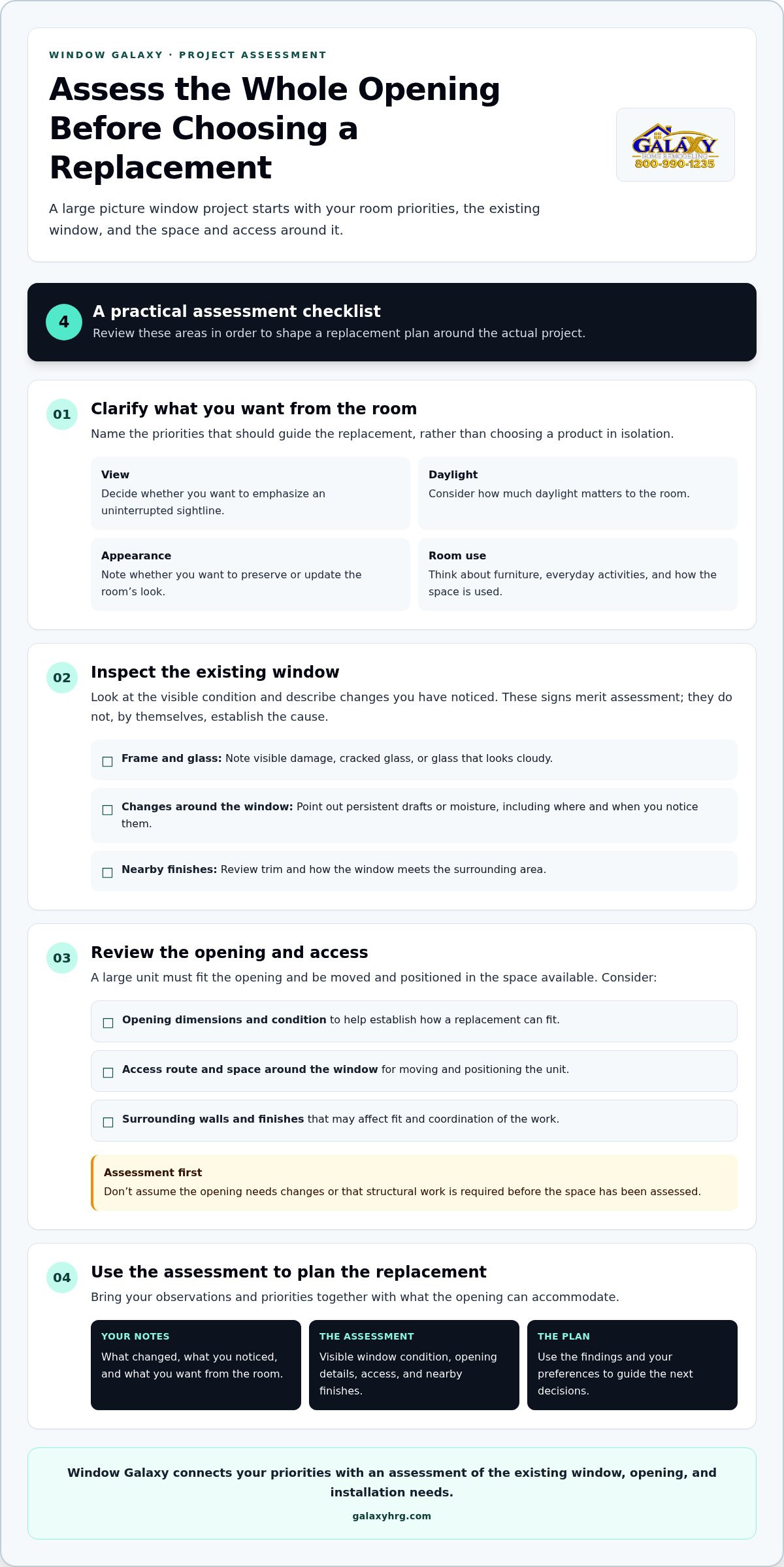
A useful assessment turns your priorities and the existing window’s condition into a project plan. Start by describing what you want from the room. Then review the current window, opening, and access route before planning a replacement around what the assessment reveals. This gives the discussion a clear focus before you make decisions about configuration and finishes.
A large-window assessment considers both the window unit and the opening it must fit. Looking only at the visible glass can miss details that affect fit, access, or the work around the window. The goal is to understand your specific project, not assume every large picture window follows the same process.
- Discuss priorities: Clarify what you want the new window to contribute to the room.
- Inspect the existing window: Review the visible condition of the frame and glass, along with nearby finishes.
- Review the opening: Consider the space for the replacement, access for installation, and surrounding details.
- Plan the replacement: Use the assessment and your preferences to guide the next decisions.
What should be reviewed around the existing window?
During inspection, note the visible condition of the frame and glass, as well as the interior finishes around the window. Trim and the way the window meets the surrounding area can help clarify what needs attention during planning. If you’ve noticed a change, point out where and when you see it. That gives the project team useful context without assuming what caused it.
The opening may need closer review as the project is planned. Its dimensions and condition help determine how a replacement can fit, while nearby walls and finishes influence how the work is coordinated. An assessment should establish what can be observed and identify which details need consideration before the replacement plan is settled. It should not assume hidden damage or structural changes.
Which homeowner priorities should guide the replacement?
Think about how you use the room and what you want the window to contribute. A view you want to frame prominently may point toward a different configuration than a room where privacy matters more. Daylight, appearance, and comfort are separate priorities, so name them individually. For instance, explain whether you want to preserve the current look, change how the window relates to the room, or make the view its main visual feature.
Clear priorities help Window Galaxy connect what matters to you with what the opening can accommodate. Consider each goal alongside the assessment findings rather than choosing a replacement based on appearance alone. As part of Window Galaxy’s window replacement planning, project coordination and clear communication help keep the assessment and next steps organized.
Compare Large Picture Window Options Without Losing the View
The right configuration balances the view you want with how you use the room. A fixed picture window doesn’t open, keeping the design focused on framing the outdoors. If ventilation matters, consider a combination that pairs a fixed center section with operable windows. Neither approach suits every opening, so compare your priorities before settling on a layout.
Should the replacement stay fixed or add an operable window?
A fixed design may suit you if an uninterrupted view is the main goal and the room doesn’t need the window for ventilation. Consider an operable combination if opening a window is important to your daily routine. Added sections affect the overall look, so consider how the frame divisions and proportions will appear from inside and outside the home.
Frame selection also affects appearance, upkeep, and how the window relates to the home’s existing finishes. Galaxy Vinyl Windows are one option to include in a project-specific comparison. The assessment can help connect frame and configuration choices to the opening, the home’s style, and the view you want to preserve. Compare the options against the actual space rather than assuming a particular frame or layout will work for every project.
How should frame and glass choices be compared?
Consider whether the frame complements nearby trim and exterior details, and what level of upkeep fits your preferences. For glass, think about how daylight and comfort factor into your decision. U-factor describes how readily heat transfers through a window, while SHGC describes how much solar heat the glazing allows inside. A lower U-factor means less heat transfer, while a lower SHGC means less solar heat passes through. Use these terms to compare available product information, but don’t assume a rating for a specific window without its specifications.
Use a priority-led comparison to clarify what matters most before narrowing the choices:
| Homeowner priority | What to compare |
|---|---|
| Preserve the view | Fixed glass versus a layout with operable sections, including how frame divisions affect the sightline. |
| Ventilate the room | A fixed picture window versus a combination that includes a window that opens. |
| Match the home | Frame appearance and how it coordinates with existing interior and exterior finishes. |
| Plan for upkeep | Material choices and the maintenance you prefer to manage. |
| Consider comfort | Available glass-performance information, including U-factor and SHGC, for the specific options under review. |
When replacing a large picture window, separate must-haves from preferences. You might prioritize an open view, then weigh ventilation, appearance, and glass performance against that goal. Window Galaxy can guide the selection around the assessed opening and your priorities, including consideration of Galaxy Vinyl Windows. A clear comparison keeps the decision grounded in your home and the view, rather than a feature that may not serve the room.
Prepare for Installation and Reduce Large-Window Project Stress
Preparation can make the work area easier to access and help you understand what comes next. The installation plan should reflect the specific opening, room, and project scope. Removal, placement, and surrounding finish work can vary, so discuss the planned steps and preparation for your home rather than assuming every large-window project follows the same sequence.
What can homeowners do before installation day?
During project planning, discuss the route to the window, access considerations, and how nearby areas will be protected. Before work begins, clear a practical path and move breakable belongings away from the work area. These steps reduce obstacles and help keep personal items out of the way.
Use the planning conversation to clarify what the work area needs and what to expect as the project progresses. For more context, review Window Galaxy’s window replacement guidance about preparing for the broader replacement process.
A short checklist can keep practical details from slipping through the cracks:
- Clear access: Move furniture or other obstacles from the route to the window when practical.
- Protect nearby belongings: Relocate breakable items, décor, and anything delicate near the work area.
- Discuss room protection: Clarify how the work area will be managed and what preparation makes sense for your room.
- Review project steps: Discuss the planned stages and how surrounding finishes fit into the scope.
- Share access details: Mention obstacles or room considerations during planning, rather than leaving them to be discovered on installation day.
How does project communication help keep work organized?
Clear expectations help homeowners understand the planned sequence, what the work area may need, and when decisions or updates are relevant. That matters during a large-window replacement because installation and finish work depend on the opening and agreed project scope. A shared understanding can reduce avoidable surprises, even though not every detail can be predicted in advance.
Communication works both ways. Share your priorities and questions, then listen as the project team explains how the plan reflects them. If the room’s use, access, or finish details matter to you, raise those points while the work is being coordinated. This keeps your needs visible as the project moves forward.
Window Galaxy emphasizes project management and clear customer communication. This approach helps organize project stages and gives homeowners a point of coordination for discussing relevant details. As replacing a large picture window moves from planning to installation, organized updates can make the process easier to follow. The specific work still depends on the home and project scope.
Window Galaxy’s window replacement guidance covers the broader process, including planning and installation preparation.
Choose a Large Picture Window Solution With Window Galaxy
A well-planned replacement follows a clear sequence: define what you want from the room, assess the existing window and opening, compare suitable options, and coordinate installation. This keeps the project grounded in your home rather than starting with a product choice alone. It also gives you a practical way to weigh the view, daylight, appearance, and comfort you want against the available space.
Window Galaxy helps homeowners consider window options in relation to their project. Galaxy Vinyl Windows are one offering to consider during selection. The right choice depends on the opening and the priorities you bring to the conversation, so connect those details before planning the work.
How does Window Galaxy support a replacement project?
Window Galaxy emphasizes quality control, project management, and clear customer communication. For a large picture window project, that focus helps organize decisions around the home’s needs and keeps the homeowner informed as planning moves forward. The discussion can connect the opening, window selection, and installation plan rather than treating replacement as a product choice alone.
Communication works best as a two-way exchange. Explain what matters most, and the project team can help align decisions with those priorities. If preserving a particular view matters more than changing the room’s appearance, say so. If comfort or daylight is a central concern, make that clear too. Sharing your preferences gives the project discussion direction without assuming one solution fits every home.
What should homeowners bring to an initial project conversation?
You don’t need to arrive with every technical detail decided. A few clear observations can make the conversation more productive. Be ready to describe where the window is, what you’ve noticed, and what you hope will be different after replacement. If you’re still weighing design ideas, Window Galaxy can discuss how your goals relate to the available window options.
- Location: Identify the room and describe how the window relates to the space.
- Visible concerns: Note changes to the frame or glass, or drafts and moisture you’ve observed.
- Desired changes: Describe what you want to preserve or update.
- Priorities: Rank view, daylight, appearance, and comfort so the discussion starts with what matters most.
These details establish a shared starting point. The opening assessment and project-specific selection can then guide decisions about the replacement and installation plan.
If you’re considering replacing a large picture window, Window Galaxy can discuss your project. Share the window’s location, what you’d like to change, and the priorities you want the replacement to support. A clear conversation is a practical first step toward a solution planned around your home.
Give Your Picture Window Project a Clear Starting Point
A large window shapes how a room feels, so replacement is an opportunity to make the view work better for your home. Before choosing a direction, consider what you want to notice when you enter the room: the landscape outside, the daylight, or a calmer connection between the window and the rest of the space. Naming those priorities can make a complex decision more personal and easier to discuss.
Replacing a large picture window doesn’t require having every detail decided in advance. A focused conversation can connect your goals to the opening and the options that suit the project. Bring your questions and describe what you’d like to change so the planning can start with what matters to you.
Discuss your large picture window replacement with Window Galaxy. Share your goals and take the next step toward a plan for your home.
Frequently Asked Questions
Is a large picture window difficult to replace?
It can require more planning than a smaller window because its size affects removal, movement through the home, and positioning at the opening. The work also needs to account for nearby finishes and the installation route. A narrow hallway or staircase, for example, may affect how the window is brought to the room. A project assessment helps identify these practical details and organize the work around the home.
Can I replace a picture window without changing its size?
Keeping the same general size may be possible if the replacement suits the existing opening. The opening still needs to be assessed so the selected unit can be planned for the space and surrounding finishes. If you want to preserve the current proportions, mention that early. It gives the project discussion a clear constraint while leaving room to consider suitable frame, glass, and configuration choices.
Does a picture window have to be fixed, or can part of it open?
A picture window itself is fixed, but a larger window arrangement can include operable sections alongside fixed glass. This may suit you if you want to keep a broad central view while adding a way to open part of the window. The layout depends on the opening and the room’s needs. Consider where you’d want the operable section and how its placement would affect the view.
What should I move before large-window installation?
Move breakable décor, small furniture, and belongings near the window, then clear a practical path from the entry point to the work area. If curtains or window treatments could obstruct access, discuss them during planning. Also consider items on nearby shelves or window seats that could be disturbed. Window Galaxy can help you plan preparation around your room and the agreed work scope.
Can a large picture window be replaced in a New Jersey home?
Yes. Window Galaxy provides window replacement and professional installation for New Jersey homeowners. Each project is planned around the home’s existing opening, the selected window, and the work involved. Share the window’s location in the home and the changes you’re considering so the project discussion can focus on the relevant details. Window Galaxy emphasizes project coordination and customer communication throughout the process.
How do I choose between a fixed picture window and an operable combination?
Choose based on what you need the window to do. A fixed design may suit your priorities if framing the view is the main goal. An operable combination may be worth considering if opening part of the window matters to your routine. Think about the room’s use, where ventilation would be helpful, and which sections you want to keep visually clear. An assessment of the opening helps narrow the options.


