

What does “virgin” mean on a vinyl window description? If you’re wondering what is virgin vinyl in windows, the term describes the material’s history, not the quality of the finished window. It can help you understand a frame’s material, but it doesn’t tell you how the whole window is built or how it will perform.
This guide explains virgin vinyl in plain language, how it differs from reground vinyl, and what the labels can and can’t tell you. You’ll also find practical ways to review product details and compare windows without treating a material claim as a complete quality rating.
For homeowners considering vinyl windows, look at the full product and installation, not just the resin used in the frame. Galaxy Home Remodeling offers energy-efficient Galaxy vinyl windows and professional replacement installation. Each project has a dedicated project manager, hands-on quality control, and ongoing communication. Knowing the terminology can help you ask more focused questions as you plan.
Key Takeaways
- To understand what is virgin vinyl in windows, start with the material: newly produced PVC resin used in vinyl window frames.
- Reground vinyl refers to reclaimed material. Neither label alone establishes how a finished window will perform.
- Assess a window as a complete product, including its construction and installation, rather than treating resin type as a quality rating.
- Separate material claims from documented product details to make a clearer comparison.
- Galaxy Home Remodeling offers energy-efficient Galaxy vinyl windows and professional installation supported by a dedicated project manager.
What Does Virgin Vinyl Mean in Windows?
Window descriptions sometimes use “virgin vinyl” as if the phrase answers every question about quality. It doesn’t. The term describes the starting material used in a window frame. The finished window is a complete product, made from components that are assembled and then installed in a home. Understanding what is virgin vinyl in windows starts with distinguishing the material label from claims about the entire window.
Virgin vinyl is newly produced PVC resin that has not previously been processed into another product. PVC, short for Polyvinyl chloride (PVC), is the plastic commonly used to make vinyl window frames. In practical terms, “virgin” describes the resin’s prior use, not the frame’s shape, style, or color.
What does “virgin” describe in vinyl window material?
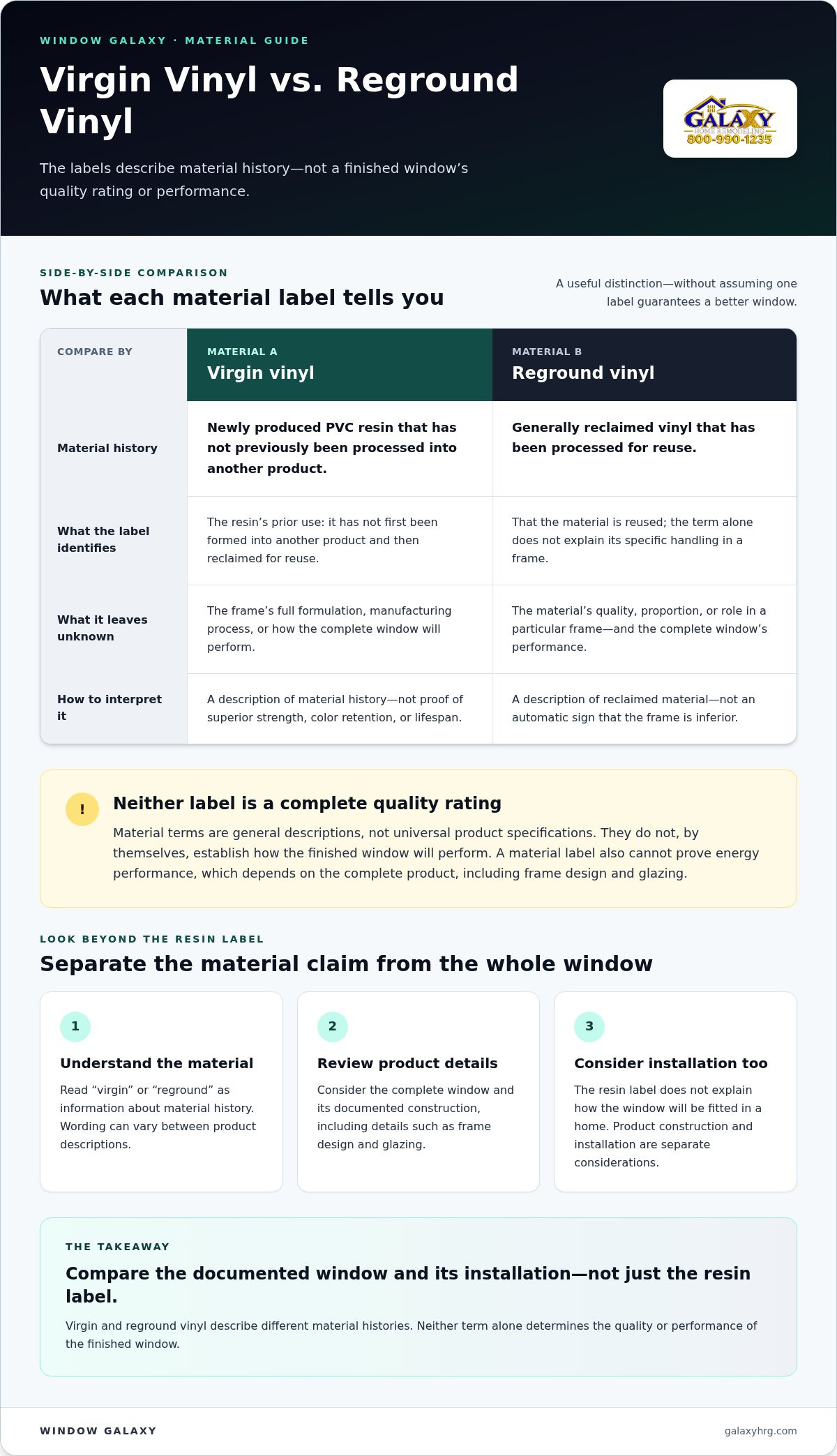
The word refers to the material’s history before it is made into a frame. Virgin resin has not first been formed into a product and then reclaimed for another manufacturing use. That distinction helps clarify the wording in a product description, but it doesn’t establish how the completed window will perform. It also doesn’t describe the frame’s full formulation or manufacturing process.
How is virgin vinyl different from reground or recycled vinyl?
Reground vinyl generally refers to reclaimed vinyl that has been ground and processed for reuse. The term may describe manufacturing scrap, although wording can vary between product descriptions. “Recycled” is also a broad label rather than a full specification. Without product-specific details, neither term tells you exactly how the material was handled or used in a particular frame.
Keep the distinction clear:
- Virgin vinyl: newly produced PVC resin that hasn’t previously been processed into another product.
- Reground vinyl: reclaimed vinyl processed for reuse.
These terms describe different material histories, not a universal ranking. Recycled content doesn’t automatically make a frame inferior. The material’s quality, how it is used, and the manufacturing process can all matter. A broad label on its own can’t answer those product-specific questions.
Read “virgin vinyl” as one piece of information, not a guarantee or complete quality rating. It tells you something about the resin’s prior use, but not every detail about the frame or window. For a useful comparison, separate the material claim from information about the complete product and its installation. That makes unfamiliar terminology easier to assess without assuming that virgin or reground material automatically determines the outcome.
How Does Virgin Vinyl Compare with Reground Vinyl?
A material label can help you understand what went into a window frame, but it’s only one part of the product description. The useful comparison isn’t which label sounds better. Consider what each term tells you, what it leaves out, and how the frame fits into the complete window.
| Virgin vinyl | Reground vinyl |
|---|---|
| Describes newly produced PVC resin that has not previously been processed into another product. | Generally describes reclaimed vinyl that has been processed for reuse. |
| Identifies a material history, but doesn’t establish how the frame or complete window will perform. | Identifies reused material, but doesn’t by itself show its quality, proportion, or role in a particular frame. |
These are general descriptions, not universal product specifications. Manufacturers may use terms differently, and a label may not explain a particular frame’s formulation or production process. A meaningful comparison relies on product-specific information rather than assumptions based on one word.
What can the material label tell a homeowner?
A label may indicate the source or composition of material used in a frame. That context helps you interpret the product description, but it isn’t a complete set of window specifications. The label can’t, on its own, tell you how the material was formulated, how the frame was made, or how the full window was designed.
Keep material information separate from promises about color retention, strength, or lifespan. Those outcomes can’t be established just by seeing “virgin” or “reground” in a description. Treat the label as a starting point for understanding the material, not proof of a specific result.
What can’t virgin vinyl tell you on its own?
The resin description doesn’t establish a window’s energy performance. That depends on the complete product, including details such as frame design and glazing. Nor does a material label explain how the window will be fitted in a home. Product construction and installation are separate considerations.
Composition alone cannot prove window quality; the material, finished product, and installation all matter. This balanced view avoids treating recycled content as an automatic drawback or virgin resin as a guarantee of superior results. It also keeps claims about appearance, strength, or durability in perspective unless they’re supported by specific product information.
For homeowners, the practical takeaway is to read the material description for what it says, then consider the rest of the window’s documented details. Galaxy Home Remodeling offers energy-efficient Galaxy vinyl windows and professional installation. Keep the resin label separate from the broader details of the product and installation as you assess your project.
Does Virgin Vinyl Mean a Better Window? Look Beyond the Label
No. Virgin vinyl describes a material, not a complete window quality rating. It may tell you something about the resin’s history, but it doesn’t establish how the finished window will perform or how long it will last. Treating the label as a guarantee makes a complex product seem simpler than it is.
Whole-window performance cannot be inferred from resin terminology alone. The frame is one part of the unit, and glazing and other product details also contribute. Installation affects how the window fits into the opening. Because these elements work together, a material description can’t stand in for an assessment of the complete product.
How do frame, glass, and installation affect the full window?
A frame’s material is one part of its design. Glazing is another, and installation is a separate consideration. A resin label doesn’t tell you the frame design, what glazing is included, or how the opening will be prepared and the unit fitted.
Rather than drawing a conclusion from one phrase, consider these elements together:
- Frame: Review the details provided about the frame, not only the resin description.
- Glazing: Look for product information that describes the glass and any stated performance measures.
- Installation: Consider how the window will be fitted and what quality-control steps support the work.
This approach keeps your comparison grounded in the actual window and project. For example, a “virgin vinyl” claim doesn’t tell you whether a particular window has the features or documented performance that suit your needs. The broader product details matter.
Why should homeowners treat absolute material claims carefully?
Statements that a material guarantees lasting color, strength, or durability need product-specific support. A broad resin label alone can’t substantiate those outcomes. The same caution applies to claims that recycled content automatically weakens a frame or that virgin resin guarantees superior performance. Neither conclusion follows from the terminology by itself.
Separate general promotional language from details tied to the actual window. Product documentation may provide information about design, glazing, or measured performance. Those details give you more to evaluate than an unspecific promise. If a description makes an absolute claim, look for information explaining what the statement applies to rather than assuming it covers every part of the window.
Understanding what is virgin vinyl in windows can help you interpret one material claim, but it can’t answer every question about window quality. Keep the resin description in context, then assess the frame, glazing, product details, and installation as parts of one decision. This gives you a clearer basis for comparing information without treating a single label as a promise.
How to Evaluate a Virgin Vinyl Claim on a Window
A material claim is easier to interpret when you separate what it says from what you still need to learn about the window. If you’re weighing what is virgin vinyl in windows against other product descriptions, use the same review process each time. It helps prevent a clear statement about material from becoming an unsupported conclusion about quality.
- Record the exact wording. Note whether the description says “virgin vinyl,” “reground,” or “recycled.” Preserve the exact phrase so you’re assessing the claim as written, not a broader assumption.
- Identify what the phrase describes. Determine whether it refers to resin source or material composition. Don’t treat it as a complete specification for the frame or whole window.
- Review the rest of the product information. Consider the frame, glazing, and any stated energy-efficiency details as separate attributes. Use product-specific information rather than filling gaps with assumptions.
- Include installation in your evaluation. A product description doesn’t explain how the window will be fitted. Consider installation alongside product details when assessing the project as a whole.
Which product details help put a material claim in context?
Read the stated frame material alongside the information available about the complete window. Glazing and energy-efficiency details are separate product attributes, so a resin label can’t substitute for them. Review the wording and scope of any product documentation carefully. If a detail isn’t stated, leave it unknown rather than assuming a particular rating, certification, or specification.
This distinction matters because product descriptions can combine a factual material statement with broader promotional language. A frame-material label tells you what the description says about the frame. It doesn’t, by itself, document the window’s energy performance or describe its glazing. Keep each claim attached to the feature it actually addresses.
How can you compare claims without overreading them?
Use consistent criteria for each window you’re considering. Write down the exact material claim, then note whether it describes the resin, frame, glazing, energy-efficiency information, or installation. Separate documented product details from general statements about a material category. This simple record makes it easier to see which information is comparable and where a description doesn’t provide an answer.
Be especially careful with sweeping statements about a material’s performance. A claim about durability or color stability isn’t automatically supported by the words “virgin” or “recycled.” Look for product-specific information that explains the claim’s scope, and avoid extending it to parts of the window it doesn’t address. If two descriptions provide different levels of detail, record that difference instead of treating the broader claim as proof.
For a next step that connects product information with installation, explore Galaxy vinyl window options from Galaxy Home Remodeling.
Galaxy Vinyl Windows and Your Next Window-Project Step
Choosing windows involves more than understanding material terms. The product and installation both shape the project, and clear communication helps you understand each step. Galaxy Home Remodeling offers energy-efficient Galaxy vinyl windows and professional window installation. Knowing the terminology can help you read product descriptions, while a clear project process helps bring your replacement plans together.
What should homeowners expect from a Galaxy window project?
A dedicated project manager supports every project, with hands-on quality control and ongoing communication. That gives homeowners a consistent point of contact as the work progresses. Clear conversations help keep project details understood, while quality control provides practical oversight during installation.
Galaxy Home Remodeling is licensed and insured. The company offers energy-efficient Galaxy vinyl windows for homeowners considering replacement. The product description identifies the window offering, but it does not specify that the vinyl is virgin resin.
As you plan, bring together the questions that matter to your home: which windows you’re considering, what product information you want to understand, and what the installation process involves. Discussing those priorities early helps establish a shared understanding of the project. A dedicated project manager and ongoing communication help keep that conversation connected as the work progresses.
How can a homeowner take the next step?
If you’re considering replacement windows, start with a conversation about your home and project goals. You can ask about Galaxy vinyl windows and professional installation, and share questions about the material terminology you’ve been reviewing. The aim is to make the next step clear, without treating a single product label as the whole story.
Understanding what is virgin vinyl in windows can help you interpret a material description, but planning a window project also means considering the product and installation together. Window Galaxy brings project management, hands-on quality control, and ongoing communication to the work. To discuss your project and arrange a free quote, contact Window Galaxy or call (800) 990-1235.
Move Forward With Confidence in Your Window Project
Clear material language can make it easier to ask focused questions, but your next step is deciding what matters most for your home. Consider your project goals and the window information you want to understand. Then you can have a more useful conversation about your options and the installation process.
Window Galaxy has served homeowners since 2005. The company has a 4.8-star average from 407 Google reviews, reflecting feedback from homeowners who have worked with the team.
If you’re ready to discuss your project, schedule a window estimate with Window Galaxy. Call (800) 990-1235 to arrange a free quote and take the next step with a clearer sense of what you want from your windows and the project ahead.
Frequently Asked Questions
What is virgin vinyl in windows?
Virgin vinyl in windows refers to PVC resin that hasn’t previously been processed into another product. The term describes the frame material’s history, not the window’s style or a complete performance grade. A description using this label tells you something about the resin, but not the glazing or how the finished window performs. Treat it as one detail to interpret alongside product-specific information.
Is virgin vinyl better than recycled vinyl for windows?
Not automatically. The label alone can’t establish that one window is better than another. For a meaningful comparison, look beyond the resin category and consider the information available for each complete window, including its design, glazing, and documented performance. A recycled-content description doesn’t prove a frame is inferior, just as a virgin-material claim doesn’t guarantee a particular result.
What is the difference between virgin vinyl and reground vinyl?
Virgin vinyl describes newly produced PVC resin, while reground vinyl generally refers to reclaimed vinyl processed for reuse. The exact use of these terms may differ across product descriptions, so read the wording closely. A label might identify material origin without explaining the frame’s full formulation. Note what the description actually says, and avoid treating it as a complete specification.
Can virgin vinyl window frames turn yellow over time?
A “virgin vinyl” label alone can’t predict whether a particular frame will change color. Color stability depends on product-specific factors, and broad material terminology doesn’t provide enough information to promise an outcome. If appearance over time matters to you, look for documentation that specifically addresses color retention for the window being considered. Don’t interpret the resin label itself as a guarantee against color change.
Does virgin vinyl make a window more energy efficient?
No material label by itself establishes a window’s energy efficiency. Consider the complete unit and its documented energy information, including measures such as U-factor and Solar Heat Gain Coefficient (SHGC), where provided. These figures describe window performance more directly than a resin-origin claim. Also consider installation, since the product description alone can’t show how the window will fit into your home.
Are all vinyl windows made with virgin vinyl?
No. Vinyl window frames can use different material formulations, and the general category doesn’t reveal the resin composition of a specific product. Some descriptions may identify virgin resin, while others may refer to reclaimed material or use broader wording. Don’t infer composition from a window’s appearance or from the word “vinyl.” Use the product’s material description to understand what is being claimed.
What should homeowners compare besides the vinyl material?
Compare the whole window, not just the frame material. Review the frame design, glazing details, and any available energy-efficiency information, then consider how installation will be handled. For example, if two descriptions both state a vinyl frame but provide different glazing or performance details, those differences may help you assess the products more clearly. Keep comparisons consistent by reviewing the same categories for each window.


