

The biggest bundle isn’t always the smartest: bundling home exterior projects to save money works best when tasks share site preparation or need to happen in a clear sequence. Roofing, siding, and window installation can be coordinated, while gutters should follow roofing and siding to avoid disruption from later work. Keep projects separate when their timing or scope doesn’t align.
It’s reasonable to want fewer scheduling headaches and a finished exterior that looks and functions as one coordinated whole. Combining work can make those goals easier to manage, but the order matters: a poorly planned bundle can lead to rework or unnecessary delays.
This article explains which exterior projects tend to fit together, how shared setup and contractor schedules can help, and when separate timing makes more sense. You’ll also learn how window and siding improvements can support energy efficiency, what to consider when sequencing the work, and how to use a simple decision checklist to plan a smoother project.
Key Takeaways
- Bundle projects when they share site preparation or depend on the same exterior surfaces; separate work that doesn’t fit the same schedule or sequence.
- Plan the order before work begins. Roofing and siding should be completed before gutters, while window and siding work can be coordinated around flashing and finish details.
- Look at the exterior as a whole to align colors, trim, and transitions, creating a more consistent appearance across the home.
- Pair window or door upgrades with other envelope improvements when they address related comfort and energy-efficiency goals.
- Use a clear scope and schedule to coordinate trades, reduce avoidable disruption, and understand how each project fits into the finished exterior.
Coordinating contractors and schedules
For a Galaxy Home Remodeling window project, start with a clear scope: which windows are being replaced, which rooms they serve, and whether siding work affects the same walls. Galaxy Home Remodeling provides window installation and siding, so homeowners planning both can discuss how the work connects. A dedicated project manager and communication throughout the remodel help keep the plan clear.
Window installation and siding work can meet at the same wall openings. If replacement windows are set into walls scheduled for new siding, the project plan should show how the tasks fit together. That helps homeowners understand the intended sequence and which exterior areas are involved. Galaxy Home Remodeling offers Galaxy vinyl windows, specialty windows, and Hardie plank siding for these projects.
Keep the schedule tied to the agreed scope. Identify the rooms and exterior elevations involved, note where window and siding work overlap, and record when each area is ready for the next task. A dedicated project manager and consistent communication give homeowners a point of contact for understanding the plan and discussing changes.
- Define the window scope: List the openings included in the installation and the rooms they serve.
- Map adjoining siding: Mark walls where siding work meets the window openings.
- Clarify the sequence: Discuss how window installation and siding details fit the project plan.
- Keep updates connected: Use project communication to follow the scope, schedule, and any changes affecting the work.
Roofing may also be part of your exterior plans, and Galaxy Home Remodeling offers roofing. If your project includes windows, siding, and roofing, define each area and task separately before deciding how they fit together. This keeps planning focused on the actual work instead of assuming every project follows the same sequence. The written scope can identify connected tasks and clarify where handoffs occur.
Schedules can change if project conditions shift or an affected work area isn’t ready. Keep communication focused on what changed, which part of the scope it affects, and what happens next. Galaxy Home Remodeling emphasizes project management, quality control, and customer communication throughout installation. For homeowners planning window work alongside related exterior improvements, these practices help keep the scope and project plan clear.
Curb appeal and resale value
Window choices can shape how your home’s facade looks from the street. Windows are visible across the front and sides, so their placement and relationship to the surrounding exterior affect the overall appearance. Galaxy Home Remodeling offers Galaxy vinyl windows and specialty windows. Consider how each option fits your home’s existing lines and the visual character you want to maintain.
For example, a front elevation with several window shapes may call for a careful review of how each opening relates to the others. Specialty windows can be part of the conversation when a home has distinctive openings. The goal is a deliberate appearance, not a promise that a particular window will increase resale value. Buyers and appraisers consider the home as a whole, and no window selection guarantees a specific market outcome.
Siding frames the windows and contributes to the facade’s appearance. Galaxy Home Remodeling offers Hardie plank siding. If you’re considering it, think about how the siding will look beside your existing windows, trim, and architectural details. A coordinated visual plan can help updated surfaces feel intentional instead of making one change seem disconnected from the rest of the home.
- Review the facade: Look at window placement, shapes, and surrounding details from the front and sides.
- Consider distinctive openings: Include Specialty Windows in the discussion when the home has unusual window shapes.
- Think about the frame around each window: Consider how Hardie plank siding relates visually to existing or planned windows.
- Set a realistic goal: Aim for a coherent exterior appearance without treating improvements as a guaranteed resale return.
Before settling on a visual direction, describe what feels mismatched or dated about your current exterior. You might focus on the contrast between the front windows and surrounding siding, or on an unusual opening that stands apart. Those observations make a discussion about Galaxy vinyl windows, specialty windows, or Hardie plank siding more specific to your home.
Resale appeal is one consideration, but personal preferences and your home’s architecture matter too. Start planning with the actual openings and surfaces involved, not an assumed market-value result. A clear visual goal helps you weigh available window and siding options against the look you want. This keeps decisions focused on the facade and the improvements under consideration.
Energy efficiency through envelope improvements
Window Galaxy planning can focus on how replacement windows relate to comfort inside the home. Galaxy Home Remodeling offers energy-efficient Galaxy vinyl windows and Window Installation Services. Homeowners can begin by noting which rooms feel drafty or uncomfortable, then identifying the windows serving those spaces. This creates a practical starting point for discussing whether window replacement fits the home’s needs.
Look at each window opening as part of the surrounding wall. For example, you might notice that one room feels different from the others and want to include its windows in a replacement plan. Window type, opening, and installation scope all matter. Discussing those specifics keeps the decision grounded in your home.
Galaxy Home Remodeling also offers specialty windows for distinctive openings. If a room has a nonstandard window shape, discuss how that opening fits the project rather than assuming every window should be treated alike. Consider your home’s existing window layout and the role each opening plays in the planned improvement.
- Identify affected rooms: Note where comfort concerns occur and which windows serve those spaces.
- Describe each opening: Include its location and any distinctive shape or layout.
- Connect the scope: Discuss Galaxy Vinyl Windows or Specialty Windows in relation to the openings being considered.
- Keep expectations grounded: Treat an energy-efficient window as part of a home improvement plan, not a guarantee of a particular energy outcome.
If siding is also part of your improvement plans, Galaxy Home Remodeling offers Hardie plank siding. Discuss how the window and siding work relate to the walls involved, and keep energy-efficiency goals focused on the specific rooms and openings. This helps distinguish a window project from broader exterior work without assuming every task affects indoor comfort in the same way.
Before planning a window project, write down the rooms of concern and the openings connected to them. Note any distinctive windows and whether adjoining siding is part of the intended scope. These details make a discussion about window installation more specific and keep product choices connected to your home. Galaxy Home Remodeling’s energy-efficient Galaxy vinyl windows are an option to consider as you plan improvements around your windows and comfort goals.
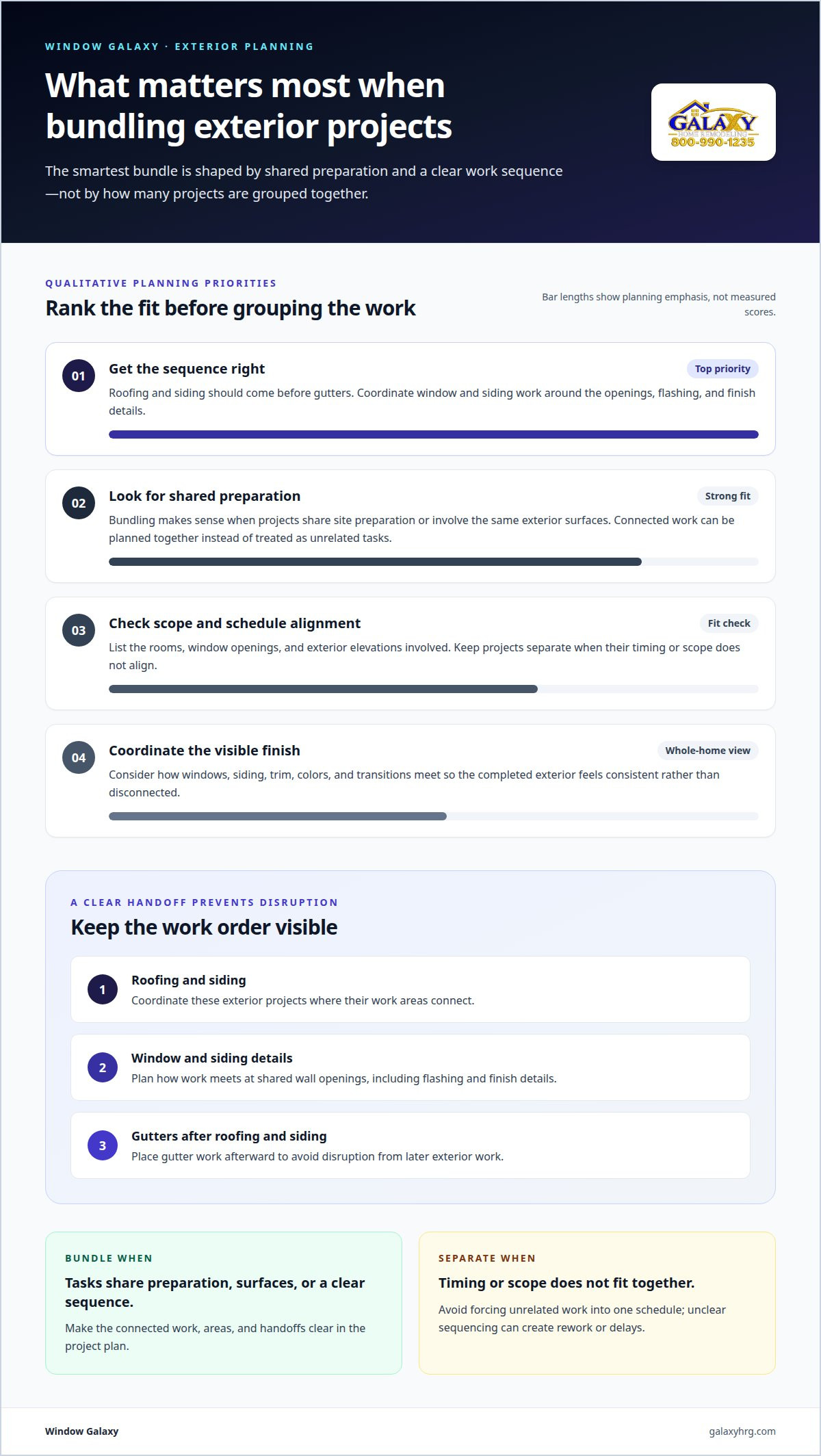
Planning and sequencing bundled projects
A useful bundle follows dependencies, site conditions, and the home’s specific scope of work. Plan the handoffs before setting dates so each task begins on a surface that’s ready.
Sequencing Bundled Work
Sequencing means arranging exterior tasks so earlier work prepares the home for later installations. It matters because finished surfaces can be damaged or obstructed if crews arrive out of order. Map each project to its prerequisite, completion point, and next handoff. For example, schedule gutters after roofing and siding, then allow time for a final alignment review.
What permits are needed for bundled exterior renovations in the United States? Permit requirements depend on the project scope and local jurisdiction, so there’s no single nationwide checklist for every bundle. Identify which proposed changes need local approval before scheduling the affected work.
Build the sequence around dependencies, not simply around which crew can arrive first. Start with work that opens or changes exterior surfaces, then schedule installations and finish details after those areas are ready. Set a clear milestone for each handoff, such as completing a wall section before adjoining finish work begins. Keep the written schedule current when a task changes, so later crews don’t rely on outdated dates.
Selecting Cost-Effective Project Combinations
Combining projects makes sense when tasks share access, preparation, or connected exterior details. A coordinated scope can reduce repeated setup and help avoid undoing completed work. For example, roofing, siding, and window work may share site preparation; windows and siding also meet at flashing. Bundle these tasks when their locations and sequence align.
What risks come with bundling multiple exterior projects at once? Overlapping crews, delayed handoffs, weather interruptions, or newly exposed conditions can disrupt several tasks together. A written sequence, a clear decision-maker, and planned pause points help contain disruptions and protect completed surfaces.
Climate, local labor rates, and regional building codes affect which combinations are practical and how work should be scheduled. Local weather patterns influence suitable work windows, while labor availability affects crew timing. Code requirements vary by jurisdiction and project scope, so the plan may need adjustment before work begins. Account for local conditions rather than assuming one sequence fits every home.
Keep the scope focused. A vehicle, auto insurance, home insurance, premiums, and liability belong to separate household planning, not an exterior renovation schedule. For the home itself, compare each proposed task by location, prerequisite, access needs, and finish dependency. If two projects affect different areas and share no setup or installation step, keeping them separate can make coordination clearer. If they meet at a roof edge, wall, or window opening, plan the shared details together and document who completes each handoff.
Before confirming dates, review the sequence alongside the site plan and work scope. Mark access areas, material staging locations, surfaces that must remain clear, and the point where each crew’s work is complete. This gives you a practical way to track progress and see when the next task is ready to proceed.
Which home exterior projects are most cost-effective to bundle together?
The strongest combinations connect through shared access, preparation, or adjoining materials. Roofing, siding, and window installation can share site preparation when work affects the same elevations. Siding and window upgrades also meet at the flashing around window openings. Bundling home exterior projects to save money makes practical sense when those connections reduce repeated setup or help crews complete related details together.
- Roofing, siding, and windows: Consider these together when work overlaps on the same elevations or requires shared site preparation. Plan window installation around siding so flashing and exterior finishes align.
- Roofing, soffits, and fascia: Coordinate these connected roof-edge details to address eaves and overhangs within a single scope.
- Roofing, siding, and gutters: Place gutters after roofing and siding. This sequence helps protect their alignment during earlier work.
- Siding, doors, and a porch or deck: Consider these together when the work affects the transition between the home and outdoor space.
Look at the affected parts of the home before choosing a combination. If siding will cover a wall with window openings, the window work has a direct connection to that siding installation. If roof work reaches the eaves, soffit and fascia improvements may fit the same scope. A porch or deck project may also connect to siding or door work where those surfaces meet. The physical relationship helps determine whether bundling home exterior projects to save money is a sensible plan or an unnecessary grouping.
Compare each pairing by location, access, preparation, and finish dependencies. A window and siding plan should identify how flashing and adjoining finishes will be completed. A roof-edge scope should show how soffit, fascia, or gutters relate to the roofing work. For a porch or deck beside new siding, note where the surfaces meet and which detail must be finished first, especially when coordinating outdoor specialists like Cascade Outdoor Services to handle structural carpentry alongside exterior wall work.
Keep separate tasks separate when they share no work area, access, or installation dependency. Adding an unrelated project can make scheduling harder without improving the completed exterior. Homeowners considering a bundle can list each project’s location, shared preparation, and handoff. If those connections are clear, the combination may simplify coordination. If not, a focused scope may serve the home better. For help planning connected window and siding work, explore coordinated exterior project options.
Galaxy Home Remodeling: Galaxy Vinyl Windows
Galaxy Home Remodeling can help homeowners plan window work alongside related exterior improvements. If a siding project includes walls with older or mismatched windows, Galaxy vinyl windows or specialty windows may fit the scope. Window installation and Hardie plank siding can address connected parts of the exterior, helping you consider how the finished surfaces meet.
Before deciding what to combine, identify the affected walls, window openings, and siding areas. A clear scope helps align the work and clarify how each part contributes to the finished exterior. Galaxy Home Remodeling emphasizes project management, quality control, and customer communication throughout installation, supporting a coordinated planning process.
If you’re considering window and siding improvements together, contact Galaxy Home Remodeling to discuss your project.
Turn your exterior plans into a clear next step
Shape your renovation plan before separate decisions become fixed. Choose the result that matters most to your household, then define the areas of the home that support it. This focus helps you decide whether bundling home exterior projects to save money fits your priorities, or whether a smaller, separate project makes more sense. A practical plan connects the work to your home’s needs instead of grouping tasks simply to do more at once.
For window-focused planning, Galaxy Home Remodeling offers Galaxy Vinyl Windows and Specialty Windows. Bringing your priorities and the areas you want to improve into one conversation gives the project a clear starting point. You can start a conversation about your exterior project and explore an approach that feels right for your home.
A thoughtful plan turns a long list of possibilities into a manageable decision. Take the next step with confidence.
Frequently Asked Questions
A Simple Decision Checklist: Bundle or Separate?
Bundle projects when they affect the same area, share preparation, or rely on a connected installation step. For example, window and siding work on one wall can be planned around the shared opening and finish. Separate tasks with no common access, surface, or sequence. Before deciding, list each project’s location, prerequisites, and finish requirements. If the work has no practical connection, combining schedules can add complexity without improving the result.
How much can you save by bundling?
There’s no single savings figure that applies to every exterior bundle. Practical benefits may come from shared setup, coordinated scheduling, and avoiding repeated disruption to the same work area. A roof and siding project, for example, may share site preparation, while unrelated projects may not. Scope, access needs, existing conditions, and sequence determine which efficiencies apply. Compare the work involved, not just the number of tasks grouped together.
How much can homeowners save by bundling exterior projects with one contractor?
There’s no standard amount that applies to every project managed under one contractor. Coordination can reduce scheduling friction when work has connected steps, such as completing exterior wall work before adjoining details. The outcome depends on scope, site access, materials, and handoffs. While comprehensive design-and-build teams like Wallpro System & Construction Inc show how unified oversight can streamline multiple construction phases, the number of projects alone doesn’t determine how much efficiency a particular plan will create.
What are typical costs for bundling roof replacement, gutters, and siding?
A roof, gutter, and siding bundle has no universal scope: roof dimensions, exterior layout, access, materials, and existing conditions all shape the work. Sequence matters too, since gutters follow roofing and siding to avoid disruption during earlier work. Define which surfaces are included, what preparation is required, and how each task connects. These details clarify the scope without assuming every home needs the same combination.
Does replacing windows and siding together reduce labor or material costs?
Pairing windows and siding can coordinate work around the same wall openings, including how flashing meets the siding. This shared installation context may reduce repeated preparation or disruption in that area. It doesn’t mean every window and siding project uses less material or labor. The number and location of openings, wall condition, and selected scope shape the work. A connected plan is most useful when both projects affect the same elevations.
How can homeowners compare bundled bids with separate contractor quotes?
Compare the same written scope across each proposal. Match the included surfaces, materials, preparation, removal, installation sequence, cleanup, and responsibility for handoffs. For example, one proposal might include window work on a wall while another covers siding alone. Note those differences before comparing schedules or deliverables. Clear line items show whether a bundle combines the same work or simply groups tasks under one project description.
How do contractor discounts, financing, and warranties work for bundled projects?
A bundled scope doesn’t by itself define discounts, financing arrangements, or warranty coverage. Treat each as a separate written term rather than assuming it follows automatically from combining projects. Warranty documents should identify the products or work covered, applicable limits, and who handles covered issues. Keep those terms with the project scope so the installation plan and any coverage details remain clear after the exterior work is complete.
How should homeowners prioritize exterior projects when working with a limited budget?
Start by separating urgent exterior problems from appearance updates. For example, address active roof or siding damage before planning a color refresh. Next, group tasks that affect the same surface or depend on one another, then postpone unrelated improvements. A written list of affected areas, needed work, and installation dependencies helps you make deliberate choices. Keep the project focused on your home’s current needs rather than adding disconnected tasks.


