

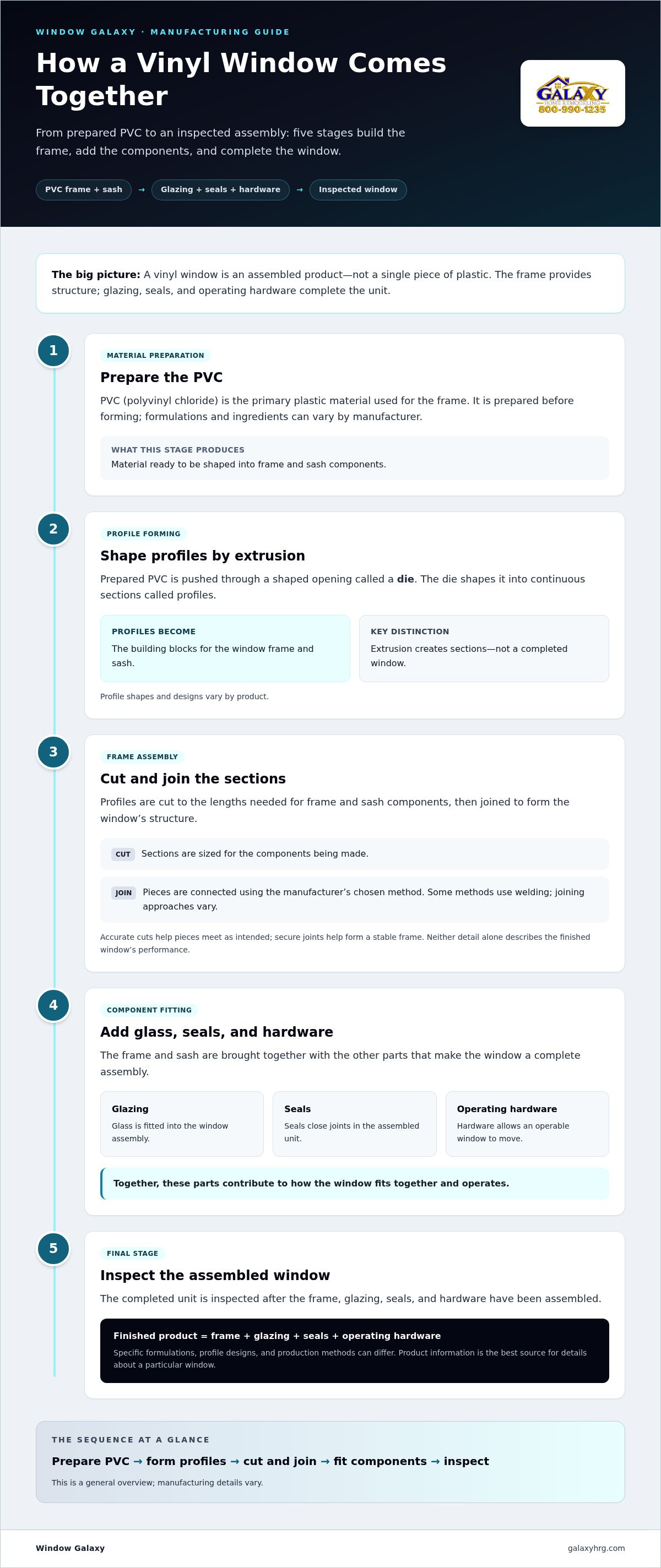
What if a finished vinyl window is less like a single piece of plastic and more like a carefully assembled system? If you’ve wondered how are vinyl windows made, the process is easier to follow when you break it into stages. PVC is the material used for the frame, and extrusion shapes it into the sections that become the frame and sash.
From there, manufacturers cut and join the profiles, fit the glazing, add seals and hardware, and inspect the assembled unit. Each stage contributes to how the window fits together and operates. Understanding the sequence can also help you compare product information and know what to look for in a replacement window.
Galaxy Home Remodeling offers energy-efficient Galaxy vinyl windows and professionally installs them with licensed and insured crews. A dedicated project manager, ongoing communication, and hands-on quality control support the installation experience. Those project services are distinct from the general manufacturing steps explained in this guide.
Key Takeaways
- How are vinyl windows made? The process typically moves from preparing PVC to forming profiles, assembling the frame, adding glass and hardware, and inspecting the finished unit.
- A vinyl window is a complete assembly, not just a frame. Glazing, seals, and operating hardware all contribute to how the finished window fits and functions.
- Frame profiles, glass, seals, and assembly methods can vary. Product details are more useful for evaluating a particular window than general manufacturing descriptions.
- Galaxy Home Remodeling offers energy-efficient Galaxy vinyl windows and professional residential installation, with project management, communication, and hands-on quality control.
How Are Vinyl Windows Made? Start With the Materials
A finished vinyl window is an assembled product, not a single piece of plastic. It brings together a PVC frame, glazing, seals, and operating hardware. The frame provides the structure; the other components fill the opening, close the joints, and allow an operable window to move. So, how are vinyl windows made? The typical process starts with preparing the material, then forming and joining frame components before adding glass and hardware and inspecting the unit.
Knowing the sequence makes manufacturing terms easier to understand. Each stage creates or adds a part of the finished window. Formulations, profile designs, and production methods vary, so a general description does not define the specifications of every vinyl window. When evaluating a specific product, look for product information about its frame, glazing, operation, and installation rather than relying on a general description of PVC.
What does PVC mean in a vinyl window?
PVC stands for polyvinyl chloride. It is the primary plastic material used in a vinyl window’s frame. In a typical process, PVC is prepared before being shaped into the components that form the frame and sash. Some formulations may use additives, such as colorants or stabilizers, but ingredients and proportions depend on the manufacturer. For broader background, see Polyvinyl Chloride (PVC).
The material name alone does not describe how a complete window will perform. Frame design, glazing, seals, hardware, and installation all contribute to the finished product and how it fits the opening. For Galaxy Vinyl Windows, use the product information to understand specific features rather than assuming details from general descriptions of PVC.
What parts are made before a vinyl window is assembled?
Before assembly, manufacturers form frame and sash profiles. Profiles are shaped sections that are cut and joined to create the window’s structure. The sash holds the glass and, in an operable window, moves to open or close it. Glazing and hardware are separate components added during later stages. Understanding these parts can also make a guide to the parts of a window easier to follow.
In broad terms, the manufacturing sequence looks like this:
- Prepare the PVC material for forming.
- Shape it into profiles for the frame and sash.
- Cut and join the profiles to create those structures.
- Add glazing, seals, and operating hardware.
- Inspect the assembled window.
This sequence is a useful overview, not a universal factory blueprint. Profile shapes, assembly choices, and material formulations can differ. For a homeowner, the practical takeaway is to consider the window as a complete unit: a frame profile is only one of several parts that need to work together.
Galaxy Home Remodeling offers energy-efficient Galaxy vinyl windows and professional residential installation. Understanding the general stages can help you make sense of frame and assembly terminology when considering a replacement. The product and installation details, rather than a broad description of manufacturing, are what matter when assessing a particular window for your home.
How PVC Becomes a Vinyl Window Frame
The answer to how are vinyl windows made becomes more concrete once PVC is shaped into frame components. In typical manufacturing, prepared material is formed into long profiles, then cut and joined to create frame and sash parts. Formulations, equipment, and assembly methods differ by manufacturer. The essential idea is that the profiles are building blocks, not a finished window.
How does extrusion create the frame profiles?
Extrusion pushes prepared PVC through a shaped opening called a die to create a continuous profile. Think of squeezing dough through a shaped nozzle: the opening determines the cross-section of the material as it comes out. Window profiles may include internal chambers or other shapes, but the design varies by product.
After shaping, the profiles are handled and prepared for fabrication. The exact steps and equipment depend on the production setup. For homeowners, the important distinction is that extrusion creates the sections used to build the frame. It does not produce the completed window, which still needs to be cut, assembled, glazed, and fitted with hardware.
How are profiles cut and joined into a frame?
Profiles are cut to the lengths needed for frame and sash components. The cut sections are then joined to form the window’s structure. Some manufacturing methods use welding at profile joints; the joining approach and equipment vary. Accurate cuts help the pieces meet as intended, and secure joints help form a stable frame. Neither detail alone describes the performance of the finished window.
In sequence, the typical frame-making stages are:
- Prepare the PVC. Compounding means preparing the PVC material for shaping. Recipes and ingredients vary, so a particular formulation should not be assumed without product-specific information.
- Form the profiles. Extrusion shapes the material into continuous sections for frame and sash components.
- Cut the sections. Profiles are cut to the lengths required for the components being made.
- Join the parts. The cut pieces are connected using the manufacturer’s chosen assembly method.
These steps explain how shaped material becomes a frame structure, but not how the full window is completed. Glazing, seals, and operating hardware are added later, and the assembled unit can then be inspected. A profile is a component; a finished window brings multiple parts together.
Galaxy Home Remodeling sells and professionally installs Galaxy vinyl windows for residential customers. If you’re considering vinyl windows for your home, explore Galaxy vinyl window options and the company’s installation service.
How Glass, Seals, and Hardware Complete a Vinyl Window
The frame is only one part of the finished unit. In a typical manufacturing sequence, glass is prepared as a separate glazing unit, then fitted into the frame or sash. Seals and operating hardware are added as assembly continues. The order and techniques can vary, but each component has a role: glazing fills the opening, seals close interfaces between parts, and hardware allows an operable window to move and stay secured.
How is the glass unit fitted into the window?
An insulated glass unit, or IGU, is made from two or more panes separated by a spacer and a sealed space. The glazing unit is fitted into the sash or frame during window assembly. Some glass may have a Low-E coating, a thin layer designed to reflect some heat while allowing visible light through. These are general descriptions; the specific glass configuration depends on the product.
Glazing needs to sit within the frame in a way that suits the window’s design. How it is held in place depends on the manufacturer’s assembly method. Configuration matters, too: a fixed window has no moving sash, while an operable design includes a sash that opens. Homeowners exploring different layouts can learn more in this complete guide to custom windows.
When are seals and operating hardware added?
Seals are positioned where components meet, including around the glazing and at closing surfaces. They help close these interfaces. Hardware is added during final assembly for operable units. Depending on the design, it may include handles, locks, or hinges. The arrangement varies according to how the window is designed to open and close.
Think of the final assembly as bringing together three connected functions:
- Glazing fills the opening in the frame or sash.
- Seals help close the joints between glazing and frame components.
- Hardware supports the movement and securing of operable parts.
These components work together, but one part alone cannot describe the entire window. Glass characteristics do not tell you how the sash operates, and hardware does not explain how the glazing meets the frame. The complete unit brings matched parts together and then moves to inspection as part of the typical production sequence. Specific assembly details vary by manufacturer.
Galaxy Home Remodeling offers and professionally installs energy-efficient Galaxy vinyl windows for residential customers. If you’re considering a window project, explore Galaxy vinyl windows and installation services.
What Quality Checks Can Tell You About a Vinyl Window
Understanding how are vinyl windows made also means considering how a finished unit may be checked. Quality checks can help identify whether parts fit together as intended, but procedures vary by manufacturer. Inspection is one part of production; fit in the home and the installation are separate considerations. For homeowners, it helps to understand the basic areas that may be reviewed and how they relate to a window’s construction.
What might manufacturers inspect before a window is finished?
Possible inspection areas include frame dimensions, visible joints, glazing fit, seals, and hardware operation. These are general examples. A check might look at whether components appear aligned or whether an operable sash moves as designed. Consistent inspection can help identify assembly issues before a window leaves production, though it cannot predict every condition the unit may encounter after installation.
- Dimensions: Do the frame measurements match the intended unit?
- Joints: Do the connected frame sections appear properly joined?
- Glazing and seals: Does the glass sit in place, with seals positioned at the component interfaces?
- Operation: Do the moving parts open and close as intended?
These examples describe common areas for review, not a universal checklist. Inspection methods, tools, and acceptance criteria differ. A homeowner can use the same categories to understand a window’s construction, but a visual look alone cannot confirm hidden details or overall performance. In a replacement project, also consider whether the window is suited to the opening and how the installation will be managed.
Why can manufacturing details differ between vinyl windows?
Vinyl windows do not all use identical profiles, glazing, or assembly methods. Frame profiles can have different shapes, and manufacturers may select different components and joining methods. Glass units and operating hardware can vary as well. This is why general manufacturing information should not be treated as a specification for a particular window. To evaluate a product, focus on its own product details and the configuration selected for your home.
Inspection is one stage in production, not a promise that every unit will behave the same in every building. Opening dimensions, installation, and the surrounding structure all affect how a window fits and operates after it is in place. Manufacturing checks and professional installation are separate parts of the homeowner’s experience, and both are worth considering when planning a replacement.
Galaxy Home Remodeling sells and professionally installs energy-efficient Galaxy vinyl windows for residential customers. The company’s installation approach includes hands-on quality control and ongoing communication. If you’re considering new vinyl windows, explore Galaxy vinyl windows and installation.
From Manufacturing to Installation: Galaxy Vinyl Windows
Learning how are vinyl windows made helps clarify where manufacturing ends and a home improvement project begins. Factory production generally turns frame material and separate components into an assembled window. Galaxy Home Remodeling offers energy-efficient Galaxy vinyl windows and professional residential installation. Knowing the difference helps homeowners focus on both the product they select and the work involved in fitting it to their home.
What is Galaxy Home Remodeling's role in the process?
For homeowners, the focus shifts from how a window is produced to how the project is managed. Galaxy Home Remodeling provides a dedicated project manager, ongoing communication, and hands-on quality control as part of its customer service approach. These practices relate to the residential project, including keeping homeowners informed as the installation progresses.
Manufacturing checks and installation quality control are separate. A factory may inspect a finished unit during production, while Galaxy’s hands-on quality control is part of its project service. Clear communication and project coordination help homeowners understand what is happening during installation and who is managing the work.
For a homeowner, the stages connect in a practical way:
- Manufacturing: Components are formed and assembled into a window unit.
- Product selection: The chosen window becomes part of the residential project.
- Installation: Galaxy Home Remodeling professionally installs Galaxy vinyl windows.
- Project coordination: A dedicated project manager, ongoing communication, and hands-on quality control support the customer experience.
Galaxy Home Remodeling is licensed and insured. Installation includes cleanup of the work site, alongside project management and quality control. Understanding the difference between product manufacturing and installation makes it easier to consider both the window and the service involved in bringing it into your home.
How can homeowners learn about Galaxy Vinyl Windows?
Galaxy Home Remodeling offers energy-efficient Galaxy vinyl windows with professional residential installation. The manufacturing information in this guide can help you understand the parts that come together in a finished window. When considering a replacement, look at the product information alongside the installation approach, project coordination, and communication that support the work.
If you’re considering vinyl windows, explore Galaxy Vinyl Windows and learn about the product and installation offering. Understanding both the window’s construction and the project support can make the next steps more manageable.
Turn Window Knowledge Into a Confident Next Step
Knowing how are vinyl windows made gives you a clearer starting point, but the right replacement project also depends on your home, priorities, and installation experience. As you consider your options, focus on the details that affect the finished result: the window configuration, how it fits the opening, how the parts work together, and how the project will be managed.
Galaxy Home Remodeling’s approach includes a dedicated project manager, ongoing communication, and hands-on quality control. The company is licensed and insured. These service practices support the installation project, while manufacturing details vary by product and manufacturer.
Explore the energy-efficient Galaxy vinyl window offering and professional residential installation to see how they may fit your plans. Explore Galaxy Vinyl Windows and take the next step with a clearer sense of what matters for your home.
Frequently Asked Questions
Can vinyl windows be recycled after removal?
Yes, PVC can be recycled through suitable processes, but local facilities may not accept old window frames. Acceptance depends on the facility’s rules and the material’s condition and composition. Don’t assume a removed frame belongs in curbside recycling. Check local waste guidance for the right disposal route, and separate glass, hardware, or other parts only if local instructions or a recycling program allow it.
Are vinyl windows made with recycled PVC?
Some may include recycled PVC, but recycled content varies by product and manufacturer. The phrase “how are vinyl windows made” describes a general process, not the material history of a specific window. For Galaxy Vinyl Windows, rely on product information for any recycled-content details. In general, look for product-specific information before treating recycled material as a feature.
Do vinyl window frames expand in hot weather?
Yes, PVC changes dimension as temperatures change, as other materials do. Window designs and installation details account for material movement, but the amount depends on the specific material and product. Normal seasonal movement alone does not prove a defect. If a window sticks, leaks, or will not operate properly, the specific condition should be assessed rather than attributed automatically to temperature.
Can vinyl windows be painted?
Whether a vinyl window can be painted depends on its specific product, finish, and coating instructions. Paint or surface preparation that is not approved may affect the frame’s finish or product coverage. Don’t assume all vinyl frames accept the same paint or preparation method. Follow the instructions supplied for the particular window before making any surface changes.
What affects the environmental impact of vinyl window manufacturing?
The overall impact depends on several factors, including material production, energy used in manufacturing, how long the window remains in service, and what happens to it at the end of its life. These details vary by product and manufacturer. Avoid assuming every vinyl window has the same environmental footprint, or treating an environmental claim as certified without supporting product information.
What happens to vinyl window offcuts during manufacturing?
Manufacturers handle offcuts according to their own production processes. Some facilities may collect production scrap for reuse or recycling, while others may manage it differently. Neither practice should be assumed for every factory. A general description of window production cannot establish how a particular facility handles its offcuts, so look for product or manufacturing information before assuming a specific practice.
Can vinyl windows be made in different colors?
Frame color depends on the product and how its material or finish is produced. Colorants may be used in PVC formulations, but that general fact does not confirm the colors or finishes available for a particular window. For Galaxy Vinyl Windows, rely on product information for specific color details rather than assuming a particular selection based on general manufacturing methods.


