

Could a glowing review tell you more about the installation team than the window finish you’re considering? That distinction matters when reading wood grain vinyl windows reviews. Homeowners want to know how the woodgrain looks in a real home, how the window works, and whether installation went smoothly. One review may cover only one of those things.
Firsthand feedback can help you compare experiences, as long as you look for details rather than relying on a star rating or a broad compliment. This guide explains how to assess descriptions and photos of a finish, separate product comments from installation and service feedback, and note where a review leaves questions unanswered.
Galaxy Home Remodeling professionally installs energy-efficient Galaxy Vinyl Windows. Company-level reviews offer context about the overall customer experience, but they do not rate a particular woodgrain finish. The company’s 4.8-star average across 407 Google reviews reflects the company as a whole. When weighing reviews, consider communication, project oversight, and hands-on quality control separately from product-specific details.
Key Takeaways
- Use wood grain vinyl windows reviews to find specific descriptions of finish color, texture, and consistency, while remembering that appearance is subjective.
- Compare comments about the finish, window details, and installation separately so one kind of feedback does not stand in for another.
- Give more weight to firsthand observations over time than to predictions about durability or performance.
- Sort review notes by product, installation, communication, and cleanup to identify repeated themes.
- Consider how Galaxy Home Remodeling’s dedicated project manager, hands-on quality control, and ongoing communication shape the window replacement experience.
What Wood Grain Vinyl Windows Reviews Can, and Cannot, Tell You
Reviews show what other homeowners noticed, but they cannot guarantee the same result in every home. Each account is shaped by a particular window, finish, room, installation, and service experience. Treat wood grain vinyl windows reviews as evidence to assess, not a promise that a finish will look or perform the same way in your space.
Separate comments about the woodgrain from feedback about vinyl windows generally. A review praising easy operation or describing the frame material may say little about the finish’s color or texture. A comment about a wood-look surface may not explain how the window worked or how installation went. Polyvinyl chloride (PVC) is the primary material for vinyl windows, but the material alone does not tell you how a particular finish looks.
As you read, sort feedback into four topics: product details, finish appearance, installation, and customer service. A difficult installation does not automatically indicate a product issue, just as praise for a helpful representative does not establish how a finish looks. Keeping these topics separate helps you judge each comment on what it actually describes.
Reviews are most useful when they identify the window and project context, not just the reviewer’s overall impression.
Which details make a review useful?
Look for details that help you picture the project: the window or finish discussed, the room where it was installed, and the type of work involved. A useful account might say whether several windows looked consistent or describe how the finish appeared in daylight compared with indoor lighting. Those observations give you something concrete to compare with your own priorities.
Specific observations are more informative than broad claims such as “looks great.” The praise may be genuine, but it does not explain what the reviewer liked. Also distinguish firsthand experience from general product language. Someone describing a finish they have lived with is sharing a direct observation; someone repeating a general claim may not be describing personal use. Read for details that make the difference clear.
Why one review cannot settle the decision
Appearance is subjective. Lighting, viewing distance, surrounding colors, and personal taste can all influence how someone describes a finish. A photo provides context, but it may not reproduce the color or texture accurately. Treat written and visual impressions as clues, not universal judgments about how the finish will look in your home.
An installation complaint may concern workmanship or communication rather than a window defect. One account rarely provides enough detail to establish the cause. Look for repeated, relevant themes across reviews and note whether they concern the same part of the project. Several specific observations can be more informative than one sweeping compliment or complaint.
How to Judge the Woodgrain Finish and Window Details in Reviews
Once a review includes useful context, focus on what it actually says about the finish. Note whether the reviewer describes the interior finish, the exterior appearance, or both. These surfaces may be seen in different lighting and surroundings, so a comment about one should not automatically be applied to the other.
Descriptions of color, texture, and consistency can help you picture the result. A reviewer who says a finish looked consistent across several windows offers a more specific observation than someone who says it “looks like real wood.” Even detailed opinions are personal: room colors, daylight, and expectations all affect how a finish appears.
An aesthetic impression describes how a window looks to someone; a product specification states a defined feature or measurement. Keep those forms of evidence separate. The Vinyl Institute discusses general considerations for vinyl windows, but broad material information does not establish the details of a particular window or finish.
What reviewers can reveal about appearance
Look for descriptions of multiple windows installed as part of the same project. Comments about whether the color or visible texture appeared consistent can be useful, especially when the reviewer explains where the windows were placed. Photos may add context when they show the windows in lived-in rooms as well as close-ups. Keep in mind that camera settings and lighting can change how colors appear on screen.
Read phrases such as “looks like real wood” as personal impressions, not objective proof. Details about what the reviewer noticed, such as a visible grain pattern or how the finish looked beside the room’s trim, make the opinion easier to interpret.
Which window details need separate attention?
Check whether the reviewer names the window type and specific finish. Without those details, the comment could refer to a different configuration or to a vinyl window without a woodgrain finish. Do not assume every observation applies to every product.
Separate comments about glass, frame, operation, and appearance whenever possible. A reviewer may praise how smoothly a window operates without discussing the finish. Another may describe the finish without saying anything about operation. The Vinyl Institute highlights general benefits of vinyl windows, but those broad points are not proof of a specific product’s features.
| Review evidence | What it may help you assess | What it doesn’t establish by itself |
|---|---|---|
| Color, texture, or grain described in a room | The reviewer’s visual impression in that setting | How the finish will look in every home |
| Several windows discussed together | Observed consistency within that project | Consistency across all products or projects |
| Operation, frame, or glass mentioned | A specific aspect of the window experience | How the woodgrain finish looks |
| Installation details or concerns | The reviewer’s experience with the project work | A product specification or finish quality |
For a broader replacement project, Galaxy Home Remodeling’s professionally installed Galaxy Vinyl Windows are one product and installation option to consider separately from finish-specific reviews.
What Wood Grain Vinyl Window Reviews Say About Durability and Performance
Durability comments need a time frame. A review posted soon after installation can describe the initial appearance or operation, but it cannot show how the window holds up through years of use. When reading wood grain vinyl windows reviews, distinguish what the homeowner has observed from what they expect will happen. A confident prediction is still a prediction.
A customer review describes one project, not a universal performance guarantee. Use reviews to identify questions and recurring experiences, then refer to the product documentation for defined specifications. This keeps one account from carrying more weight than its evidence supports.
How to read durability comments with care
Check how long the reviewer has owned the windows and what issue they describe. “Still looks good” is more meaningful when the reviewer explains how long the windows have been in place and what “good” means to them. A report of a specific problem is easier to assess when it says what happened, where it occurred, and whether it happened once or repeatedly.
Look for patterns rather than dramatic wording alone. Several detailed accounts describing a similar concern may be worth noting, while an isolated statement without a time frame or explanation offers limited evidence. Neither one positive review nor one negative review proves that a product is flawless or defective. Keep the reviewer’s experience in view instead of extending it to every window or home.
What energy and maintenance feedback can establish
Reviews can offer firsthand accounts of maintenance, comfort, or how a room feels after a window replacement. They do not establish a technical rating or prove that the window alone caused a change in energy use. A homeowner’s experience may also reflect the room, weather, other home conditions, and the particular window installed.
Check whether the reviewer identifies the window and explains the conditions behind the observation. For example, “the room feels more comfortable” describes the homeowner’s impression, not a measured performance result. Similarly, “easy to maintain” is a personal account unless it explains what upkeep was done and over what period.
For technical claims, compare the review with the documentation for the specific window being discussed. A review may not identify the complete product configuration or provide enough information to verify a specification. Product documents are the appropriate reference for stated ratings, materials, and features. In your notes, distinguish what the homeowner experienced, what they believe caused it, and what the documentation states.
This approach lets reviews inform your decision without asking them to prove more than they can. Specific, time-framed observations can describe one homeowner’s experience; product documentation provides defined details for assessing performance claims.
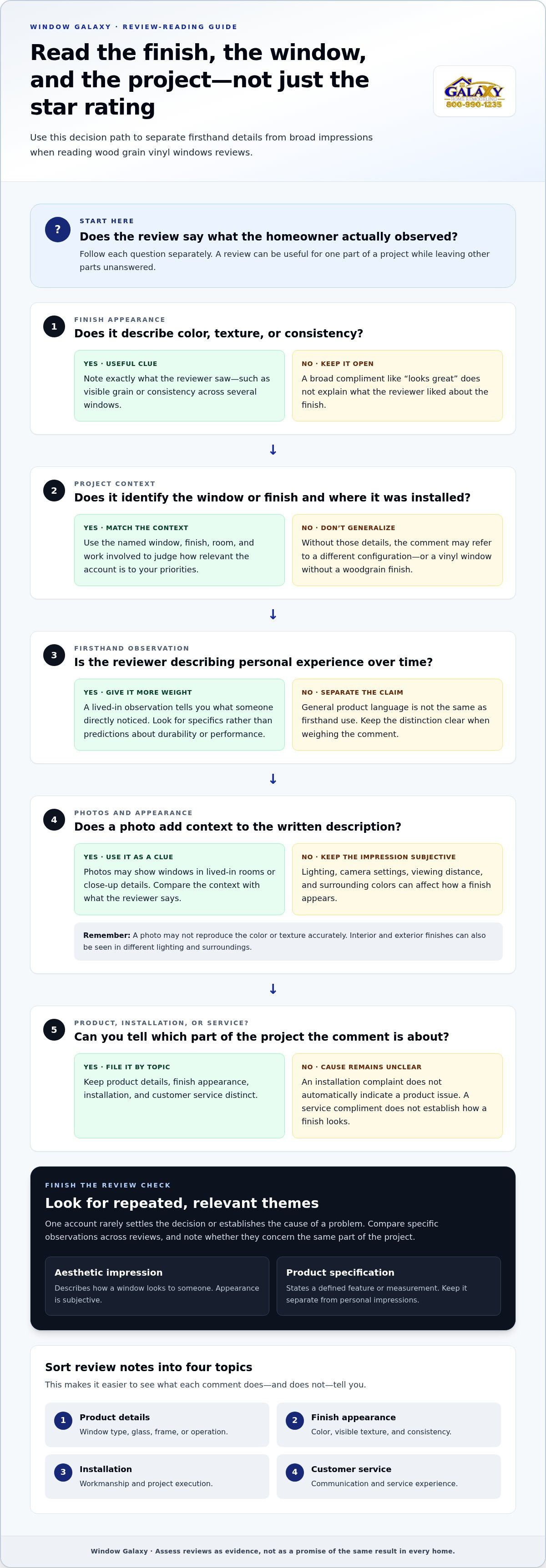
A Practical Checklist for Comparing Wood Grain Vinyl Windows Reviews
A consistent method makes review research easier to use. Rather than relying on star ratings or one memorable comment, record what each review actually identifies. This helps you compare similar windows and projects while keeping product feedback separate from installation and service experiences.
A five-step review-reading method
- Identify what the review covers. Record the product name, finish, window type, and project details provided. If the review only says “vinyl windows,” do not treat it as specific evidence about a woodgrain finish.
- Sort comments by topic. Group observations under appearance, operation, performance, installation, communication, and cleanup. Keep each comment in the category it describes rather than letting praise in one area stand in for another.
- Check the context. Note details such as the room, number of windows discussed, or how long the reviewer has used them. These specifics help you judge whether the experience relates to your priorities.
- Compare like with like. Look for reviews that describe a similar window type, finish, or project. Avoid drawing conclusions from mismatched products or assuming that one configuration’s features apply to all windows.
- Summarize recurring themes. Record patterns supported by specific accounts, then note where the evidence is limited or reviewers describe different experiences. Separate what customers observed from conclusions they assume.
For example, a review describing smooth operation without identifying the finish may help you understand that homeowner’s experience using the window, but it will not tell you how the woodgrain looked. A comment about careful installation is useful project feedback, not a product specification.
Turn review patterns into useful questions
Before comparing comments, list the details that matter in your home. You might focus on the interior finish, consistency across several windows, ease of operation, or project management. Then match each review to those priorities. This keeps your comparison relevant and prevents unrelated comments from dominating.
Assess service feedback separately. Look for concrete observations about communication, updates, and project oversight. Galaxy Home Remodeling assigns a dedicated project manager and emphasizes hands-on quality control and ongoing communication. These are useful dimensions to consider when reading about a window replacement experience. For broader replacement planning, also clarify your home’s needs and project priorities.
After reviewing the comments, write a short summary: which themes appear more than once, which are supported by firsthand details, and which questions remain unanswered. That summary is more useful than a simple count of positive and negative reviews because it shows what the feedback actually helps you evaluate.
Galaxy Home Remodeling’s window replacement services include professionally installed Galaxy Vinyl Windows, a relevant product and project consideration as you review your options.
Choosing Galaxy Home Remodeling for Your Window Replacement Next Step
Review research can clarify what matters to you, from appearance and operation to installation communication. Consider the product and the project experience separately. Galaxy Home Remodeling provides window replacement with professionally installed, energy-efficient Galaxy Vinyl Windows. This is relevant to a broader replacement plan, but it is not a claim that these windows have a woodgrain finish.
Galaxy Home Remodeling is licensed and insured. The company has a 4.8-star average across 407 Google reviews. That rating reflects feedback about the company overall, not a particular window, finish, or woodgrain product. As you evaluate wood grain vinyl windows reviews, keep that distinction clear and compare each account with the product and project details it describes.
What to expect from Galaxy Home Remodeling’s project approach
A dedicated project manager supports communication throughout the window replacement project, providing a consistent point of coordination and helping keep homeowners informed. Ongoing communication also gives homeowners an opportunity to share questions and priorities as work progresses.
Hands-on quality control is part of Galaxy Home Remodeling’s project approach. This oversight complements the installation work, while the project manager helps coordinate communication throughout the process. These elements can help you evaluate the service side of a replacement project separately from product-specific details such as finish appearance or performance specifications.
Before discussing a project, prepare a short list of priorities. Note which windows you are considering, what matters most in their appearance or everyday use, and what you value in project updates. Clear priorities make it easier to have a focused conversation about how replacement relates to your home.
Take the next step with your window replacement goals
A thoughtful review process can help you identify useful questions, but it cannot replace a discussion about your home and project goals. Bring forward the themes you noticed in reviews, separating product questions from installation or communication priorities. This keeps the conversation practical and focused on your needs.
Galaxy Home Remodeling’s project approach centers on a dedicated project manager, hands-on quality control, and ongoing communication. These are company practices, not claims about a particular woodgrain finish. Consider them alongside product documentation and relevant customer feedback when evaluating the complete window replacement experience.
Ready to discuss your window replacement goals? Contact Galaxy Home Remodeling to take the next step toward professionally installed Galaxy Vinyl Windows.
Turn Your Window Research Into a Confident Next Step
Online feedback can help shape your priorities, but the next step is to connect them to your home and the replacement project you are considering. Keep any woodgrain-specific preferences clear as you assess the window details that matter to you. This helps distinguish the look you are drawn to from other considerations, such as operation and installation.
Galaxy Home Remodeling is licensed and insured, and its project approach includes dedicated oversight and hands-on quality control. Use your research as a starting point for a focused conversation about your window replacement goals, rather than expecting reviews to answer every question about your home. If wood grain vinyl windows reviews have helped clarify what you value, bring those priorities into your planning.
Discuss your window replacement with Galaxy Home Remodeling and take a thoughtful step toward a project that fits your home. The team emphasizes ongoing communication throughout the process.
Frequently Asked Questions
Is wood grain vinyl the same as a real wood window?
No. Vinyl describes the window material, while woodgrain describes an appearance or finish intended to suggest wood. The phrase alone does not explain how the window is constructed, where the finish appears, or which specifications apply. In a review, look for the exact window and finish being discussed. A visual resemblance is an aesthetic impression, not evidence that the window is made from natural wood.
Can wood grain vinyl windows look like real wood?
Some homeowners may find the appearance wood-like, but impressions depend on the particular finish, lighting, viewing distance, and personal expectations. A close-up photo, for instance, may show texture differently from a view across the room. Reviews and photographs can offer useful impressions, not a guarantee of how a finish will look in your home. Look for detailed descriptions and images of the exact finish in realistic settings before drawing your own conclusion.
Are wood grain vinyl windows durable?
Durability cannot be determined from a broad category label or a single review. Check how long the reviewer has owned the window and whether the account describes an issue with the window itself or its installation. A reported problem is worth understanding, but it does not establish a universal defect. For technical questions about a particular window, use its product documentation rather than assuming one account applies to all products.
Do wood grain vinyl windows require special maintenance?
Follow the care instructions for the specific window rather than relying on a review headline. One homeowner’s routine may reflect a particular finish, conditions, or personal habits, so it should not replace manufacturer guidance. A useful maintenance review explains what was cleaned and how the finish or window responded. Look for those details, then use the product documentation to guide care for your own windows.
How can I tell whether a window review is about the product or installation?
Look for descriptions of the window, finish, and observed behavior, such as how it operates. Then distinguish those from comments about scheduling, workmanship, communication, or cleanup. A review may cover both. Praise for a tidy work area, for example, describes the project experience, not how the window performs. If the writer does not clarify what caused an issue, treat the comment as general context rather than proof about the product.
Should I trust photos in wood grain vinyl window reviews?
Use photos as supporting evidence, not as a guarantee of color or finish. Camera settings, daylight, nearby wall colors, and your screen can all affect how an image appears. In wood grain vinyl windows reviews, look for pictures that show the whole window as well as a closer view of the finish, with enough room context to interpret it. Read the accompanying description and compare it with product information before deciding what the image tells you.


