

A higher visible-transmittance rating can bring more daylight through a window, but that doesn’t automatically make it the right choice for every room. If window ratings feel technical, start with a practical question: how much visible light passes through the window unit, and how might that affect the space? Understanding visible transmittance for windows can help you compare ratings without treating one number as the answer to every daylight preference.
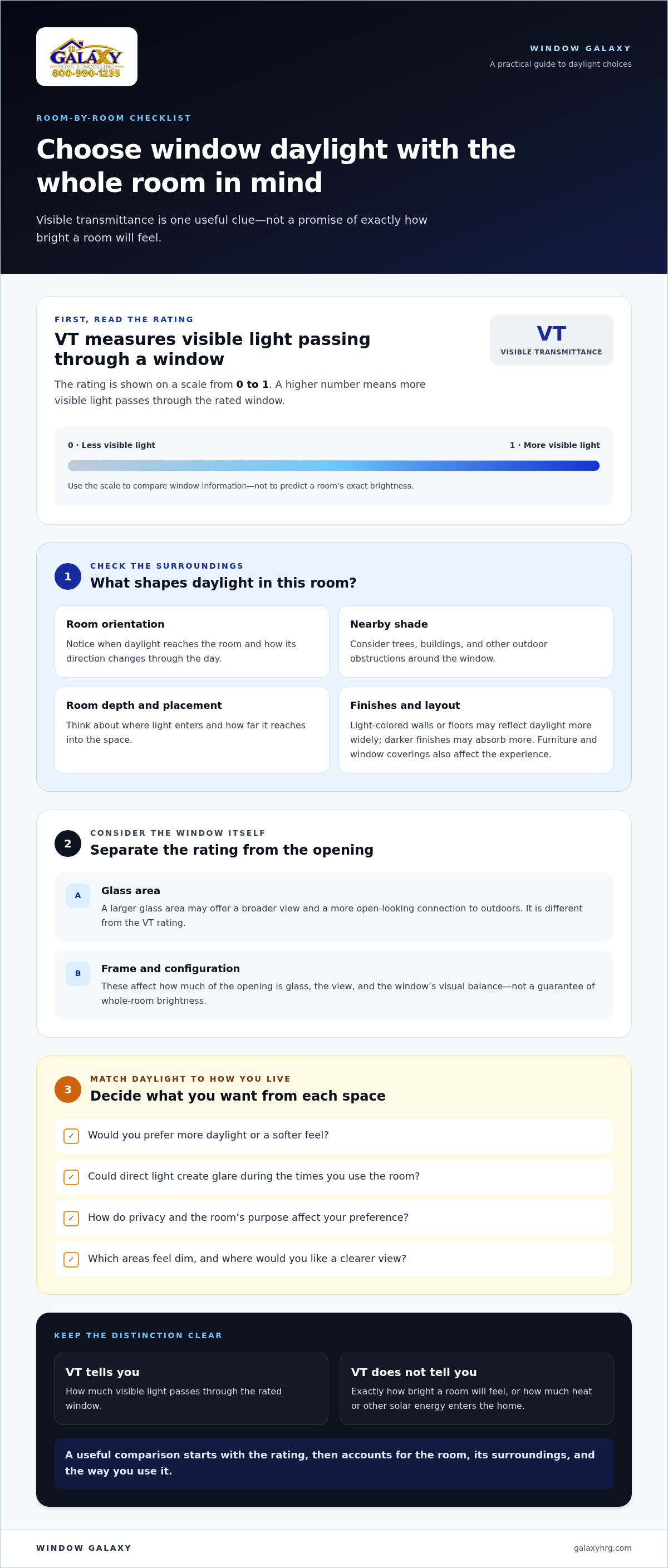
The National Fenestration Rating Council (NFRC) expresses visible transmittance, or VT, on a scale from 0 to 1. A higher number indicates that more visible light passes through the window. The rating does not tell you exactly how bright a particular room will feel, because the room and its surroundings matter too.
This guide explains what VT measures, how to read it alongside other window information, and what to consider before choosing replacement windows. As you plan a project with Galaxy Home Remodeling, you’ll be better prepared to describe the daylight you want and discuss window options for your home.
Key Takeaways
- Use visible transmittance for windows as one clue when comparing daylight, not as a guarantee of how bright a room will feel.
- Consider room orientation, nearby shade, interior finishes, and window size when deciding how much light you want indoors.
- Compare VT ratings in the same category to make product information easier to interpret.
- Note when each room gets morning or afternoon light, how much shade it receives, and how you use the space.
- Galaxy Home Remodeling installs energy-efficient Galaxy vinyl windows and considers homeowners’ daylight preferences during project planning.
What Is Visible Transmittance for Windows?
Visible transmittance is the proportion of visible light that passes through a window. It’s commonly abbreviated as VT on window-rating information. A higher VT generally means more visible daylight passes through the rated window, while a lower VT means less does.
Featured-snippet definition: Visible transmittance for windows measures the proportion of visible light that passes through a window unit.
The word “visible” matters. The rating concerns light people can see, within the visible spectrum. It is not a complete measure of solar energy, heat entering a home, or a room’s overall brightness. These are related window considerations, but VT describes a specific part of a window’s performance.
What does a visible-transmittance rating measure?
A VT rating describes how much visible light passes through the rated window product. Window-rating information may show the rating as a number from 0 to 1. A higher number indicates greater visible-light transmission through that unit.
Think of VT as a product attribute, not a prediction of exactly how a room will look. The rating can help you understand and compare window information, but it cannot promise a particular brightness inside your home. The daylight you perceive also depends on the room and its surroundings.
VT should not be treated as a stand-in for every other performance measure. A window may transmit visible daylight, but the VT rating itself does not say how much heat or other solar energy enters the home. Keeping these measures separate makes product information easier to interpret.
Is a higher VT rating always better?
Not necessarily. More visible daylight may suit a room where you want a brighter feel or enjoy natural light during everyday activities. But preferences vary, and the same amount of incoming light may feel welcome in one space and uncomfortable in another.
Glare, privacy, and how you use a room all matter. If you read or work near a window, consider whether strong daylight could make the space uncomfortable at certain times. In a bedroom or another room where privacy is a priority, light transmission is only one part of the decision.
Rather than looking for one universally ideal VT, use the rating to frame a practical conversation about your preferences. Consider questions such as:
- Would you like more daylight in this room, or do you prefer a softer feel?
- Could direct light create glare during the times you use the space?
- How do privacy and the room’s purpose affect your choice?
These questions give the rating context. VT is a useful starting point for understanding a window’s visible-light transmission, but the right interpretation connects the product information to what you want from each room.
How Window Glass and Room Conditions Shape Visible Transmittance
A window’s stated VT rating describes the product, but the daylight you notice indoors depends on more than that figure. Room orientation, nearby shade, window placement, and interior finishes all affect how incoming light reaches and appears across a space. That’s why visible transmittance for windows is best considered alongside the conditions in the room where the window will be installed.
VT alone can’t predict a room’s brightness because the rating describes the window, while the light you perceive depends on the window’s surroundings and the room itself.
Why can two rooms feel different with similar window ratings?
Imagine two rooms with windows that have similar ratings. One is shallow, and its window receives open daylight. The other is deeper, with trees or a nearby structure shading its window. The first may feel brighter farther into the space, while the second may have less light reaching areas away from the glass. These examples help explain how daylight can differ, but they are not guaranteed outcomes for every home.
Orientation affects the direction and timing of daylight, while window placement changes where it enters the room. Interior surfaces play a part, too. Light-colored walls or floors may make daylight feel more widely reflected; darker finishes may absorb more of it. Furniture, window coverings, and the room’s layout can also shape how the light is experienced.
What can glass and frame design change?
Glazing provides the window’s light-transmitting surface, while the frame occupies part of the overall opening. A larger glass area may offer a broader view and a more open-looking connection to the outdoors, but it doesn’t replace the VT rating. The rating and the amount of glass describe different aspects of a window, so consider both when picturing the daylight and view you want.
Frame design and window configuration also affect how much of the opening is glass. That can change the view and the visual balance of a window within a room, but it does not by itself tell you how bright the entire room will feel. Room depth, shade, and interior finishes remain part of the picture.
As you plan a replacement project, consider each room rather than imagining its daylight from a rating alone. Note which areas feel dim, where you’d like a clearer view, and whether exterior shade changes during the day. These observations make your preferences more concrete when you discuss window options.
- Room orientation: Notice when daylight reaches the room and how its direction changes your experience of the space.
- Nearby shade: Consider trees, buildings, or other obstructions outside the window.
- Room finishes and layout: Think about how far the room extends from the window and how its surfaces interact with daylight.
- Glass and frame area: Consider the balance between the view, the visible glass, and the frame.
Galaxy Home Remodeling can include these room-specific daylight preferences in a window replacement discussion, alongside the window information relevant to your project.
How to Compare Visible Transmittance Without Misreading Window Ratings
A window rating is most useful when you compare it with your priorities for a specific room. VT helps you consider visible daylight, but it is not a complete score for comfort or overall window performance. Use it alongside room conditions and other relevant ratings, and make sure you are comparing the same type of information across product materials.
How does VT differ from solar heat gain information?
VT describes visible light transmitted through a window. Solar heat gain information addresses a different question: how much of the sun’s heat the window allows indoors. The National Fenestration Rating Council (NFRC) includes these as separate categories in window-rating information. Read each rating for what it measures rather than assuming one can stand in for the other.
For example, if you want a room to feel brighter, VT is relevant to that daylight preference. If you’re thinking about solar heat entering the space, look at the applicable solar heat gain information too. Neither rating alone tells the whole story about how a room will feel, so consider them together with the room and your needs.
What should homeowners record when comparing windows?
A short comparison note can keep product details and room preferences organized. Make a separate entry for each window or room, and record the same kinds of information each time. This makes differences easier to understand without drawing conclusions from unrelated figures.
VT information: Record the value shown in the product information and the product or configuration it refers to.
Room location: Note which room the window serves and where the window sits within it.
Daylight preference: Describe whether you’d like more visible daylight, a softer feel, or a balance that suits the room’s use.
Shading conditions: Note nearby trees or buildings, and whether shade changes throughout the day.
Other ratings: Keep solar heat gain information in its own category instead of treating it as another expression of VT.
Compare like with like. Check that each VT figure refers to the same kind of rating and product information, rather than comparing a VT value with a different performance measure or an unrelated window configuration. If a detail is unclear in your notes, mark it for discussion instead of guessing what it means.
This simple approach connects window information to the rooms you’re planning for. Bring your notes into the broader replacement-window conversation, including observations about daylight and shade. That gives Galaxy Home Remodeling a clearer picture of what matters to you as window options are discussed for your home.
How to Use Visible Transmittance When Planning Window Replacement
A rating becomes more useful when you connect it to what you want from each room. Instead of starting with a number and trying to predict the result, begin with your home and your everyday routines. Visible transmittance for windows can then inform a conversation about daylight, alongside the window details and other ratings relevant to your project.
How can you describe your daylight preferences?
Use familiar descriptions rather than trying to choose a technical target. A room-by-room note about when daylight feels comfortable, distracting, or insufficient gives the project conversation a clear starting point. Observe the space at different times, since morning and afternoon light may feel different, and note whether shade changes during the day.
- Room: Identify where the window is and how you use the space.
- Daylight: Describe whether the room feels too dim, too bright, or comfortable in the morning and afternoon.
- Glare: Note when incoming light makes reading, working, or relaxing less comfortable.
- Privacy: Explain whether privacy is a priority in that room.
- Shade: Record nearby trees, buildings, or other features that block daylight.
These observations are more helpful than assigning a VT goal without knowing how a particular window will feel in your home. They keep the focus on your preferences and give the team practical context for discussing options.
What should you discuss during a window project?
Bring your notes into a conversation about each room, its window placement, and the daylight you’d like to experience. Share what is working now and what you hope to change. If window terminology makes the discussion harder, ask for the ratings and product details to be explained in plain language so you can understand how each one relates to your priorities.
Galaxy Home Remodeling assigns a dedicated project manager and maintains ongoing communication to keep project details and homeowner preferences part of the conversation. This gives you a clear point of coordination as window choices are discussed. The goal is to consider the rating in context, not to treat it as a promise of exactly how bright a room will be.
Keep the decision grounded in your home. A preference for more daylight in one room doesn’t automatically apply to every window. Use the same simple notes for each space, then discuss relevant product information and options as part of your replacement plans.
Bring your room-by-room daylight preferences to discuss your window replacement project with Galaxy Home Remodeling.
How Galaxy Home Remodeling Connects Window Choices to Your Home
Visible transmittance can help you talk about how much visible daylight a window transmits, but it cannot promise how bright a room will feel. The rating is one discussion point among several, alongside room conditions, window placement, and everyday needs. Galaxy Home Remodeling considers those preferences when planning residential window replacement projects.
Galaxy Home Remodeling installs energy-efficient Galaxy vinyl windows. Product information can help inform the discussion, but a rating should not be treated as a guarantee of a particular result. Your notes about how each space feels can help connect window details to what matters in your home.
What can homeowners expect from Galaxy Home Remodeling?
Window installation includes a dedicated project manager, hands-on quality control, and ongoing communication throughout the project. This approach helps keep project details and your preferences in the conversation, including which rooms you’d like to feel brighter and where glare or privacy is a concern. Galaxy Home Remodeling is licensed and insured.
Clear communication is useful when you’re reviewing window information. Share what you’ve noticed in each room, discuss the relevant product details, and keep daylight preferences in view as choices are considered. The goal is a project conversation grounded in your home, not a promise that one rating will determine a room’s final brightness.
- Share room-by-room preferences: Describe where you’d like more daylight and where current light feels comfortable.
- Explain how you use each space: Mention activities that may make glare, privacy, or daylight especially relevant.
- Discuss the window information: Review VT as one product rating alongside other details relevant to the project.
How can you take the next step?
Bring your observations into a window replacement discussion. Note when a room gets morning or afternoon light, whether nearby shade changes, and how you’d like the space to feel during the activities that happen there. These details make your preferences clear without requiring an unsupported VT target.
Galaxy Home Remodeling offers advice to help homeowners discuss their replacement-window project and daylight priorities. Visit the Galaxy Home Remodeling homepage to start a conversation and share what you want each room to feel like.
Make Your Daylight Priorities Part of the Plan
Your home’s daylight needs are personal. A space for quiet mornings may call for different considerations than a room used for focused work or family time. Treat visible transmittance for windows as a useful part of that conversation, not a promise of how bright your finished room will feel. Your observations can help shape a replacement plan around how you use your home.
Galaxy Home Remodeling is a licensed and insured window replacement company with a 4.8-star average from 407 Google reviews. A dedicated project manager and hands-on quality control support attentive project coordination, while clear communication keeps your preferences in view. Share which rooms feel too dim or too bright, when glare is a concern, and what you’d like to change.
Ready to talk through your home’s daylight needs? Discuss your window replacement project with Galaxy Home Remodeling and share what you want each room to feel like.
Frequently Asked Questions
Does visible transmittance measure how much sunlight enters a room?
No. Visible transmittance for windows measures visible light passing through the window, not every effect of sunlight. Sunlight can also bring heat, which VT alone doesn’t describe. The rating can’t tell you exactly how bright or warm a room will feel. A shaded room with a large window may feel different from an exposed room with a similar VT, depending on orientation, glazing area, and interior finishes.
Can a window have high visible transmittance and still cause glare?
Yes. A window with high VT can still contribute to glare because the rating doesn’t describe the intensity of light at a particular spot or time. A desk facing a bright window may feel different from a seat farther back. The rating alone can’t predict whether glare will occur. Consider how the room is used, where the window sits, and whether direct light feels comfortable when discussing replacement options.
Is visible transmittance the same as the amount of glass in a window?
No. VT is a rating for visible-light transmission; glass area describes how much of the window opening is glazing rather than frame. A larger glazed area may change the view and the daylight entering, but it doesn’t redefine the product’s VT rating. Keep these details separate in your notes. That makes it easier to explain whether you’re prioritizing a broader view, light transmission, or both when reviewing window information.
Does visible transmittance change with the time of day?
No. A window’s stated VT is a product rating, not a reading of outdoor light that changes through the day. Daylight reaching the room can vary with cloud cover, sun position, orientation, and exterior shade. A room may look different at breakfast than in the afternoon without the window rating changing. Observe the space at the times you use it, then share those notes during replacement planning.
Where can I find a window’s visible-transmittance rating?
Look for VT in the window’s product information and related rating documentation. National Fenestration Rating Council (NFRC) materials can help explain window-rating terms and categories. Document formats may differ, so identify the VT category rather than assuming every sheet presents it in the same place. For a useful comparison, record the VT information for each product separately and don’t treat it as equivalent to another type of rating.
Should I choose windows based only on visible transmittance?
No. VT is one factor, not a complete basis for choosing replacement windows. Consider how you use the room, your daylight preferences, privacy, possible glare, and other relevant ratings. A living area used for reading may have different priorities from a bedroom where privacy matters more. A room-by-room discussion helps connect product information to your routines without assuming one rating suits every window in your home.


